
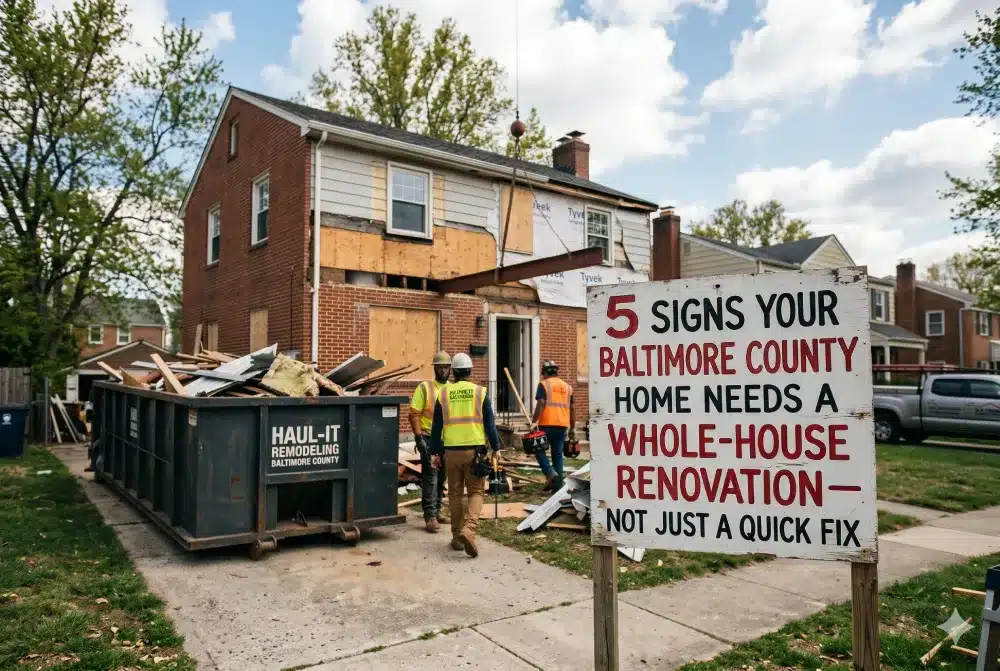
What Are the Signs That Your Baltimore County Home Needs a Whole-House Renovation Instead of Just Another Quick Fix?
By the Team at Genesis Contracting & Home Improvements | Serving Nottingham, Perry Hall, White Marsh, Towson & the Greater Baltimore Area
There is a pattern we see regularly in Baltimore County. A homeowner has a kitchen that needs updating. So they remodel the kitchen. Then the bathrooms look dated by comparison. So they update the bathrooms. Then the floors look wrong next to the new bathroom tile. So they replace the floors. Then the paint looks tired against everything else. And on it goes.
Three years and $80,000 later, the house still does not feel cohesive. The systems behind the walls were never touched. And they paid a premium for every project because each one was treated as a separate, disconnected job.
This is the piecemeal renovation trap. And it catches more Baltimore County homeowners than you might think.
According to the 2025 U.S. Houzz & Home Study, 39% of homeowners exceeded their renovation budget in 2024, and 24% never set a budget at all. Much of that overrun comes from scope creep — each individual project revealing the next one, which reveals the one after that. Piecemeal renovations may address individual issues but often cost more over time. A whole-house renovation, by contrast, upgrades multiple systems and spaces together — typically delivering better efficiency, better cohesion, and stronger long-term value. (HomeRenew360, 2025)
If you have been doing one room at a time and still feel like your home is not getting where you want it, or if you are sitting on a property with multiple significant needs, this post is for you.
At Genesis Contracting & Home Improvements, we handle whole-house renovations throughout Nottingham, Perry Hall, White Marsh, Towson, Rosedale, and Parkville. We have seen both paths — the piecemeal approach and the comprehensive renovation — and we can tell you clearly which one makes financial sense for a given home. Here are the five signs we look for.
Sign #1 — More Than One Major Space Needs Significant Work
The clearest indicator that a whole-house renovation deserves serious consideration is when multiple rooms need major updates simultaneously.
One outdated kitchen? That is a kitchen remodel. An outdated kitchen, two bathrooms that have not been touched since 1995, original flooring throughout, and a basement that has never been finished? That is a whole-house scope — and tackling it as a coordinated renovation rather than a sequence of individual projects delivers advantages that are hard to overstate.
What whole-house renovation coordination delivers:
- One mobilization instead of four. Every contractor project involves a mobilization cost — the overhead of setting up the job, securing materials, and getting a crew on site. Do four separate projects and you pay that four times. Do them together and you pay it once.
- Systems work done once, correctly. Plumbing, electrical, and HVAC work that runs throughout the house makes the most sense when addressed as a single, coordinated scope. Upgrading the electrical panel for the kitchen remodel, then having to revisit it six months later for the bathroom renovation, then again for the basement finish is inefficient and expensive.
- Consistent design and finishes. One of the most common complaints we hear from homeowners who have renovated room by room is that nothing quite matches. Flooring transitions are awkward. Trim profiles are inconsistent. Hardware finishes are close but not the same. A whole-house renovation — planned and executed as a unified project — eliminates this entirely.
- One permit application instead of many. Baltimore County’s Department of Permits, Approvals and Inspections (PAI) processes permits per project scope. One comprehensive permit application for a whole-house renovation is typically more efficient than four separate applications with four separate review processes and four separate inspection sequences.
As Sweeten’s guide to whole-home renovation signs notes, when issues overlap across rooms — the kitchen is closed off, the bathrooms need work, the hallway is inefficient — an extensive remodel can be more practical than planning separate projects. One coordinated plan creates better outcomes than a disconnected sequence.
Sign #2 — Your Home’s Core Systems Are Aging Out
This is the sign that matters most for safety — and the one most homeowners underestimate until something fails.
Older Baltimore County homes — many built in the 1960s, 1970s, and 1980s — are now reaching the end of life for their core mechanical systems simultaneously. Electrical panels that were sized for the appliance loads of 40 years ago. Galvanized plumbing supply lines that are corroding from the inside out. HVAC systems that are 25 years old and running on borrowed time. Insulation that was installed before modern energy efficiency standards existed.
Specific system age thresholds that should trigger serious evaluation:
- Electrical panel: If your home still has a 100-amp service panel, or if it has fuse boxes rather than circuit breakers, your electrical system is significantly undersized for modern loads and represents both a capacity and a safety concern. Panel upgrades to 200-amp service are frequently required when kitchens and bathrooms are remodeled — doing it as part of a whole-house project is substantially more efficient.
- Plumbing: Galvanized steel supply pipes — common in Baltimore County homes built before 1970 — have a typical lifespan of 40–70 years. They corrode from the inside, reducing water pressure and eventually failing. If your home has galvanized plumbing, it is reaching or past its functional lifespan.
- HVAC: The average lifespan of a central air system is 15–20 years; furnaces last 15–30 years. If your system is approaching or past these thresholds, a whole-house project is an efficient time to replace it — the walls are already open, the disruption is already happening.
- Windows and insulation: Pre-1980 windows and insulation were installed to standards far below current Maryland building codes. Upgrading them as part of a whole-house renovation is more cost-effective than addressing them separately and dramatically improves energy efficiency.
The Harvard Joint Center for Housing Studies tracks renovation spending across the U.S. and consistently finds that owners of homes built before 1940 spend 50% more on renovations than owners of newer homes — largely because aging systems require comprehensive replacement rather than simple updates. Baltimore County’s housing stock, with a significant proportion built before 1980, sits squarely in this category.
When multiple systems are aging simultaneously, addressing them together in a whole-house renovation is almost always more economical — and more practical — than dealing with each one as it fails.
Sign #3 — Your Home’s Layout No Longer Fits How You Live
Houses built in the 1970s and 1980s were designed for a different way of living. Formal living rooms and dining rooms separated from the kitchen. Small, closed-off kitchens where a single person cooked while the family was elsewhere. Inadequate storage. Primary bedrooms without en suite bathrooms. Guest bedrooms that are barely large enough for a bed.
Life in Baltimore County in 2025 looks different. Families cook together and want an open kitchen. Remote work requires dedicated office space. Multi-generational living arrangements are more common. Entertaining has moved to the kitchen and family room. Buyers — and homeowners staying put — want the layout to reflect these realities.
When a home’s layout is fundamentally misaligned with how it is used, piecemeal cosmetic updates do not solve the problem. You can put beautiful new countertops in a small, closed-off kitchen and it will still be a small, closed-off kitchen. The only solution is structural — and structural work is the core of what a whole-house renovation delivers.
Common layout improvements that drive whole-house renovation decisions in Baltimore County:
- Open-concept conversion — removing a wall between the kitchen and living area to create a connected, functional space. This is among the most requested changes in Baltimore County’s housing stock and requires structural engineering to determine the appropriate beam.
- Primary suite creation — combining a bedroom with an adjacent space to create a true primary suite with an en suite bathroom and walk-in closet.
- Home office addition — converting an underused formal space or finishing a portion of the basement specifically as a dedicated home office.
- Mudroom or entry improvement — creating functional entry storage in a home that currently dumps coats and shoes into the main living area.
- Laundry relocation — moving laundry from an inconvenient basement location to a main-floor or bedroom-level utility space.
Each of these improvements requires plumbing, electrical, structural, or all three — which means permits, licensed trades, and coordination. Done individually, each one is a standalone project. Done together, they are a whole-house renovation that addresses how the home functions at a fundamental level.
Sign #4 — The Math on Piecemeal Repairs No Longer Makes Sense
There is a financial threshold at which individual repairs stop making sense — where the accumulated cost of sequential fixes exceeds what a coordinated whole-house renovation would have cost, without the coherent, lasting result a renovation produces.
We see this calculation clearly with Baltimore County homeowners who have been maintaining older homes for years. Each individual repair is justified in isolation. A new roof when the old one starts leaking. An HVAC replacement when the system finally dies. A kitchen update when the appliances need replacing. But when you add up five years of piecemeal repairs and compare the total to what a planned whole-house renovation would have cost — the numbers often tell a different story.
The whole-house renovation cost reality for Maryland:
According to current pricing data for our region, Maryland homeowners should plan on approximately $150 per square foot as a realistic middle-of-the-road target for a whole-house renovation, with entry-level cosmetic refreshes starting around $50 per square foot and full gut renovations in older homes running higher. For a 1,500-square-foot Baltimore County home, a mid-range whole-house renovation might run $150,000–$250,000. For a 2,000-square-foot home, expect $200,000–$350,000 for a comprehensive renovation including systems, kitchen, bathrooms, flooring, and finishes. (AW Martin Construction, 2025)
When the math shifts in favor of a whole-house renovation:
- When you have already spent $40,000–$60,000 on individual repairs over the past several years with no coordinated plan and the home still has major unaddressed needs
- When the cost to address your remaining individual issues — separately — would exceed the cost of a coordinated whole-house project
- When the home is in a Baltimore County neighborhood where renovated properties are commanding significantly stronger sale prices than unrenovated ones
Baltimore County’s strong real estate market supports the investment. The average home value in Baltimore County is approximately $363,263, up 2.3% year over year (Zillow, 2026), and Maryland property values rose 12% statewide in 2025 (The Baltimore Banner, 2026). In a market where homes are appreciating consistently, a well-executed whole-house renovation is not just a quality-of-life improvement — it is a capital investment in a rising asset.
The break-even calculation to run: add up all the individual repairs your home needs over the next 3–5 years. Compare that number to what a coordinated whole-house renovation would cost. If the gap is narrow — or if the whole-house number is actually lower when you factor in mobilization savings, permit efficiency, and the superior result — the case for renovation becomes clear.
Sign #5 — You Are Planning to Stay Long-Term and Want Your Home to Work for the Next Decade
This is perhaps the most underappreciated driver of whole-house renovation decisions in Baltimore County.
In a strong housing market with limited inventory, many homeowners are choosing to renovate rather than sell. The cost of moving in Baltimore County — realtor commissions, closing costs, transfer taxes, and the premium on a replacement home — frequently exceeds what a comprehensive renovation would cost. When you factor in the emotional and logistical cost of moving a family, the math often points strongly toward renovating in place.
For homeowners who are staying long-term, a whole-house renovation is not just a financial calculation — it is a decision about the quality of daily life for the next decade. A home that functions beautifully, has been updated throughout, and reflects how your family actually lives is worth investing in seriously rather than incrementally.
What long-term stay homeowners in Baltimore County typically focus on in a whole-house renovation:
- Energy efficiency upgrades — new windows, improved insulation, upgraded HVAC, smart thermostats. These pay back in utility savings year after year and are far more efficient to install when walls are already open during a renovation.
- Aging-in-place features — wider doorways, curbless showers, main-floor primary bedroom options, grab bar blocking in bathrooms. Baltimore County’s Housing and Community Services provides information on programs supporting accessibility improvements for seniors. Building these features in during a renovation costs a fraction of what retrofitting them later requires.
- Systems longevity — replacing aging electrical, plumbing, and HVAC systems with new, properly sized, code-compliant installations that will serve the home for another 20–30 years.
- Layout optimization — making the home work for how the family actually lives rather than accepting the constraints of a 40-year-old floor plan.
A well-planned whole-house renovation with these priorities creates a home that requires minimal significant investment for the next 15–20 years. Piecemeal repairs create a home that requires the next repair as soon as the last one is complete.
What Does a Whole-House Renovation Cost in Baltimore County — and What Does the Process Look Like?
Realistic Cost Ranges for Baltimore County:
| Renovation Scope | Cost Range | Typical Scope |
| Light whole-house refresh | $50,000 – $100,000 | Cosmetic updates throughout — paint, flooring, fixtures, lighting — no structural changes |
| Mid-range whole-house renovation | $100,000 – $250,000 | Kitchen, 1–2 bathrooms, flooring, paint, lighting, systems updates |
| Comprehensive renovation | $200,000 – $400,000 | Full systems replacement, kitchen, multiple bathrooms, layout changes, finishes throughout |
| Down-to-studs gut renovation | $300,000 – $500,000+ | Complete rebuild of all interior systems and finishes |
A few Baltimore County-specific factors affect where your project lands on this range:
- Pre-1980 homes — older homes frequently have galvanized plumbing, undersized electrical panels, and insulation that does not meet current Maryland energy code. Bringing these up to standard adds cost that newer homes do not require.
- Permit costs — plan on 8–12% of construction costs for design, engineering, and permit fees in Baltimore County. (Innovative Building Services, 2025)
- Contingency — budget 10–15% above your estimate for older Baltimore County homes. Surprises behind walls are the rule, not the exception, in homes built before 1985. The 2024 Houzz & Home Study found 39% of homeowners exceeded renovation budgets — a contingency buffer is not pessimism, it is prudence.
- Labor costs — Baltimore County labor runs above national averages due to Maryland’s licensing requirements and regional cost of living.
What the process looks like with Genesis Contracting:
- Free In-Home Consultation We walk the entire home with you. We assess every space, look at mechanical systems, identify what the home actually needs versus what you want, and have an honest conversation about priorities and budget. We will tell you directly if we think your home needs a comprehensive renovation or if targeted individual projects make more sense for your situation.
- Detailed Scope and Proposal We produce an itemized proposal that breaks out the full project by room and trade. You know exactly what you are getting and what it costs — no lump sums that obscure the details.
- Permitting We handle the complete permit process through Baltimore County PAI. For a whole-house renovation, this typically includes building, electrical, plumbing, and mechanical permits — all managed by our team through the county’s online portal.
- Construction and Project Management Our team manages all trades and coordinates the construction sequence. We communicate proactively throughout, and you have a consistent point of contact for questions and updates.
- Inspections and Closeout We schedule and pass all required Baltimore County inspections. When the project is complete, your renovation is fully permitted, fully inspected, and fully documented — which protects your investment and simplifies any future sale.
Is a Whole-House Renovation Right for Your Baltimore County Home?
The honest answer is: it depends on your home, your goals, and your timeline. A whole-house renovation is not right for every situation. But for Baltimore County homeowners whose homes have multiple significant needs, aging systems, layout issues that piecemeal updates cannot solve, or a financial case that favors coordination over sequence — it is absolutely worth a serious evaluation.
Our whole-house renovation team at Genesis Contracting helps Baltimore County homeowners make this decision honestly. We do not push projects bigger than what a home actually needs. We give you our genuine assessment of what makes sense for your specific situation — and if targeted individual projects are the right answer, we will tell you that too.
We serve Nottingham, Perry Hall, White Marsh, Towson, Rosedale, Parkville, and the greater Baltimore area. In addition to whole-house renovations, we handle every component of the project: kitchen remodeling, bathroom remodeling, basement finishing, home additions, decks, flooring, painting, exterior work, and fencing — all under one contractor relationship.
Contact us today for a free in-home consultation, or call us at (443) 982-4289. View completed projects in our project gallery and read what our clients say on our testimonials page.
Frequently Asked Questions About Whole-House Renovations in Baltimore County
Q1: How do I know if my home needs a whole-house renovation or just individual room updates?
The clearest signals are: multiple rooms with significant needs, aging core systems (electrical, plumbing, HVAC) approaching end of life, a layout that does not function for how your family lives, or a financial case where the accumulated cost of piecemeal repairs exceeds what a coordinated renovation would deliver. If two or more of these describe your home, a whole-house renovation consultation is worth having. Contact our team for an honest, no-pressure assessment of your specific situation.
Q2: How much does a whole-house renovation cost in Baltimore County in 2025?
For most Baltimore County homes, a mid-range whole-house renovation runs $100,000–$250,000 depending on scope and the age of the home’s systems. Comprehensive renovations with full systems replacement and layout changes run $200,000–$400,000. Entry-level cosmetic refreshes throughout start around $50,000. Maryland homeowners should plan on approximately $150 per square foot as a realistic middle target, with older pre-1980 homes running higher due to systems that need upgrading. Always budget a 10–15% contingency for older Baltimore County homes.
Q3: Is a whole-house renovation worth it in Baltimore County’s real estate market?
Yes, in most cases — particularly for homeowners who are staying long-term or whose homes are significantly undervalued relative to renovated comparables in their neighborhood. Baltimore County home values averaged $363,263 in 2026 and are appreciating steadily. Maryland property values rose 12% statewide in 2025. In a market where renovated homes command meaningful premiums over unrenovated ones, a well-executed whole-house renovation is both a quality-of-life investment and a strong capital investment.
Q4: How long does a whole-house renovation take in Baltimore County?
Timeline depends heavily on scope. A light cosmetic whole-house refresh might take 8–12 weeks. A mid-range renovation involving kitchen, bathrooms, flooring, and systems typically runs 4–6 months. Comprehensive gut renovations with structural changes can take 6–12 months. Permit processing time in Baltimore County (typically 10–15 business days for complete applications) is included in these estimates. Genesis Contracting provides a project-specific timeline during the initial consultation and communicates proactively throughout construction.
Q5: Can I live in my home during a whole-house renovation?
It depends on the scope. For partial renovations — kitchen and bathrooms being done while bedrooms and common areas remain intact — many families stay in the home with some inconvenience. For comprehensive gut renovations involving systems throughout the entire home, temporary housing is typically required for the most intensive phases of construction. We discuss this honestly during the planning process so you can make appropriate arrangements.
Q6: What permits are required for a whole-house renovation in Baltimore County?
A comprehensive whole-house renovation typically requires building permits for structural work, electrical permits for system upgrades and new circuits, plumbing permits for any plumbing modifications, and mechanical permits for HVAC work. Per Baltimore County PAI, all permit applications are submitted online. Genesis Contracting handles the complete permitting process for every whole-house renovation we build. All work is fully permitted, fully inspected, and fully documented.
Q7: What is the biggest mistake homeowners make when planning a whole-house renovation?
Underestimating the contingency budget. The 2024 Houzz & Home Study found that 39% of homeowners exceeded their renovation budgets — and older Baltimore County homes are particularly prone to surprises behind walls. Galvanized plumbing discovered during a kitchen renovation, knob-and-tube wiring found during a bathroom update, or water damage uncovered during demo are not uncommon in homes built before 1980. Budget 10–15% above your contractor’s estimate as a contingency — if you do not need it, great. If you do, you will be grateful it was there.
Q8: Should I renovate my whole house or sell and buy something newer?
This calculation depends on your specific situation, but for many Baltimore County homeowners it points toward renovation. The combined cost of selling (commissions, closing costs, transfer taxes) and buying a replacement home at current prices frequently exceeds the cost of a comprehensive renovation — particularly when you factor in the premium required to find a home that already meets your needs in Baltimore County’s competitive market. A whole-house renovation also lets you customize your home exactly to your preferences, which a purchased home cannot fully deliver. Genesis Contracting provides honest guidance on this question during our initial consultation.
Q9: How does Genesis Contracting approach whole-house renovations differently from individual room projects?
For a whole-house renovation, we start with a comprehensive assessment of the entire home before developing any scope — looking at systems, layout, structural conditions, and priorities together rather than in isolation. This allows us to develop a coordinated plan that addresses everything efficiently, avoids the redundant costs of piecemeal mobilizations, and produces a cohesive result throughout the home. We also handle the complete permit process as a single coordinated application where possible, which is more efficient than multiple separate permit applications for individual rooms.
Q10: What services does Genesis Contracting offer beyond whole-house renovations?
We are a full-service general contractor for the greater Baltimore area. Our services include kitchen remodeling, bathroom remodeling, basement finishing, deck construction, home additions, exterior work, flooring, interior and exterior painting, fencing, and investor-friendly contractor services. We serve Nottingham, Perry Hall, White Marsh, Towson, Rosedale, Parkville, and the greater Baltimore area. Contact us today for a free in-home estimate.
Genesis Contracting & Home Improvements — Proudly Serving the Greater Baltimore Area Nottingham | Perry Hall | White Marsh | Towson | Parkville | Rosedale | Baltimore County (443) 982-4289 | genesiscontracting.biz