
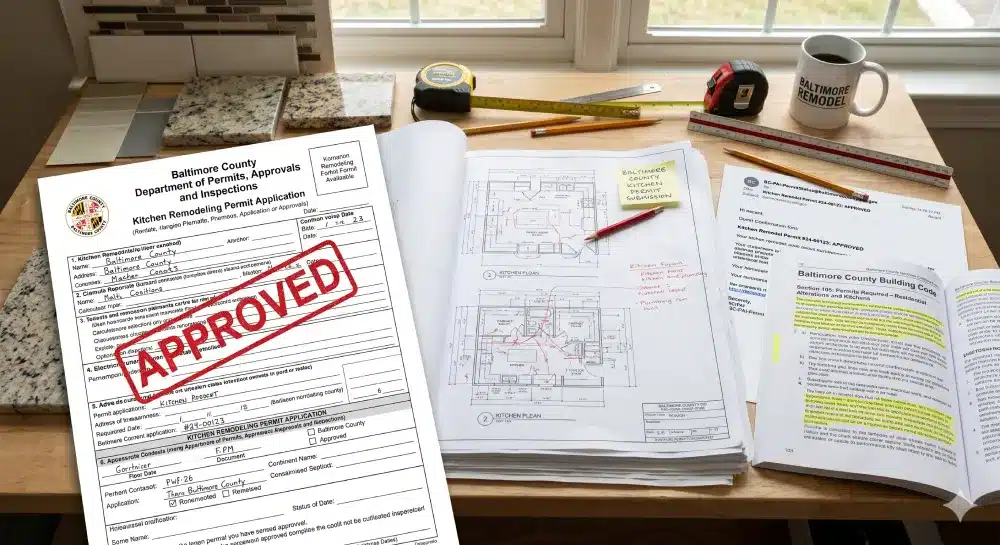
Do You Need a Permit to Remodel Your Kitchen in Baltimore County, Maryland — and What Happens if You Skip It?
By the Team at Genesis Contracting & Home Improvements | Serving Nottingham, Perry Hall, White Marsh, Towson & the Greater Baltimore Area
It is one of the most common questions we get from homeowners across Nottingham, Perry Hall, and Towson before they start a kitchen renovation:
“Do I actually need a permit for this?”
The honest answer is: it depends on what you are doing. And the line between what requires a permit and what does not is more important than most homeowners realize — both for safety and for what happens when you eventually sell your home.
Here is something worth knowing upfront: according to the Maryland Department of Housing and Community Development, over 70% of remodeling projects require some form of permit due to structural, electrical, or plumbing concerns. (Vini’s Renovation & Restoration, 2025). Kitchen remodels are one of the most frequently permitted residential projects in Baltimore County — because kitchens almost always involve at least one of the trades that trigger a permit requirement.
At Genesis Contracting & Home Improvements, we handle permits for every kitchen project we build. In this post, we are going to walk you through exactly what requires a permit in Baltimore County, what does not, what the process looks like, and why cutting corners on permits is a risk no homeowner should take.
What Requires a Permit for a Kitchen Remodel in Baltimore County?
Baltimore County’s permitting requirements for kitchen remodels are administered by the Department of Permits, Approvals and Inspections (PAI), located at the County Office Building, 111 West Chesapeake Avenue, Towson, Maryland 21204. All permit applications in Baltimore County are submitted online through the county’s permitting portal.
Here is the clear breakdown of what does and does not require a permit for a kitchen remodel in Baltimore County:
Work That REQUIRES a Permit:
Structural Changes Any modification to walls — removing a wall, relocating a doorway, widening an opening, or any work that affects load-bearing structure — requires a building permit. This is one of the most common triggers in kitchen remodels because open-concept conversions almost always involve removing a wall. Per Baltimore County’s official Addition, Alteration, and Structural Modification permit page, structural work and creation of a new kitchen space require a permit.
Electrical Work Per Baltimore County PAI’s official guidance: all electrical work requires a permit and must be obtained by a licensed electrician. This includes:
- Adding new outlets or circuits
- Upgrading the electrical panel to support new appliances
- Installing under-cabinet lighting on new circuits
- Relocating any existing electrical wiring
- Installing a new range hood that requires dedicated ventilation or electrical work
If your kitchen remodel touches electricity in any meaningful way — and most do — an electrical permit is required.
Plumbing Work All plumbing work requires a permit and must be obtained by a licensed plumber per Baltimore County’s official requirements. In kitchen remodels, this includes:
- Moving the sink to a new location
- Adding a dishwasher connection where none existed
- Installing a pot-filling faucet at the stove
- Adding a garbage disposal with new plumbing
- Any modification to supply or drain lines
Simply replacing a faucet in the same location with existing supply lines typically does not require a permit. Moving plumbing — almost always does.
Mechanical / HVAC Changes If your kitchen remodel includes modifying, extending, or installing HVAC ductwork or ventilation — including a new range hood that vents to the exterior — a mechanical permit is required in Baltimore County.
Creating a New Kitchen If your remodel involves creating a new kitchen in a space that was not previously a kitchen — such as a basement kitchen or an in-law suite kitchen — this triggers a building permit requirement in Baltimore County.
Work That Does NOT Require a Permit:
Cosmetic updates in the same footprint generally do not require a permit:
- Painting walls, ceiling, or cabinets
- Replacing flooring in the same location (tile, LVP, hardwood)
- Replacing cabinet doors and hardware without moving cabinet boxes
- Replacing countertops
- Replacing appliances with same-size units in the same locations
- Replacing a light fixture in an existing box
- Replacing a faucet in the same location with existing supply connections
The key distinction is this: if you are replacing like-for-like without moving, adding, or modifying systems — you likely do not need a permit. The moment you start modifying plumbing, electrical, or structural elements — you do.
When in doubt, contact Baltimore County PAI directly or ask your contractor. At Genesis Contracting, we evaluate permit requirements for every project during our initial consultation and handle the entire process on your behalf.
How Does the Baltimore County Kitchen Permit Process Actually Work?
Understanding the process removes the mystery — and the anxiety — around permits. Here is how it works in Baltimore County for a typical kitchen remodel:
Step 1: Submit the Application Online As of March 2025, Baltimore County accepts all permit applications electronically through the county’s online portal. This is a significant improvement over the previous paper-based process and has made submissions faster and more trackable.
Your permit application for a kitchen remodel that includes structural, electrical, and plumbing work will need to include:
- Detailed floor plans showing the existing and proposed kitchen layout
- Plans for any structural modifications (wall removal, new openings)
- Electrical plans showing new circuit locations, outlet placements, and panel work
- Plumbing plans showing existing and proposed fixture locations
- Any mechanical/ventilation changes
The level of detail required scales with the complexity of your project. A simple kitchen refresh that only involves new electrical circuits and a faucet relocation requires less documentation than an open-concept conversion that removes a wall and relocates the sink.
Step 2: Plan Review Once submitted, Baltimore County PAI reviews your application and plans. For residential kitchen remodels, review time is typically 10–15 business days for complete, code-compliant applications. Complex projects or applications that require revisions will take longer.
According to Baltimore County’s permit processing page, permits are valid for one year with an option to request one additional year at the time of application filing. All reviewing departments assess your application before a permit is issued.
Step 3: Permit Issuance When your application passes review, you receive notification through the online portal. The permit must be posted at the job site throughout construction. Work cannot legally begin before the permit is in hand.
Step 4: Inspections During Construction Baltimore County requires inspections at specific stages of the work. For a kitchen remodel with electrical and plumbing:
- Rough electrical inspection (before walls are closed)
- Rough plumbing inspection (before walls are closed)
- Rough mechanical inspection (if HVAC work is included)
- Final inspections for each trade
- Final building inspection
The sequence matters. Rough-in inspections must pass before drywall can go up. This is not bureaucratic inconvenience — it is how the county ensures that the systems behind your walls are safely installed before they are covered up.
Step 5: Final Permit Closeout When all inspections are passed and work is complete, the permit is closed out. This creates a documented record of permitted, inspected work that stays with your property. That record matters enormously at resale.
What Does a Kitchen Remodel Permit Cost in Baltimore County? Permit fees in Baltimore County are calculated based on project valuation. For a kitchen remodel, you can expect:
- Electrical permit: Based on scope and valuation — typically $100–$300 for residential kitchen work
- Plumbing permit: Similar range, $100–$300 depending on the number of fixtures and scope
- Building permit (if structural): Typically $200–$600 for residential kitchen remodeling based on project value
- Mechanical permit (if HVAC): $100–$250 typically
Total permit costs for a mid-range kitchen remodel in Baltimore County typically run $400–$1,200 depending on the scope of trades involved. This is a small fraction of your total project cost and not a reason to skip the process.
What Actually Happens If You Skip the Permit?
This is the part of the conversation where we are always direct with homeowners who ask about skipping permits to save time or avoid cost. The short answer: the risks far outweigh the savings.
Here is what can happen when kitchen remodeling work is done without required permits in Baltimore County:
Stop-Work Orders and Fines If Baltimore County inspectors discover unpermitted work in progress — through a routine inspection of a neighboring project, a neighbor complaint, or any other reason — they can issue an immediate stop-work order. Work cannot resume until the proper permits are obtained, which now involves a more difficult after-the-fact process. Fines can apply.
Forced Demolition of Completed Work In some cases, unpermitted work must be opened up for inspection — meaning walls that have been drywalled and finished must be cut open to allow inspectors to verify that behind-the-wall systems are safe. In serious cases, completed work may need to be demolished and rebuilt to meet code.
Insurance Complications If unpermitted electrical or plumbing work causes a fire, flood, or other damage, your homeowner’s insurance may deny the claim. The insurer’s argument is straightforward: the work was not inspected, therefore they cannot verify it was safe, therefore they will not cover the resulting damage.
Real Estate and Resale Problems This is the risk we see bite homeowners most often. When a home is listed for sale, the buyer’s home inspector will note signs of unpermitted work — evidence of a wall that was removed, new wiring that does not match permit records, a relocated sink without a corresponding permit. Buyers have three options when they discover unpermitted work: negotiate a price reduction, require the seller to retroactively permit and inspect the work (complicated, expensive, and time-consuming), or walk away from the deal entirely.
Retroactive permitting is hard. Getting a permit after work is already complete often requires opening up walls to expose what was done, having it inspected, and potentially bringing it up to current code requirements even if it was done correctly by the original contractor’s standards. It almost always costs more than permitting properly would have.
A real example worth noting: the Maryland Department of Housing and Community Development documents cases where homeowners discovered unpermitted work during sales transactions and were required to either remediate or disclose, significantly complicating or delaying their sale.
Kitchen Remodel Costs in Baltimore County — What Are You Actually Working With?
Since permit questions almost always come up in the context of planning a kitchen remodel budget, let us cover real costs for Baltimore County homeowners.
According to current market data for our area, kitchen remodels in Baltimore County typically fall into three tiers:
| Remodel Type | Cost Range | What’s Typically Included |
| Minor Refresh | $15,000 – $30,000 | Cabinet doors/hardware, countertops, backsplash, faucet, appliances, paint |
| Mid-Range Remodel | $30,000 – $60,000 | New cabinets, countertops (quartz/granite), appliances, flooring, electrical, plumbing updates |
| Full Renovation / Open Concept | $60,000 – $120,000+ | Layout changes, wall removal, fully new everything, custom features, premium finishes |
The average kitchen remodel in Baltimore runs $22,253 for the Maryland statewide average, though Baltimore County projects skew higher due to local labor costs. For a complete gut renovation of a 200-square-foot kitchen, costs in Baltimore County typically run $30,000–$60,000. (Kris Konstruction, 2025)
What affects your kitchen remodel cost most in Baltimore County:
- Cabinet choice — Stock cabinets (budget), semi-custom (mid-range), and fully custom cabinets vary enormously in cost. Cabinets and countertops together often represent 40–50% of a kitchen remodel budget.
- Whether you change the layout — Keeping your plumbing and appliances in the same locations dramatically reduces cost. Moving the sink, island, or refrigerator location requires plumbing and electrical work that adds significantly to the total.
- Countertop material — Laminate ($2,000–$4,000 installed), quartz ($4,000–$10,000), granite ($3,500–$8,000), and premium materials like marble or quartzite ($8,000–$20,000+) create wide cost ranges.
- Appliances — A standard appliance package runs $2,500–$7,000. Professional-grade or luxury appliances can add $15,000–$30,000 to a project.
- Structural changes — Removing a wall to create an open concept typically adds $5,000–$20,000 depending on whether it is load-bearing and how complex the beam work is.
A good rule of thumb for Baltimore County homeowners: allocate 5–15% of your home’s current value toward a kitchen remodel. For a home valued at $350,000, that is $17,500–$52,500. Spending significantly more than 15% of your home’s value on a kitchen remodel is difficult to recover at resale in most Baltimore County neighborhoods.
What Is the ROI on a Kitchen Remodel in Baltimore County?
Kitchen remodels consistently rank among the highest-return home improvement investments in the Mid-Atlantic market — which is good news for Baltimore County homeowners considering the investment.
Here is how ROI breaks down by remodel type in Maryland:
- Minor kitchen remodel: 75–80% cost recovery at resale (Crown Remodeling, 2026)
- Mid-range kitchen remodel: 65–75% ROI (HomeAgain Renos, 2025)
- Major/luxury kitchen remodel: 50–60% ROI, though the absolute dollar value added is often higher
In practical terms: a $30,000 mid-range kitchen remodel in Baltimore County can add $19,500–$22,500 in home value. A $60,000 renovation adds $39,000–$45,000.
But there is another dimension to ROI that the percentages do not capture. Kitchens sell homes. In Baltimore County’s competitive real estate market, an updated kitchen is consistently one of the top factors buyers cite in purchase decisions. An outdated kitchen can hold a home’s sale price down and extend days on market — both of which have real financial costs that do not show up in simple ROI calculations.
The bottom line on ROI: mid-range kitchen remodels offer the best percentage return. Luxury remodels offer a lower percentage but are often appropriate for higher-value homes in premium Baltimore County neighborhoods where buyers expect premium finishes. When in doubt, invest in quality cabinets, quartz countertops, and reliable appliances — the combination that consistently appeals to the broadest buyer pool.
How Does Genesis Contracting Handle Kitchen Remodeling in Baltimore County?
When you work with Genesis Contracting & Home Improvements on a kitchen remodeling project, here is what you can expect:
We determine permit requirements upfront. During our initial consultation, we walk through your scope of work and identify every permit that will be required. You get a clear picture of permit costs and timelines before you commit to anything.
We pull every permit. Our team is fully MHIC-licensed and handles all permit applications through the Baltimore County PAI online portal. All licensed electricians and plumbers working on your project hold the required Maryland trade licenses.
We schedule and manage all inspections. You do not have to coordinate with the county — we handle the full inspection sequence from rough-in through final.
We serve your neighborhood. We have completed kitchen remodeling projects in Nottingham, Perry Hall kitchens, Towson kitchens, and throughout White Marsh, Rosedale, Parkville, and the greater Baltimore area. We know the neighborhoods, the county requirements, and the specific challenges older Baltimore County homes present.
Ready to talk about your kitchen? Contact Genesis Contracting today for a free in-home estimate. Call us at (443) 982-4289. We also offer bathroom remodeling, basement finishing, deck construction, home additions, and whole-house renovations throughout Baltimore County.
Frequently Asked Questions About Kitchen Remodel Permits in Baltimore County
Q1: Do I need a permit to replace my kitchen cabinets in Baltimore County?
Replacing cabinets in the same locations without any structural, electrical, or plumbing modifications typically does not require a permit in Baltimore County. However, if you are adding outlets for under-cabinet lighting, moving the dishwasher, or altering any electrical or plumbing connections during the cabinet work, permits are required for those specific trade scopes. When in doubt, ask your contractor or contact Baltimore County PAI directly.
Q2: Do I need a permit to replace my kitchen countertops in Baltimore County?
No — replacing countertops is a cosmetic update that does not require a permit in Baltimore County. The same applies to backsplash replacement, painting, and flooring replacement in the same location. Permits are triggered by trade work (electrical, plumbing, structural) — not surface material changes.
Q3: What happens if my contractor skips the permit for my kitchen remodel?
The risks are significant. Unpermitted work can trigger stop-work orders, fines, required demolition of completed work, insurance claim denials, and serious complications at resale. If a home inspector identifies unpermitted work when you sell, you may be required to remediate the issue, disclose it, or accept a price reduction. Retroactive permitting — getting a permit after work is done — is more expensive and more complicated than permitting properly at the start. Never allow a contractor to suggest skipping a required permit.
Q4: How long does it take to get a kitchen remodel permit in Baltimore County?
For complete, code-compliant permit applications, Baltimore County PAI typically processes residential permits in 10–15 business days. Applications that require revisions or additional information will take longer. Factor permit processing time into your project timeline — work cannot begin before the permit is issued.
Q5: How much does a kitchen remodel permit cost in Baltimore County?
Permit fees are calculated based on project valuation. For a typical mid-range kitchen remodel, total permit costs across building, electrical, and plumbing permits typically run $400–$1,200. This is a small cost relative to the total project and should always be included in your contractor’s estimate. Any contractor who quotes a kitchen remodel without permit fees is either planning to skip permits (a serious red flag) or has not thought through the full project scope.
Q6: Can a homeowner pull their own permit for a kitchen remodel in Baltimore County?
A homeowner can pull certain permit types for work they perform themselves. However, in Baltimore County, licensed tradespeople are required for electrical and plumbing permits — meaning those permits must be pulled by a licensed Master Electrician and Master Plumber respectively. The building permit for structural work or a new kitchen creation can be pulled by a homeowner for owner-performed work, but a contractor performing the work must have a valid MHIC license to apply. In practice, for any remodel involving hired contractors, your contractor should handle all permits.
Q7: Does removing a wall for an open-concept kitchen always require a permit in Baltimore County?
Yes. Any structural modification — including wall removal, regardless of whether the wall is load-bearing — requires a building permit in Baltimore County. Load-bearing wall removal is particularly significant because it requires structural engineering to determine the appropriate beam sizing and support requirements. This is a code requirement, not just a Baltimore County policy. Any contractor who suggests removing a wall without a permit is exposing you to serious risk.
Q8: What is the average cost of a kitchen remodel in Baltimore County in 2025?
Kitchen remodel costs in Baltimore County range from $15,000–$30,000 for minor refreshes, $30,000–$60,000 for mid-range remodels with new cabinets and layout work, and $60,000–$120,000+ for full renovations with open-concept conversions and premium finishes. The Maryland statewide average kitchen remodel cost is approximately $22,253, though Baltimore County projects with trade work, permits, and quality materials typically run higher. For a personalized estimate on your specific kitchen, contact Genesis Contracting here.
Q9: How do I find a licensed kitchen contractor in Baltimore County?
Look for Maryland Home Improvement Contractor (MHIC) license number — every residential contractor working in Maryland must have one. You can verify MHIC license status through the Maryland Department of Labor (DLLR) license lookup tool. Also confirm that any electricians and plumbers on your project hold active Maryland master trade licenses. Genesis Contracting is fully MHIC-licensed, fully insured, and has been serving Baltimore County homeowners for over a decade. Contact us here or call (443) 982-4289.
Q10: Does Genesis Contracting handle kitchen remodeling across all of Baltimore County?
Yes. We serve Nottingham, Perry Hall, Towson, White Marsh, Rosedale, Parkville, and the greater Baltimore area. We also offer bathroom remodeling, basement finishing, deck construction, home additions, painting, flooring, fencing, exterior work, whole-house renovations, and investor-friendly contractor services. Visit our services page or contact us today.
Genesis Contracting & Home Improvements — Proudly Serving the Greater Baltimore Area Nottingham | Perry Hall | White Marsh | Towson | Parkville | Rosedale | Baltimore County (443) 982-4289 | genesiscontracting.biz