
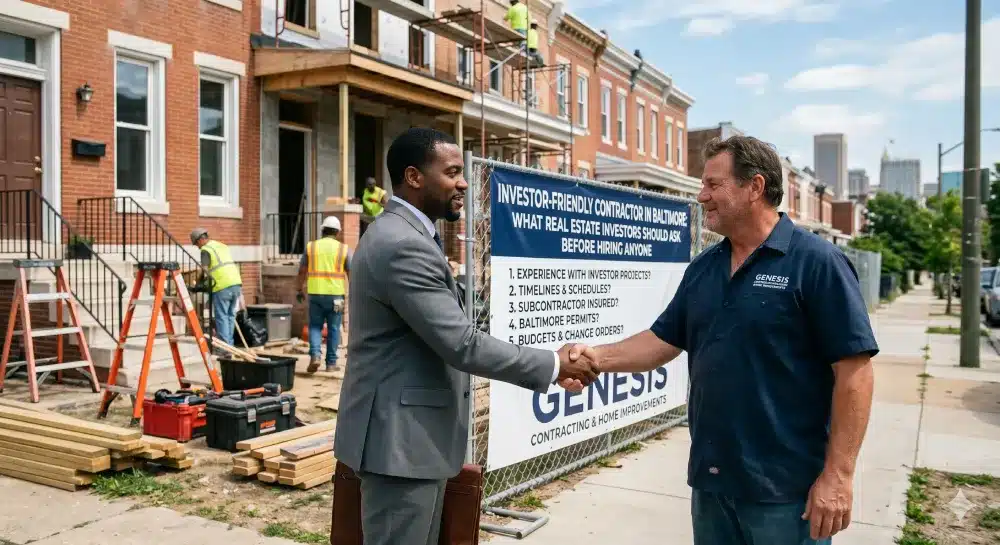
What Should Real Estate Investors in Baltimore Ask an Investor-Friendly Contractor Before Starting a Rehab?
By the Team at Genesis Contracting & Home Improvements | Serving Nottingham, Perry Hall, White Marsh, Towson & the Greater Baltimore Area
Finding a good contractor is hard. Finding a good contractor who actually understands real estate investing is something else entirely.
Most residential contractors are built around the homeowner experience. They work on one project at a time, communicate at a pace that suits a family remodeling their kitchen, and think about cost in terms of quality and aesthetics rather than ARV, holding costs, and exit timelines. That is completely appropriate for the clients they serve.
But it is not what an investor needs.
If you are buying distressed properties in Baltimore County — in Nottingham, Perry Hall, White Marsh, Parkville, or Rosedale — you need a contractor who thinks the way you think. Someone who understands that every extra week on a rehab is another week of hard money interest. Someone who can scope a job accurately the first time because a bad estimate does not just affect the budget — it affects whether the deal makes money at all. Someone who has been through enough investment properties to know where the surprises hide and how to handle them without blowing up your timeline.
Baltimore County is one of the most active fix-and-flip markets in Maryland. According to ATTOM data cited by Hard Money Bankers, Baltimore and Baltimore County recorded approximately 1,567 flips in Q2 2025 alone, with median gross profits of $165,000 and a 75% gross ROI — making Maryland the second most profitable state in the country for fix-and-flip investors. And Perry Hall’s median sale price sits at approximately $424,950, with fixer uppers regularly available in the $300,000–$360,000 range — a profile that creates real, executable investment opportunities for informed investors with the right contractor relationships.
At Genesis Contracting & Home Improvements, we built our investor-friendly contractor program specifically for real estate investors in the Baltimore metro area. We work with flippers, BRRRR investors, landlords, and wholesalers who need a contractor that operates at an investor’s pace and precision.
This post is going to give you the exact questions you should ask any contractor before they touch your investment property — and explain why each answer matters.
Why Most Contractors Are Not Actually Investor-Friendly
The phrase “investor-friendly contractor” gets thrown around a lot. But most contractors who claim it have not thought deeply about what it actually means.
A truly investor-friendly contractor is not just a contractor who works on investment properties. It is a contractor who understands the specific operational and financial dynamics of real estate investment and has built their service delivery around those dynamics.
Here is the gap that matters:
A standard residential contractor:
- Schedules projects sequentially with comfortable lead times
- Provides general cost ranges that may or may not account for all line items
- Communicates updates when convenient
- Is accustomed to homeowners who can tolerate timeline slippage
- Focuses on long-term quality for an owner-occupant living in the space
A genuinely investor-friendly contractor:
- Understands that every day of delay has a measurable dollar cost to the investor
- Provides accurate, itemized scopes that hold up against your ARV math
- Communicates proactively and consistently — without you having to chase updates
- Has systems for managing multiple investment projects simultaneously
- Calibrates finish quality to the neighborhood’s buyer expectations, not a luxury standard
- Knows how to sequence work efficiently to hit your target exit timeline
That last point matters more than most investors realize when they are building their first contractor relationships. The renovation budget on a flip is not just a cost — it is a variable that directly determines whether the deal works at the number you paid. A contractor who scopes the project incorrectly at the front end can turn a profitable deal into a break-even or a loss, regardless of how well they execute the actual construction.
The Baltimore County Fix-and-Flip Market — What the Numbers Look Like Right Now
Before we get into the questions, let us put the Baltimore County market in context, because the local dynamics shape what an investor-friendly contractor relationship needs to deliver.
The market fundamentals:
- Baltimore County’s median home price reached approximately $385,000 in 2025 — up significantly from pre-pandemic levels (Yes I Pay Cash, 2025)
- Maryland ranked as the second most profitable state for fix-and-flip investors in Q2 2025, with median gross profits of $165,000 and a 75% gross ROI per flip (Hard Money Bankers / ATTOM, 2026)
- Median gross profits hitting $143,000 per flip in early 2025 across Maryland, with Baltimore area properties driving much of that activity (Hard Money Bankers, 2025)
- Perry Hall fixer-uppers average 34 days on market and regularly receive multiple offers after renovation — a favorable absorption rate for investors (Redfin, 2026)
The renovation cost reality: In the Baltimore metro area, renovation costs run $60–$150 per square foot depending on scope. Cosmetic refreshes sit at the low end. Full gut renovations with new mechanicals push toward the high end. For a realistic Baltimore County flip targeting a $250,000–$300,000 ARV, the renovation budget typically falls in the $35,000–$55,000 range — which is exactly the scope of work that an investor-friendly general contractor like Genesis is built to handle efficiently.
The 70% Rule in Baltimore County: The investor standard — never pay more than 70% of ARV minus renovation costs — requires an accurate rehab estimate from a contractor who has actually done this kind of work in this specific market. An inflated or inaccurate estimate from an inexperienced contractor directly affects your maximum allowable offer (MAO) and your deal viability. Get the estimate wrong and you either overpay for the property or underbudget the renovation. Either way, the deal suffers.
10 Questions Every Real Estate Investor Should Ask a Contractor Before Hiring Them
These are the questions that separate contractors who understand investing from those who just work on investment properties. The answers will tell you everything you need to know.
Question 1: “Have you worked with real estate investors on fix-and-flip or rental rehab projects?”
This is the first filter. As REIkit puts it, the very first question to ask is whether a contractor works with investors at all — because it immediately reduces the field to contractors who actually understand your operational context.
A contractor who has worked exclusively on primary residences will typically not understand holding costs, ARV-based scoping, or the pace at which investment projects need to move. Someone who has completed investor rehabs in Baltimore County understands all of this by default — because they have lived the consequences of getting it wrong.
What you want to hear: Specific examples of investment projects they have completed in your target market, with outcomes they can speak to.
Red flag: Vague claims of investor experience without specific examples or references.
Question 2: “Can you provide a detailed, itemized scope of work — not a lump sum?”
An itemized scope of work is non-negotiable for investors. A lump sum estimate tells you a total number but gives you no visibility into what is actually included — or what happens when one line item changes.
According to Privy’s guidance on investor contractor relationships, requiring an itemized estimate directly reduces the risk of hidden costs. As an investor, you need to know exactly what is in scope: how many light fixtures, what type of flooring and at what square footage, the specific scope of kitchen and bath updates, what the plumbing and electrical scopes include.
A detailed itemized estimate also lets you make intelligent scope adjustments when you need to value-engineer the rehab to hit your numbers. If you need to cut $8,000, you need to know where it can be cut without hurting your ARV.
What you want to hear: Willingness and ability to produce a line-item estimate broken out by trade and material category.
Red flag: A contractor who resists itemizing or says “I prefer to work from a lump sum.”
Question 3: “What is your current workload and when can you start?”
This question matters because of timeline — and timeline matters because of money. In Baltimore County’s hard money lending environment, typical loan rates run 10–15% annually with origination fees of 1–3% (Hard Money Bankers, 2026). On a $200,000 loan at 12% annual interest, every additional month of holding costs you $2,000 in interest alone. That does not include property taxes, insurance, utilities, and other carrying costs.
A contractor who is too busy to start your project for 6–8 weeks is not investor-friendly, regardless of their quality. And a contractor who overpromises their capacity and then splits their crew between too many projects simultaneously will miss your timeline — which has a direct, measurable cost.
What you want to hear: An honest, realistic answer about current workload and a specific start date — not just “we can start soon.”
Red flag: Evasive answers about capacity, or a contractor who is suspiciously always immediately available.
Question 4: “How do you handle scope changes and unexpected conditions?”
Every investment property has surprises. Old homes in Baltimore County may have knob-and-tube wiring. Basements may have hidden moisture issues. Walls may conceal plumbing runs that affect your kitchen layout plan. How a contractor handles these surprises — both in terms of communication and pricing — is one of the most important variables in your investor-contractor relationship.
You want a contractor who immediately communicates the issue, presents the options with associated costs, and waits for your decision before proceeding. What you do not want is a contractor who makes decisions without consulting you and presents you with a change order after the fact.
What you want to hear: A clear process for change order communication — how quickly you are notified, what information is provided, and that no work on changed scope proceeds without your explicit approval.
Red flag: A contractor who talks about “doing what needs to be done and sorting it out later” or who cannot clearly articulate their change order process.
Question 5: “Are you MHIC-licensed and fully insured? Can I see your certificate of insurance?”
This should be table stakes — but it is still worth asking because there are unlicensed contractors operating in Baltimore County, and the consequences of working with one fall entirely on you. Per Maryland law, every residential contractor must hold a valid Maryland Home Improvement Contractor (MHIC) license. You can verify any contractor’s MHIC status directly through the Maryland Department of Labor.
Insurance matters for a different reason. If an uninsured worker is injured on your investment property, you may bear liability. If an uninsured contractor causes property damage, you have no recourse through their carrier. Always get a current certificate of insurance — do not just accept a contractor’s claim that they are insured.
What you want to hear: An immediate, clean answer with the license number and a same-day ability to send a COI.
Red flag: Hesitation, inability to produce the license number quickly, or any resistance to providing proof of insurance.
Question 6: “Have you worked on similar properties in this specific neighborhood?”
Neighborhood-specific experience matters in Baltimore County because buyer expectations, finishes, and price ceilings vary significantly between markets. What sells in a $500,000 Perry Hall home is not the same finish package that maximizes value in a $250,000 Rosedale flip. A contractor who has rehabbed properties throughout Baltimore County will understand the difference intuitively. One who has not will either over-improve (reducing your ROI) or under-improve (leaving money on the table).
What you want to hear: Specific examples from your target neighborhood or comparable markets, with outcomes that reflect understanding of neighborhood price ceilings.
Red flag: A contractor who treats every project as identical regardless of neighborhood positioning.
Question 7: “What does your payment schedule look like?”
Payment structure is one of the clearest signals of whether a contractor is legitimate and financially stable. A standard, professional payment structure ties disbursements to completed milestones — not to upfront requests for large deposits.
A contractor who requires a very large upfront payment (50% or more before work begins) is either financially strained or insufficiently capitalized to front material costs — neither of which is a good sign for your project. Conversely, a contractor who wants to be paid entirely upon completion may struggle to fund materials.
Industry-standard payment schedules typically look like: a modest mobilization deposit (10–15%), followed by progress payments at defined milestones (rough-in completion, drywall completion, substantial completion), with a final retention payment held until punch list is complete and all inspections are passed.
What you want to hear: A milestone-based payment structure with clear definitions of what constitutes each milestone.
Red flag: Requests for large upfront payments before work has begun, or vague payment terms.
Question 8: “Can you pull all required permits, and will you?”
Unpermitted rehab work on an investment property is a problem that shows up at the worst possible time — at the closing table, when a buyer’s inspector flags it or when the lender’s appraiser notes it. For investors on a timeline, a required stop to retroactively permit work is a nightmare.
Any legitimate investor-friendly contractor in Baltimore County should pull every required permit — building, electrical, plumbing, mechanical — as a standard part of every project. The contractor also needs to be comfortable navigating Baltimore County PAI’s permit process efficiently, which requires specific experience with the county’s online portal and inspection sequence.
What you want to hear: An affirmative answer with a clear explanation of which permits their projects typically require and how they manage the process.
Red flag: Any suggestion that permits can be skipped “to save time,” or a contractor who is unfamiliar with Baltimore County PAI’s process.
Question 9: “How do you communicate progress updates throughout the project?”
For investors — particularly those managing multiple properties or properties they are not visiting daily — communication is everything. You need to know when milestones are hit, when surprises occur, and when delays are developing before they have already cost you a week.
The best investor-friendly contractors have a defined communication system: weekly update cadence at minimum, immediate notification of any issue affecting scope or timeline, and consistent availability by phone or text for time-sensitive questions.
What you want to hear: A specific, defined communication protocol — not “we stay in touch” but a clear answer about how often updates come, through what channel, and how urgency is handled.
Red flag: Vague commitments to “staying in communication” without any defined structure.
Question 10: “Can you provide references from other investors you’ve worked with in Baltimore County?”
Investor references are categorically different from homeowner references. A homeowner reference tells you about quality and communication. An investor reference tells you about whether the contractor hit timelines, managed budgets accurately, handled surprises professionally, and understood the investment context of the project. Those are the things that matter to you.
Ask for investor references specifically, and ask those references directly: did the project come in on time, on budget, and were there any surprises that the contractor handled well or poorly?
What you want to hear: Multiple investor references who are willing to speak with you.
Red flag: Only homeowner references, or a contractor who deflects the reference request.
What Genesis Contracting’s Investor Program Offers
At Genesis Contracting & Home Improvements, our investor-friendly contractor program is built around everything described above. Here is what working with our team on an investment property looks like:
Accurate, itemized scoping. We produce detailed line-item estimates that hold up against your ARV math and support accurate deal analysis.
Investor-paced project management. We understand that your carrying costs are running daily. Our projects move efficiently and our timelines are communicated honestly.
Full-service rehab capability. We handle the complete scope of a typical investment property rehab — kitchen updates, bathroom renovations, basement finishing, flooring, painting, exterior work, decks, and additions — under one contractor relationship, which eliminates the coordination risk of managing multiple trades independently.
Permit management. We are fully MHIC-licensed and pull every required permit through Baltimore County PAI. Your rehab is fully permitted, fully inspected, and fully code-compliant — which protects your resale.
Neighborhood-calibrated finish quality. We know the Baltimore County neighborhoods where we work — Nottingham, Perry Hall, White Marsh, Rosedale, Parkville, Towson — and we scope rehabs to match neighborhood buyer expectations, not an arbitrary quality standard.
Consistent communication. We treat your project like the business transaction it is, not a favor. You know where things stand.
View our project gallery for examples of completed work across Baltimore County. Read what our clients say on our testimonials page. Ready to discuss your next investment project? Contact us here or call (443) 982-4289 for a free consultation.
Frequently Asked Questions — Investor-Friendly Contractors in Baltimore County
Q1: What makes a contractor “investor-friendly” versus just a regular contractor?
An investor-friendly contractor understands the financial dynamics of real estate investment — particularly the relationship between rehab costs, ARV, and holding costs — and builds their service delivery around those dynamics. They provide itemized estimates that support accurate deal analysis, manage projects at an investor’s pace, communicate proactively about progress and surprises, calibrate finish quality to neighborhood buyer expectations, and pull all required permits. The difference is not just experience with investment properties — it is a fundamentally different operational mindset. Our investor program is built specifically around these needs.
Q2: How do I verify that a contractor is properly licensed in Maryland?
All residential contractors working in Maryland must hold a valid Maryland Home Improvement Contractor (MHIC) license. You can verify any contractor’s license status directly through the Maryland Department of Labor’s MHIC license lookup tool. Additionally, verify that electricians and plumbers working on your project hold active Maryland master trade licenses. Ask for a current certificate of insurance and verify it directly with the issuing insurer. Genesis Contracting is fully MHIC-licensed, fully insured, and happy to provide documentation immediately.
Q3: What is a realistic rehab cost for a flip in Baltimore County in 2025?
In the Baltimore metro area, renovation costs run approximately $60–$150 per square foot depending on scope, according to Hard Money Bankers’ analysis of Maryland rehab costs. Cosmetic refreshes — paint, flooring, fixtures — sit at the low end. Full gut renovations with new mechanicals push toward $150. For a typical Baltimore County flip targeting $250,000–$300,000 ARV, the rehab budget generally falls in the $35,000–$55,000 range. Baltimore County projects typically run above Maryland’s statewide average due to local labor costs. For a specific scope and estimate on your property, contact Genesis Contracting.
Q4: How does the 70% rule apply to hiring a contractor in Baltimore County?
The 70% rule — never pay more than 70% of ARV minus renovation costs — makes accurate contractor scoping essential to deal underwriting. If your contractor’s rehab estimate is inflated by $15,000, your maximum allowable offer (MAO) drops by $15,000. If the estimate is too low and the real cost comes in higher, you either eat the overrun or sell at reduced margins. An investor-friendly contractor with Baltimore County experience scopes projects accurately from the start, which protects your deal analysis and your profitability.
Q5: What types of projects does Genesis Contracting handle for Baltimore County investors?
We handle the full scope of a typical investment property rehab: kitchen remodeling, bathroom renovations, basement finishing, flooring installation, interior and exterior painting, deck construction, exterior work, fencing, and home additions. We manage the full scope under one contractor relationship, which eliminates the coordination complexity of managing multiple independent trade contractors. We serve investment properties throughout Nottingham, Perry Hall, White Marsh, Rosedale, Parkville, Towson, and the greater Baltimore area.
Q6: How quickly can Genesis Contracting turn around an estimate for an investment property?
We understand that investors often need to move quickly on deal analysis and contract deadlines. We prioritize fast turnaround for investor estimates. For standard scopes, we can typically provide a detailed, itemized estimate within 3–5 business days of walking the property. For time-sensitive situations, contact us directly at (443) 982-4289 to discuss your timeline and we will do everything we can to accommodate it.
Q7: What neighborhoods in Baltimore County are most active for real estate investment right now?
Baltimore County as a whole is highly active, with 1,567 recorded flips in Q2 2025 and strong buyer demand across the county. Perry Hall, with its median sale price around $424,950 and fast absorption for renovated homes, is particularly attractive. White Marsh, Nottingham, Rosedale, and Parkville all offer distressed inventory at price points that support profitable flip math when renovation costs are managed correctly. The key in any Baltimore County market is neighborhood-calibrated finish quality — which is something our team understands across all the markets we serve.
Q8: Do investors need to be present during the rehab, or can Genesis manage the project independently?
Genesis Contracting manages the full project — you do not need to be on-site daily. We handle coordination of all trades, permit management, inspection scheduling, and progress tracking. We provide regular updates on a defined schedule and immediately notify you of any material changes to scope, timeline, or budget. Many of the investors we work with manage multiple projects simultaneously and rely on us for independent project management. If you are local and want to be involved, we welcome that. If you prefer a more hands-off approach, we are built for that too.
Q9: What is the biggest mistake investors make when hiring a contractor for a Baltimore County rehab?
Based on our experience, the single biggest mistake is prioritizing the lowest bid without understanding what is included. A lowball estimate that does not account for permit costs, proper subcontractor licensing, code-compliant electrical and plumbing scopes, and an adequate contingency will almost always result in a higher actual cost than an accurate mid-range estimate. The second most common mistake is not asking about permits — specifically, allowing a contractor to suggest skipping permits “to save time.” Unpermitted work on an investment property is a problem that shows up at the closing table and costs far more to remediate than the permits would have.
Q10: How do I get started with Genesis Contracting’s investor program?
The easiest first step is a phone call or contact form submission to discuss your current or upcoming project. We will schedule a property walkthrough, produce a detailed scope and estimate, and walk you through our approach. There is no cost for the estimate and no obligation. Contact us here or call (443) 982-4289. We look forward to learning about your investment goals in Baltimore County.
Genesis Contracting & Home Improvements — Proudly Serving the Greater Baltimore Area Nottingham | Perry Hall | White Marsh | Towson | Parkville | Rosedale | Baltimore County (443) 982-4289 | genesiscontracting.biz