
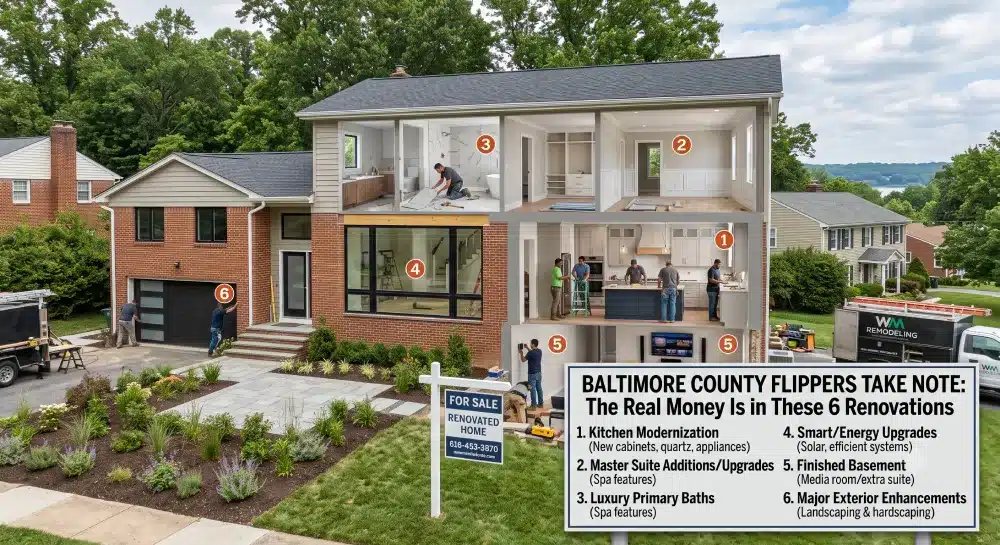
The honest answer? A smart, targeted kitchen update, a clean bathroom refresh, and strong curb appeal upgrades will do more for your bottom line than a luxury overhaul ever will. In fact, the 2025 Cost vs. Value Report shows that a minor kitchen remodel now returns an average of 113% ROI nationally — meaning you can make money on the renovation itself. Keep reading, because the numbers below are ones most flippers never see coming.
Key Takeaways
- Maryland flippers earned an average gross profit of $157,650 per flip in Q2 2024 (Houzeo/Bright MLS data).
- The Baltimore metro posts an average gross ROI of ~76% — one of the highest for any large metro in the country (Hard Money Bankers, 2025).
- Minor kitchen remodels return 113% ROI; major kitchen overhauls return as little as 38%. The difference is massive.
- Mid-range bathroom remodels return between 66.7% and 74% of cost at resale — a reliable, consistent performer.
- A garage door replacement now returns 268% ROI nationally per the 2025 Cost vs. Value Report — the single highest-performing project tracked.
- Pools, sunrooms, and home theaters are money traps for flippers — pools return just 30–50% of cost in most Maryland markets.
- Genesis Contracting has worked with real estate investors across Baltimore County for decades. We know which renovations move units and which ones just burn budget.
- Always add a 15% contingency to your renovation budget on older Maryland homes — hidden issues behind walls are the rule, not the exception.
- Renovation costs in the Baltimore metro run $60 to $150 per square foot depending on scope (Hard Money Bankers).
- Unpermitted work kills deals. Always pull permits. We handle that for you.
Why Is Baltimore County Such a Hot Market for House Flipping Right Now?
Let’s be real. Baltimore County doesn’t get the press that D.C. gets, but investors who know the market understand exactly what’s sitting right here under everyone’s noses.
Neighborhoods like Perry Hall, Towson, Nottingham, White Marsh, Rosedale, and Parkville all have something going for them that bigger markets don’t: relatively affordable acquisition prices, tight inventory, and strong buyer demand from working families who want suburbs without a two-hour commute. That’s a recipe investors love.
Maryland as a whole recorded one of the highest foreclosure rates in the nation through 2024, which means distressed properties are available. Days on market statewide have crept up slightly — from about 8 to 11 days — but that’s still blazing fast compared to most markets. Inventory sits at a tight 1.6 to 2 months of supply statewide. When supply is that low and buyer demand stays steady, the right renovation on the right house sells fast.
Here at Genesis Contracting, we’ve been working across Baltimore County for decades. We’ve seen the neighborhoods shift, the buyer preferences change, and the renovation trends come and go. What hasn’t changed? Buyers still want a kitchen they’re proud of, a bathroom that doesn’t feel outdated, and a front of house that makes them want to walk in the door.
Which Renovations Actually Increase Resale Value for Baltimore County Flippers?
This is the section you probably came here for. No fluff. Just the numbers, with context you can actually use.
1. Minor Kitchen Updates — The Best ROI in the Business Near Me
Here’s something that surprises a lot of first-time investors. You don’t need a full gut-and-rebuild to move the needle on kitchen value. In fact, you shouldn’t do one.
The 2025 Cost vs. Value Report (published by Zonda/JLC, the gold standard for this data) found that minor kitchen remodels now return 113% ROI — up from 96.1% just one year earlier. That means, on average, you spend a dollar and get back $1.13. That’s not just a good renovation. That’s a profitable one.
What does a minor kitchen remodel look like? Think cabinet refacing or painting, new countertops (quartz is the sweet spot in mid-range Baltimore County homes), updated hardware, a tile backsplash, new appliances, and fresh lighting. You’re not moving walls. You’re not redoing the layout. You’re making the kitchen look and feel like it was updated in the last few years — because buyers in the $250,000–$450,000 price range in White Marsh and Perry Hall aren’t expecting a magazine kitchen. They want clean, functional, and current.
For a realistic Baltimore County flip targeting roughly a $250,000 after-repair value (ARV), a well-executed kitchen update typically runs between $15,000 and $35,000, depending on scope and finishes.
What NOT to do: A major kitchen overhaul — think custom cabinetry, high-end appliances, structural changes — returns only about 38% to 50% of its cost according to multiple 2025 cost analyses. On an $85,000+ major remodel, that math is brutal. We see investors make this mistake in Towson all the time. The best kitchen for a flip is the one that photographs well, impresses on walkthrough, and didn’t cost you $80,000 to build.
Learn more about our kitchen remodeling work near you
2. Bathroom Remodels — Consistently Strong, Rarely Fails
Bathrooms are one of the safest bets in the flip game. A mid-range bathroom remodel on a standard 5×7 space returns roughly 66.7% to 74% of its cost at resale. That’s not a home run, but it’s steady, dependable, and buyers absolutely notice a dated bathroom.
In Baltimore County markets like Rosedale and Parkville, where you’re dealing with a lot of 1960s–1980s housing stock, bathrooms often show their age hard. Harvest gold tile. Builder-grade vanities from 1987. Fluorescent lighting. These are buyer turn-offs that cost you offers, not just purchase price.
A quality mid-range bathroom remodel — new tub or walk-in shower surround, updated vanity and fixture set, fresh tile, proper exhaust fan, new lighting — averages about $24,000 to $26,000 and returns roughly $16,000 to $18,000 in added resale value nationally. In a tight Baltimore County market, the real value is often faster sale time and fewer buyer objections, which has its own ROI that doesn’t show up in percentage stats.
One thing worth noting: an upscale bathroom remodel returns only about 45% of its cost at resale. Don’t put a spa bathroom in a $220,000 home. Match the finish level to the neighborhood’s buyer expectations — always.
See our bathroom remodeling portfolio near Perry Hall and Towson
3. Curb Appeal — The Biggest Bang for the Smallest Buck
This one genuinely shocks investors when they first see the numbers.
A simple garage door replacement — a standard insulated steel door in the right style for the home — now returns 268% ROI nationally according to the 2025 Cost vs. Value Report. The cost is roughly $4,000–$4,500. The added value can top $10,000–$12,000. That’s the highest-returning project tracked in the entire report.
A steel entry door replacement follows close behind at 188% ROI.
Think about what this means for a flip in Nottingham or White Marsh. You’ve got a mid-century colonial or cape cod. The bones are good. The interior work is done. But the front of the house still looks tired. A new garage door, a new front entry door, and fresh exterior paint transform the street presence completely — and they do it for a fraction of what a kitchen costs.
Buyers form their impression of a home before they walk through the door. That’s not a saying. That’s backed by real estate buyer behavior research. First impressions at the curb set the emotional frame for every room they walk into after. Smart investors in Parkville and Rosedale know this.
4. Fresh Paint — The Cheapest Per-Dollar Win Available
This one isn’t in the Cost vs. Value Report because it’s almost too obvious to track formally. But the numbers are stunning when you think about them. Clean, neutral interior paint is one of the lowest-cost updates available — typically $2,500 to $6,000 for a full interior repaint on a standard Baltimore County rancher or colonial — and the buyer perception value is enormous.
Buyers associate fresh paint with a home that has been cared for. Chipped, yellowed, or dated paint (especially anything bold or personalized) signals work. Neutral tones — soft whites, warm grays, agreeable beige tones — photograph clean, feel spacious, and appeal to the broadest pool of buyers.
The team here at Genesis has painted our share of investment properties across Perry Hall and Towson. It’s not glamorous work, but it consistently moves the needle on showings and offers.
5. Flooring Replacement — Specifically Hardwood or LVP
Carpet is a buyer objection waiting to happen. Buyers in Baltimore County — especially in the $280,000–$400,000 range in White Marsh and Nottingham — have come to expect hard surface flooring or clean hardwood throughout living areas.
Replacing worn carpet with luxury vinyl plank (LVP) or refinishing existing hardwood returns well and has a strong visual impact for its cost. LVP in particular has become the investor’s best friend: it’s durable, moisture-resistant, installs fast, and photographs as well as hardwood at a fraction of the price.
Refinishing existing hardwood floors (where they’re present in older Baltimore County homes) returns roughly 147% ROI nationally according to some estimates — making it one of the few projects that may return more than it costs.
6. Roof Replacement or Repair — The Trust Builder
Here’s one that rarely gets talked about in the flip ROI conversation, and we think that’s a mistake.
A roof in obvious disrepair — missing shingles, visible sagging, dark staining — kills buyer confidence before they’ve even walked inside. Home inspectors flag it. Buyers’ agents warn their clients. Lenders get skittish. The deal can fall apart entirely over a roof that would have cost $8,000 to $15,000 to replace.
A new roof doesn’t add the same “wow” factor as a kitchen, but it removes a major obstacle to closing. In Baltimore County’s inspection-driven market, a clean roof means smoother due diligence, fewer credits, and less time sitting on the market waiting for a buyer who isn’t scared away.
View our roofing services in Baltimore County
Which Renovations Should House Flippers in Baltimore County Avoid?
Just as important as knowing what to do is knowing what to skip.
Swimming Pools — Almost Always a Mistake for Flippers
The data on this is about as clear as it gets. An in-ground pool costs anywhere from $30,000 to $80,000 to install. At resale, nationally, it returns about 30–50% of its cost — and in many markets, it actually makes the home harder to sell. Buyers see maintenance costs, liability, insurance increases, and a smaller usable yard. Unless you’re flipping a high-end property in a neighborhood where pools are standard, skip it.
Sunrooms — Expensive With Limited Return
A sunroom addition returns just 40–55% of its cost at resale according to multiple sources. They’re beautiful to live in, but they’re expensive to build, difficult to insulate properly, and don’t always count as full conditioned square footage in appraisals. For a flip, that math doesn’t work.
Luxury Master Suite Additions — A Money Pit Near Me
Adding a luxury master suite addition typically returns around 50–60% of its cost. You’re looking at potentially $40,000+ investment that recovers less than half. If the home genuinely needs an extra bedroom, a simpler addition might pencil out — but over-improving a home for its neighborhood is one of the fastest ways to turn a profitable flip into a loss. The rule of thumb most pros follow: don’t spend more than 30% of the home’s current value on renovations total.
High-End Finishes in Entry-Level Homes
Marble countertops and custom cabinetry belong in a $600,000 home in Towson. They do not belong in a $220,000 flip in Parkville. Over-improving for the neighborhood’s buyer pool is one of the most common mistakes we see from newer investors. The buyer who can afford that Parkville home is not comparing it to luxury homes — they’re comparing it to other homes in that same price range. Match your finishes to the market, not your personal taste.
What Makes an Investor-Friendly Contractor Different in Baltimore County?
This is actually something we think about a lot over here at Genesis, because we’ve worked with investors for decades and we understand that your needs are completely different from a homeowner’s needs.
When a family remodels their kitchen, they’re living there. They have time to think about it, change their minds, pick out finishes. They care deeply about every detail because it’s their home.
When an investor remodels a kitchen, they need it done on schedule, on budget, and to the spec that maximizes resale value — not personal preference. They need a contractor who understands ROI, not just renovation. They need someone who’s seen enough Baltimore County neighborhoods to know when $2,000 extra on countertops will actually help the sale price, and when it won’t.
That’s what we offer. We’re not just the best contractor near you. We’re the contractor who thinks like an investor — because we’ve been doing this long enough to know that your success is our reputation.
See our full Investor-Friendly Contractor page
We work across Nottingham, Perry Hall, White Marsh, Rosedale, Parkville, and Towson — and we know the buyer expectations in each of those zip codes. That matters. A flip in Towson has a different buyer profile than a flip in Rosedale, and your finishes should reflect that.
Contact the Genesis team to talk about your next project
The Real Cost of a Baltimore County Flip — Numbers Most Investors Don’t Plan For
According to Hard Money Bankers, renovation costs in the Baltimore metro area run $60 to $150 per square foot, with cosmetic refreshes at the low end and full gut renovations at the high end.
For a realistic moderate rehab targeting a $250,000 ARV, renovation budgets typically fall in the $35,000 to $55,000 range. That covers kitchen and bathroom updates, new flooring, fresh paint, updated lighting and fixtures, and selective repairs to roofing, HVAC, or plumbing.
But here’s what many investors don’t budget for:
- Holding costs: Property tax in Baltimore County, carrying interest on hard money loans, utilities.
- Closing costs: Transfer taxes, recordation fees, agent commissions (typically 5–6% combined on the sale side alone).
- The 15% contingency: Older Maryland homes hide problems. Water damage behind bathroom tile, knob-and-tube wiring, inadequate insulation, undersized HVAC. Always budget 15% over your renovation estimate, not 10%.
Maryland gross profit on a flip averages impressively. But net profit — after holding costs, loan interest, commissions, taxes, and all closing costs — typically runs 30–50% lower than the gross number. Plan accordingly.
Frequently Asked Questions — Home Remodeling in Baltimore County
1. How do I find the best home remodeling contractor near me in Baltimore County? Look for a contractor with verifiable local experience, proper licensing and insurance in Maryland, and a portfolio of completed projects in your specific neighborhoods. Referrals from other investors or real estate agents are worth more than any online review. Genesis Contracting has served Baltimore County communities including Perry Hall, Towson, Nottingham, White Marsh, Rosedale, and Parkville for decades.
2. What permits do I need for a renovation in Baltimore County, Maryland? Most structural, electrical, plumbing, and HVAC work requires permits through Baltimore County’s Department of Permits, Approvals & Inspections. Cosmetic work like painting, flooring, and most cabinet replacements typically don’t require permits. Unpermitted work is a serious problem at resale — it can delay or kill a sale, create liability issues, and reduce appraised value. We handle the permit process for our clients.
3. How long does a typical house flip renovation take in Baltimore County? A cosmetic flip on a smaller home can be completed in 4–8 weeks with the right crew and materials ready to go. A more extensive renovation involving kitchen, bathroom, roofing, flooring, and painting on a larger home typically runs 8–14 weeks. Timeline depends heavily on material lead times, permit approval speed, and what’s discovered once walls are opened.
4. What’s the 70% rule in house flipping, and does it apply in Baltimore County? The 70% rule says you should pay no more than 70% of the ARV minus your renovation costs. For a home with a $300,000 ARV and $50,000 in renovation costs, that means paying no more than $160,000 to acquire it. It’s a solid guideline, though in tight Baltimore County markets you’ll sometimes see successful flips that push past it. Always run your own numbers with real local data.
5. Should I use the same contractor for multiple investment properties? Absolutely, yes — and this is actually a major strategic advantage. A contractor who knows your standards, your target buyer profile, and your budget expectations can move faster, price more accurately, and avoid the learning curve that comes with every new relationship. At Genesis, we actively seek repeat investor relationships because they’re better for everyone involved.
6. What’s the biggest mistake first-time house flippers make with renovations? Over-improving for the neighborhood. Spending $80,000 on a luxury kitchen in a $240,000-price-point neighborhood is the fastest way to lose money on a flip. Match your finishes to the buyer expectations of that specific area and price range, not to your personal taste or what looked good on a design show.
7. Is a home addition worth it for a house flip? Rarely. Adding square footage is expensive — often $150+ per square foot in the Baltimore metro — and the ROI at resale frequently doesn’t justify the cost on a flip timeline. There are exceptions when a home is genuinely undersized for its neighborhood comps, but in general, flippers are better served maximizing the value of existing square footage than adding more.
8. How important is curb appeal for selling a flipped home in Baltimore County? Very important. Buyers in Nottingham, Perry Hall, and Towson often drive neighborhoods before scheduling showings. A home that looks tired from the street gets fewer showings regardless of how good the interior is. A garage door replacement (268% ROI nationally), new entry door, fresh exterior paint, and clean landscaping can transform the street appeal for a relatively modest investment.
9. What financing options do real estate investors use for renovations in Maryland? Most active Baltimore County investors use hard money loans for the acquisition and renovation, then refinance or sell before the term expires. Home equity lines of credit (HELOCs), private lenders, and partnership structures are also common. Interest rates on hard money in Maryland typically run higher than conventional loans, which is why renovation speed and timeline matter so much — every extra month of holding costs cuts into your margin.
10. Why should I choose Genesis Contracting for my investment property renovations in Baltimore County? We’ve been doing this for decades. We’ve renovated homes across Perry Hall, Towson, Nottingham, White Marsh, Rosedale, and Parkville. We understand investor timelines, investor budgets, and investor ROI goals — not just homeowner preferences. We’re the best investor-friendly contractor near you because we’ve built our entire workflow around the way investors need to work: clear pricing, realistic timelines, consistent communication, and renovations that actually move the market price. Reach out here
Helpful Resources for Baltimore County Real Estate Investors
- Zonda 2025 Cost vs. Value Report — The gold standard for renovation ROI data.
- Hard Money Bankers — Maryland Fix and Flip Guide — Local market data and neighborhood analysis.
- Baltimore County Permits, Approvals & Inspections — Official permit requirements and applications.
- National Association of Realtors — Remodeling Impact Report — Buyer perception data on renovation projects.
- Houzeo — Maryland House Flipping Analysis — State-level flipping data and market trends.
Genesis Contracting has proudly served Baltimore County families and investors for decades. We specialize in kitchen remodeling, bathroom remodeling, home additions, decks, roofing, and full investment property renovations across Nottingham, Perry Hall, White Marsh, Rosedale, Parkville, and Towson, Maryland. We are the best contractor near you when it comes to investor-focused renovation work that moves the market price.
Ready to talk about your next flip? Contact us today.