
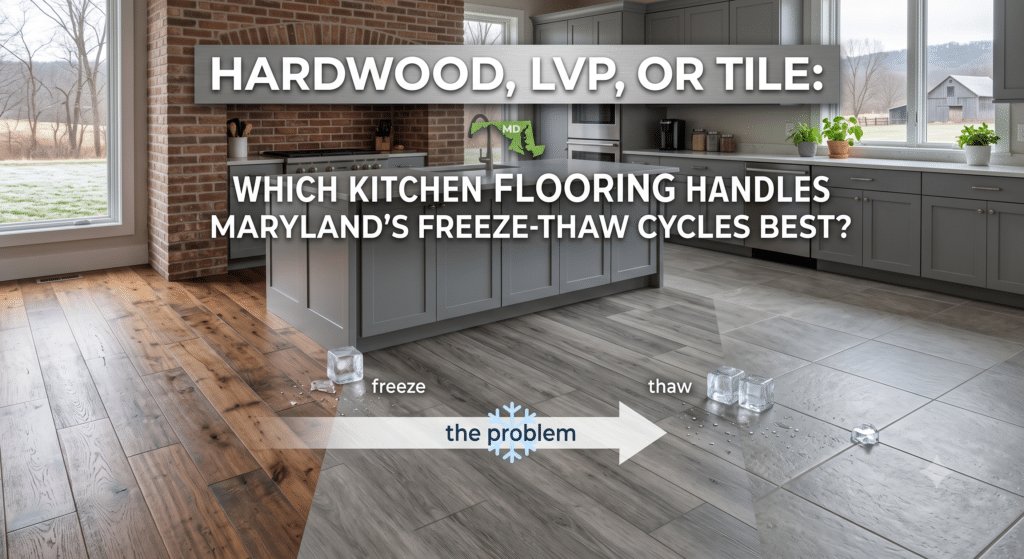
Key Takeaways
-
Water & Slush Resistance:
Luxury Vinyl Plank (LVP) and glazed porcelain tile are 100% waterproof, making them ideal for handling winter slush and mud tracked in from back decks. -
Subfloor Dictates Choice:
Plywood subfloors over crawl spaces or joists accommodate all flooring types, while concrete slab basements in parts of Baltimore County require vapor barriers and click-lock LVP or uncoupling membranes for tile. -
Seasonal Expansion:
Solid hardwood expands and contracts significantly during humid Maryland summers and dry freeze-thaw winters, leading to gapping or cupping if relative indoor humidity isn’t strictly controlled. -
Long-Term Longevity:
Porcelain tile lasts 50+ years with minimal maintenance, while high-wear LVP lasts 20–25 years, and solid hardwood can be sanded and refinished multiple times over a century.
How Does Maryland Weather Impact Kitchen Flooring Performance?
Direct Answer:
Maryland’s drastic seasonal climate shifts—ranging from 90°F+ humid summers to winter freeze-thaw cycles—subject kitchen floors to constant humidity fluctuations, thermal expansion, and tracked-in moisture. Flooring materials that absorb water or expand significantly can warp, cup, or crack grout lines when slush and road salt are tracked inside from decks and driveways.
When our field crews step into kitchens across Towson, Parkville, and White Marsh, we inspect more than just current floor cosmetics. We look at how the home handles the elements. Between humid Chesapeake Bay summer air and freezing mid-Atlantic winter dips, local homes move and breathe.
| Performance Category | Luxury Vinyl Plank (LVP) | Porcelain Tile | Engineered / Solid Hardwood |
|---|---|---|---|
| Moisture & Slush Resistance | 100% Waterproof | 100% Waterproof | Susceptible to Warping |
| Freeze-Thaw Dimensional Stability | Exceptional (Rigid Core) | Exceptional | Moderate to Poor (Solid) |
| Subfloor Flexibility | High (Floats over minor) | Requires Rigid Prep | Requires Flat Plywood Sub |
| Comfort Underfoot & Warmth | Warm & Cushioned | Cold (Needs Radiant) | Warm & Natural |
| Expected Lifespan | 20–25 Years | 50+ Years | 50–100 Years (Refinishable) |
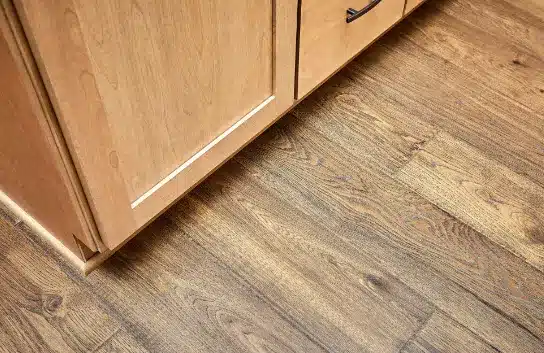
Here is how the three top kitchen flooring choices compare against our local climate:
-
Luxury Vinyl Plank (LVP):
Modern Stone Polymer Composite (SPC) rigid-core LVP is 100% waterproof and dimensionally stable. It won’t swell when snow melts near the back patio door or buckle when summer humidity spikes in Rosedale. -
Porcelain Tile:
According to installation standards from the
Tile Council of North America (TCNA),
glazed porcelain has a water absorption rate under 0.5%. It is immune to liquid spills and slush, though rigid subfloor prep is mandatory to prevent cracked grout during seasonal home settling. -
Hardwood Flooring:
Traditional solid oak or maple looks timeless, but guidelines from the
National Wood Flooring Association (NWFA)
warn that solid wood shrinks during dry winter heating seasons and swells during humid summers. Engineered hardwood—built with cross-ply plywood cores—offers far greater dimensional stability than solid wood in local climates.
Which Subfloor Construction Is Best for Your Kitchen Flooring Choice?
Direct Answer:
Plywood subfloors over joists accommodate solid wood, engineered hardwood, tile, or LVP, whereas concrete slab subfloors require moisture vapor barriers and favors floating LVP or glued engineered wood. Installing heavy porcelain tile over flexible joist subfloors without an uncoupling membrane will lead to cracked tiles and failed grout lines over time.
| Subfloor Type | Recommended Flooring | Required Preparation |
|---|---|---|
| 3/4" Plywood Subfloor (Joists) | LVP, Hardwood, Tile | Cement Board or Ditra for Tile |
| Concrete Slab (Basement/At-Grade) | Rigid Core LVP, Engineered Wood | 6-mil Poly Vapor Barrier |
| Old Strip Hardwood / Linoleum | LVP or Underlayment Prep | Leveling Compound or Tear-out |
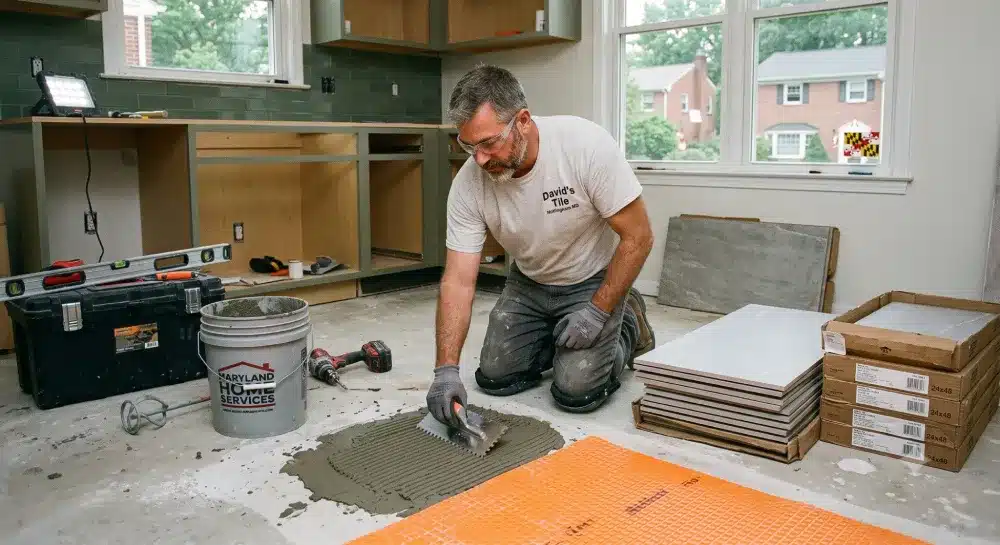
In older split-levels in Perry Hall or ranch homes in Parkville, subfloors vary dramatically:
-
Plywood Subfloors Over Frame Joists:
Common in two-story homes in Towson and Nottingham. When planning a
kitchen tile installation in Nottingham,
our team at Genesis Contracting
checks floor joist deflection (L/360 rating) and installs uncoupling membranes (like Schluter-DITRA) to absorb natural floor flexing. -
Concrete Slabs:
Common in ground-level or basement kitchens across White Marsh and Rosedale. Slabs wick ground moisture upward. Installing a
luxury vinyl plank kitchen in Parkville MD
over slab requires testing for relative humidity and laying a 6-mil polyethylene vapor barrier first.
How Do Installed Costs Compare for LVP, Tile, and Hardwood in Maryland?
Direct Answer:
LVP is the most budget-friendly option at $6 to $11 per square foot installed, while porcelain tile ranges from $10 to $22 per square foot and hardwood costs $12 to $25+ per square foot. Higher installation costs for tile and hardwood reflect extensive subfloor prep, underlayment materials, and skilled trade labor hours.
| Flooring Material Type | Material Cost / Sq. Ft. | Total Installed Cost / Sq. Ft. |
|---|---|---|
| Luxury Vinyl Plank (SPC Rigid) | $2.50 – $5.50 | $6.00 – $11.00 |
| Porcelain / Ceramic Tile | $3.00 – $8.00 | $10.00 – $22.00 |
| Engineered Hardwood | $5.00 – $10.00 | $11.00 – $20.00 |
| Solid Hardwood (Oak / Hickory) | $6.00 – $12.00 | $14.00 – $25.00+ |
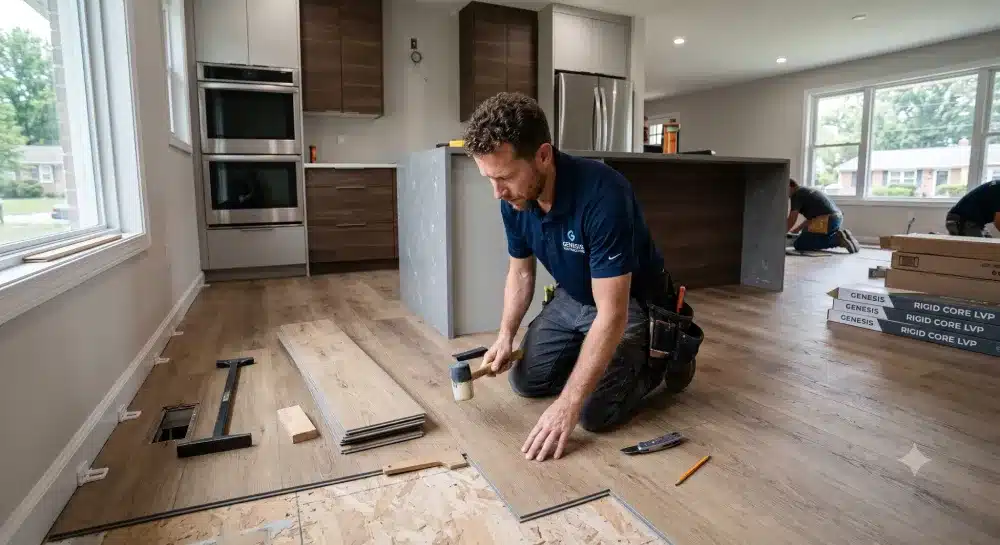
Industry figures from the annual Remodeling Magazine
Cost vs. Value Report
show that durable, low-maintenance kitchen finishes yield top resale value in the South Atlantic region. When establishing your project budget, factor in these installation realities:
-
Subfloor Preparation Labor:
Levelling uneven subfloors with self-leveling underlayment or installing 1/2-inch cement backer board adds $2 to $4 per square foot to tile installations. -
Layout Complexity & Demolition:
Tearing out legacy layers of linoleum or glued vinyl in older Nottingham homes adds labor time and disposal fees. -
Plumbing & Appliance Resetting:
Removing and reinstalling refrigerators, gas ranges, and dishwashers safely requires experienced technicians working to code.
How Does Daily Maintenance Compare for Busy Families and Pets?
Direct Answer:
LVP requires the least daily upkeep, resisting scratches from pet nails, spilled liquids, and heavy foot traffic with simple damp mopping. Tile is equally stain-proof but requires occasional grout sealing, while hardwood demands prompt spill cleanup and specialized wood cleaners to prevent water rings and finish dulling.
Data from the
National Association of the Remodeling Industry (NARI)
confirms that family-friendly durability is a primary decision driver for home buyers.
-
Pet Claws & High Heels:
High-grade LVP features commercial wear layers (20-mil thickness or higher) that resist pet claw scratches. Porcelain tile is completely scratch-proof, while solid hardwood can dent under heavy impacts. -
Cleaning Slush & Mud:
Winter mud tracked in from the back yard during a winter thaw wipes off LVP and tile instantly. Wet slush left standing on solid oak can penetrate finish seams and stain the wood dark.
What Building Permits and Safety Standards Apply to Kitchen Flooring in Baltimore County?
Direct Answer:
Replacing kitchen flooring alone does not require a building permit in Baltimore County unless you are replacing structural subfloor joists or altering under-floor plumbing and electrical runs. All contractor work over $500 must be executed by a contractor licensed by the State of Maryland.
Under consumer protection guidelines set by the
Maryland Home Improvement Commission (MHIC):
-
Structural Subfloor Repairs:
If water damage from an old dishwasher leak rots out subfloor joists in Parkville or Towson, replacing structural framing members requires a residential building permit submitted via the
Baltimore County Department of Permits, Approvals and Inspections. -
Appliance Clearance Heights:
Adding thick tile or hardwood over existing subfloors raises floor heights. Our field crews ensure built-in dishwashers remain clear of low counter edges so they can be serviced easily. -
Licensed Accountability:
Genesis Contracting handles structural repairs, subfloor prep, and
kitchen remodeling near Nottingham
under active license MHIC #130227.
Frequently Asked Questions About Kitchen Flooring
1. What is the best kitchen flooring for Maryland’s freeze-thaw weather?
Rigid-core Stone Polymer Composite (SPC) Luxury Vinyl Plank and porcelain tile handle local freeze-thaw weather best because they are 100% waterproof and do not expand or warp when exposed to slush or humidity.
2. Is LVP better than hardwood for a kitchen with a back deck door?
Yes, LVP is better near back doors because melted snow, mud, and water tracked in from a back deck will not damage or warp vinyl planks like it can with natural solid hardwood.
3. Can you install porcelain tile over a plywood subfloor?
Yes, but you must install a 1/2-inch cement backer board or an uncoupling membrane (such as Schluter-DITRA) over the plywood first to prevent subfloor flexing from cracking tiles and grout lines.
4. Why does solid hardwood expand and gap in Maryland homes?
Solid hardwood is a natural hygroscopic material that absorbs moisture from humid summer air (causing swelling) and releases moisture during dry winter heating seasons (causing shrinkage gaps).
5. How thick should the wear layer be on kitchen LVP?
For high-traffic kitchens with kids and pets, choose LVP with a wear layer of at least 20 mil (0.5 mm) to prevent scratches and scuffs.
6. Does LVP require a moisture barrier over concrete basement slabs?
Yes, you should always lay a 6-mil polyethylene vapor barrier over concrete slabs before installing click-lock floating LVP to block ground vapor transmission.
7. How long does porcelain kitchen tile last compared to LVP?
Glazed porcelain tile can last 50 years or more with minimal maintenance, whereas quality rigid-core LVP typically lasts 20 to 25 years before needing replacement.
8. Will raising the kitchen floor height affect my dishwasher?
Yes, adding thick tile or extra underlayment layers can trap a dishwasher beneath standard 36-inch countertop edges. Our master tradespeople measure clearances to ensure appliances slide out smoothly.
9. Can I install radiant floor heating under kitchen tile?
Yes, electric radiant heating mats installed beneath porcelain tile provide comfortable warmth underfoot during cold Maryland winters.
10. How do I verify that my flooring contractor is licensed in Maryland?
Check your contractor’s license status on the
Maryland Department of Labor MHIC database search.
Genesis Contracting maintains active license MHIC #130227.
Ready to Upgrade Your Kitchen Flooring?
Choosing the right flooring comes down to your home’s subfloor, layout, and lifestyle. Whether you need durable LVP, timeless tile, or a complete
kitchen remodeling
transformation,
bathroom remodeling,
or a custom
home addition,
contact our team at Genesis Contracting
today. We provide itemized fixed bids, subfloor evaluations, and master craftsmanship across Nottingham, Perry Hall, White Marsh, Rosedale, Parkville, and Towson.