
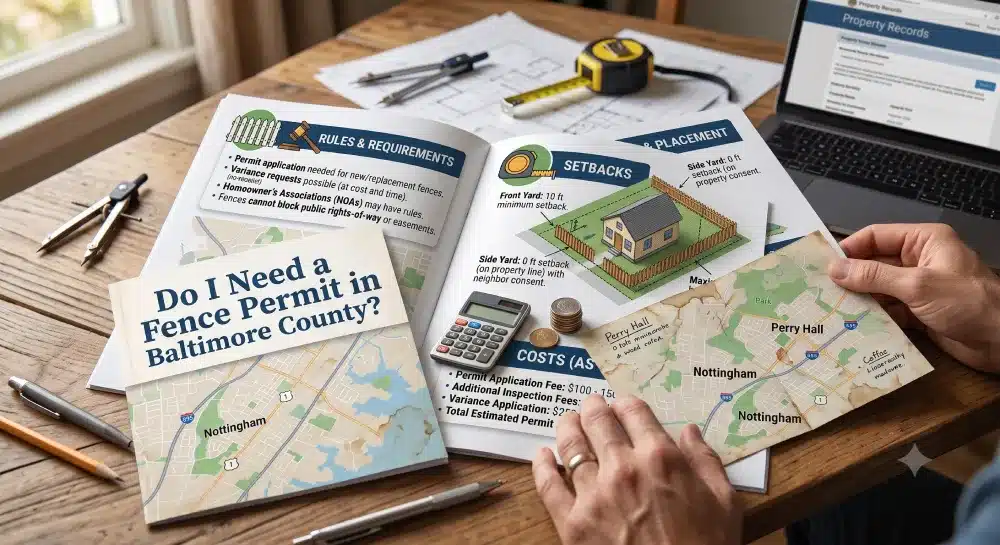
Before You Order That Fence, Baltimore County Has a Few Things to Say About It
The permit rules, height limits, setback requirements, and HOA landmines that catch Perry Hall, Nottingham, Towson, Parkville, Rosedale, and White Marsh homeowners off guard every single summer — explained plainly, from a team that’s installed fences across Baltimore County for decades.
Do I Need a Permit to Install a Fence in Baltimore County — and What Are the Setback Rules in Perry Hall and Nottingham?
Short answer: yes, in most cases you do need a permit to install a fence in Baltimore County. A permit is required for any fence 42 inches (3.5 feet) or taller, plus all fences regardless of height in historic districts, flood zones, and Chesapeake Bay Critical Areas. The setback rules are straightforward — 42 inches max in front yards, 6 feet max in side and rear yards at the property line, and up to 10 feet in side or rear yards if you set the fence back 2 feet from the property line for every foot of height above 6 feet. Perry Hall and Nottingham fall under standard Baltimore County residential zoning rules, though individual neighborhoods with an HOA may have stricter limits layered on top.
The team at Genesis Contracting has been helping Baltimore County families build beautiful, properly permitted fences for decades. We work in Perry Hall, Nottingham, Towson, Parkville, Rosedale, White Marsh — all of it. Every single summer, we get calls from homeowners who already installed a fence before checking the rules, and now they’re dealing with a stop-work order or a neighbor dispute or a code violation notice. We’d rather you read this first.
This guide pulls directly from the official Baltimore County Department of Permits, Approvals and Inspections (PAI) requirements. We’re not guessing at this — we looked it up, the same way you should before starting any project. Let’s walk through everything you need to know near you before a single post hole gets dug.
📋 Key Takeaways — The Most Important Facts Before You Start
- Baltimore County requires a building permit for any fence 42 inches or taller — that covers the vast majority of residential fences
- Front yard fences are capped at 42 inches (3.5 feet) by Baltimore County code — no exceptions for standard residential lots
- Side and rear yard fences can be up to 6 feet tall at the property line, or up to 10 feet with the proper setback
- Corner lots have special rules — no fence higher than 3 feet within 25 feet of a street corner intersection
- Pool fences are always required and must be at least 48 inches tall with a self-closing, self-latching gate
- Fences cannot be built within any easement — utility, drainage, or access — and removal is at the homeowner’s expense
- If your neighborhood has an HOA, its rules layer on top of county rules and may be more restrictive on materials, color, and style
- Always call Miss Utility (811) before digging — hitting a buried utility line is dangerous, expensive, and entirely avoidable
- Fence installation in Baltimore County costs $1,156 to $5,472 based on actual completed project data from the Baltimore area
- Genesis Contracting handles permit applications as part of our process — you don’t have to figure out the paperwork alone
Why So Many Baltimore County Homeowners Skip the Permit — and What Happens Next
Let’s be honest about something. Every summer, a ton of fence installations happen in Perry Hall, Nottingham, Parkville, and Rosedale without a permit ever being pulled. Some of them never get caught. Some of them do. And the ones that do get caught are in a really uncomfortable spot — because Baltimore County can require you to remove a fence that was built without the proper permit, and they don’t help you pay for it.
There’s also the home sale problem. When you go to sell your house, a buyer’s home inspector or the title company may flag an unpermitted structure. Suddenly that fence you installed five years ago for $3,500 becomes a negotiating point on a $400,000 sale. Or you’re scrambling to get a retroactive permit before closing, which isn’t always straightforward.
⚠ We see this more than you’d think: A homeowner in Parkville contacted us because their neighbor built a fence that crossed the property line by about 18 inches. No survey had been done beforehand. No permit had been pulled. The fence had been up for three years. Sorting out that property line dispute ended up involving a surveyor, a lawyer, and a lot of aggravation that a $400 survey at the start would have prevented entirely.
The permit process in Baltimore County isn’t designed to be an obstacle — it’s designed to make sure fences end up in the right place, at the right height, and don’t create safety hazards or block sight lines at street corners. Most residential fence permits are processed without major drama when the application is complete and the proposed fence meets the code requirements.
The Official Baltimore County Fence Permit Rules — Straight From the Source
We pulled these directly from the Baltimore County Department of Permits, Approvals and Inspections. This is not our interpretation — this is the actual county code as published on their official website. The PAI office is located at 111 West Chesapeake Avenue in Towson and can be reached at 410-887-3900.
📋 When Is a Fence Permit Required in Baltimore County?
A building permit is required for:
- Fences 42 inches or taller (measured vertically from the ground — even if the fence sits on top of a wall)
- All fences, regardless of height, that are located in a proposed or designated Baltimore County Historic District
- All fences on the Baltimore County Landmarks List
- All fences located in a floodplain
- All fences located in the Chesapeake Bay Critical Area
Source: Baltimore County Department of Permits, Approvals and Inspections, official fence permit page (baltimorecountymd.gov)
📐 Baltimore County Fence Height Rules — Residential Properties
- Front yard: Maximum 42 inches (3.5 feet) above normal grade
- Side and rear yards at property line: Maximum 6 feet above normal grade
- Side and rear yards with setback: Up to 10 feet, if the fence is set back 2 feet from the property line for every vertical foot above 6 feet (so a 10-foot fence must be 8 feet back from the property line)
- Side or rear yard that adjoins a neighbor’s front yard:
- If setback 0–10 feet from the property line: cannot exceed 42 inches
- If setback more than 10 feet: no height limit (with exceptions noted below)
- Historic district side yards: DR or RC-5 zone in a historic district — maximum 42 inches if the side yard adjoins a public road
Source: Baltimore County Zoning Regulations Section 427.1, Baltimore County Residential Fence Detail document
📐 Corner Lot Fence Rules in Baltimore County
- No fence higher than 3 feet within 25 feet of the corner of two intersecting streets
- No fence higher than 3 feet within 15 feet of a street and alley
- No fence higher than 3 feet within 10 feet of two alleys
Corner lot rules exist for one reason: driver sight lines. A 6-foot privacy fence at a street corner can make it impossible to see cross-traffic. These rules aren’t negotiable. If you own a corner lot in Perry Hall, Rosedale, or anywhere else in Baltimore County, you’ll need to plan your fence layout accordingly before you apply for the permit.
Source: Baltimore County Department of Permits, Approvals and Inspections
🏊 Pool Fence Requirements in Baltimore County
- Fences enclosing in-ground pools must be at least 48 inches tall
- Gates must be self-closing and self-latching
- Pool fences always require a permit — no exceptions
If you’re putting in a pool this summer anywhere in Baltimore County — Towson, White Marsh, Nottingham, anywhere — the fence is not optional. It’s a code requirement and a safety requirement. A 48-inch fence with a properly latching gate is the minimum. We’ve seen homeowners try to get away with shorter decorative fencing around a pool and get flagged at the final inspection. Don’t put that risk on yourself.
Source: Baltimore County Department of Permits, Approvals and Inspections
The Easement Rule — The One That Causes the Most Expensive Surprises Near Me
Here is the rule that catches more Baltimore County homeowners off guard than any other. Read it twice:
“Fences cannot be built within easements, including access, drainage and utility easements. If a fence is erected within an easement and is required to be removed, it is done at the owner’s expense.”
— Baltimore County Department of Permits, Approvals and Inspections
Most Baltimore County residential properties have utility easements running along the rear or side property lines — sometimes 5 feet wide, sometimes 10 feet, sometimes more. These easements give utility companies (BGE, water authorities, etc.) the right to access that corridor to maintain or repair underground lines. If your fence is sitting in that easement, and BGE needs to dig up a gas line, they can require you to remove the fence before they start. And you pay for the removal.
How do you find your easements? Your property survey is the place to start. If you don’t have one — which is common in older neighborhoods in Nottingham and Parkville where the house has changed hands several times — you can request a copy from the Baltimore County land records office, or hire a surveyor to do a current boundary survey. We strongly recommend knowing exactly where your property lines and easements are before you apply for a permit or dig a single hole.
💡 Miss Utility is not optional: Call 811 or visit call811.com at least three business days before any digging. It’s free, it’s required by Maryland law, and it’s the only way to know where underground utilities are buried on your property. A buried electric line or gas line doesn’t announce itself before a post-hole digger hits it.
HOA Rules in Perry Hall, Nottingham, and Towson — Where County Rules End and HOA Rules Begin
Baltimore County’s zoning code sets the floor for what’s allowed. An HOA sets its own rules on top of that, and the HOA rules can be more restrictive than the county code in almost every way — height, materials, colors, styles, even whether a fence is allowed in a certain yard at all.
In many of the newer planned communities and subdivisions throughout Perry Hall, Nottingham, Towson, White Marsh, and Rosedale, HOAs are common. Some neighborhoods require all fence requests to go through an architectural review committee. Others prohibit certain materials outright — chain-link, for example, is restricted or outright banned by many Baltimore County HOAs even though the county code itself doesn’t prohibit it in residential settings.
⚠ The approval sequence matters: Always get HOA architectural approval before you apply for the county permit — not after. Some homeowners get the county permit approved, then find out the HOA won’t allow the fence style they chose, and now they’ve paid permit fees and potentially ordered materials for a fence they can’t legally build in their community. Get HOA sign-off first, then go to the county.
62%
Of U.S. households own pets — one of the biggest drivers of fence installation nationally, and a key reason fenced properties in family-oriented neighborhoods like Perry Hall consistently appeal to a larger buyer pool
Source: Cedar Rustic Fencing, Does a Fence Add Value to a Home (2026)
Finding your HOA’s fence rules usually means digging out your CC&Rs (Covenants, Conditions & Restrictions) — the governing document you received when you bought your home. If you can’t locate it, your HOA management company can provide a current copy. It’s worth an hour of reading before you invest thousands of dollars in a fence project. We’ve seen homeowners in some of the more tightly governed Nottingham and Perry Hall subdivisions get surprised by HOA restrictions that are genuinely stricter than anything the county requires.
Some Baltimore County communities have no HOA at all — particularly older established neighborhoods in Parkville, Rosedale, and parts of Nottingham where homes were built before HOAs became standard. If you’re not sure whether your property falls under an HOA, your title documents from your home purchase will show it clearly.
How to Apply for a Fence Permit in Baltimore County — Step by Step
Baltimore County processes fence permit applications through their online portal at cityworkspro.baltimorecountymd.gov. Here’s what the process looks like:
- Create an account on the Baltimore County online permit portal at cityworkspro.baltimorecountymd.gov if you don’t already have one
- Gather your documents: Residential applications require a site plan (plot plan) showing the fence location on your property. Baltimore County provides a residential plot plan template on their permits page.
- Know your property lines — the site plan must show accurate setbacks from the property line. If you’re not sure where your property line is, this is when you hire a surveyor. A property survey in the Baltimore area costs $400–$900.
- Complete and submit the online application — include fence type, height, location, and setbacks from property lines. Upload your site plan following Baltimore County’s file-naming conventions.
- Pay the permit fee — Baltimore County accepts Mastercard, Visa, and PayPal for online payments. Permit fees for residential fences typically run $90–$470 depending on scope.
- Wait for technical review — staff may leave comments or request revisions. Straightforward residential fence permits are generally processed without major back-and-forth when the application is complete.
- Permit is issued — you’ll be notified by email. Keep the permit and approved plans available at the job site for inspections.
- Schedule any required inspections through the applicant portal after work is complete
💡 Our shortcut for you: When you work with Genesis Contracting on a fence project, we handle the permit application as part of the job. We know what Baltimore County’s permit reviewers look for on residential fence applications, and we’ve submitted enough of these to know how to put together a clean application that doesn’t come back with revision requests. It’s one less thing for you to manage.
What If You Want a Fence Taller Than What the Rules Allow Near You?
Baltimore County has a formal waiver application process for homeowners who want a fence that exceeds the standard height limits. The Zoning Review Office handles these requests — you can contact them at 410-887-3391 or visit Room 124, County Office Building, 111 W. Chesapeake Avenue in Towson.
A waiver application for fence height requires:
- A completed waiver application form (available on the Baltimore County website)
- An aerial map of the requested fence location (available through Baltimore County’s online GIS tool at bcgis.baltimorecountymd.gov)
- Fence type, height, location, and setbacks from property lines clearly specified
- Two photographs of the affected fence location
- A site plan with all of the above
Once submitted, the property gets posted and there’s a 15-day comment period during which neighbors can weigh in. This is the process for things like taller privacy screens adjacent to a pool, fences on lots with unusual grade changes, or other situations where the standard height limits create a genuine hardship.
Honestly? Most homeowners don’t need a waiver. A properly designed 6-foot privacy fence in your side or rear yard handles the vast majority of privacy, security, and pet-containment needs without any waiver process at all.
Best Fence Types for Baltimore County Homes — and What They Actually Cost Near You
Now that you know the rules, let’s talk money. Fence installation costs in the Baltimore area are driven by the same factors that affect everything else in construction: materials, linear footage, site conditions, and the reputation of the crew doing the work. Maryland’s construction labor costs run about 12% above the national average — something the national fence-cost calculators rarely account for.
$2,576–$3,522
Average fence installation cost in the Baltimore area based on 297 actual completed projects, with a total range of $1,156 to $5,472 depending on material, linear footage, and site conditions
Source: Homeyou, Baltimore Fence Installation Costs — actual completed project data through April 2026
| Fence Type | Cost Per Linear Foot (Installed) | Best For | Baltimore County Notes |
|---|---|---|---|
| Wood Privacy | $15–$30 | Backyards, privacy, families with kids/pets | Most popular in Perry Hall & Nottingham; requires periodic sealing/staining in our humid climate |
| Vinyl / PVC | $20–$40 | Low maintenance, long lifespan | Great for Baltimore County’s humidity — never rots, never needs painting. HOAs in some communities specify vinyl only. |
| Aluminum | $25–$40 | Decorative, front yards, pool enclosures | Baltimore average: $4,000–$7,720 total. Resists our coastal humidity better than iron or steel |
| Chain Link | $8–$18 | Utility, pet containment, budget projects | Functional but often restricted by HOAs in newer Baltimore County communities. Verify HOA rules first. |
| Split Rail | $10–$20 | Property boundary definition, decorative | Common in larger lots in rural-adjacent areas. Not a privacy fence — more of a boundary marker. |
| Wrought Iron / Steel | $30–$55 | High-end, decorative, maximum longevity | Requires rust-prevention treatment in Maryland’s humidity. Premium cost for premium look. |
$17–$62
Range per linear foot for fence installation in Maryland in 2026, factoring in the state’s 12% above-average construction cost multiplier — significantly higher than generic national estimates
Source: CostFlowAI Maryland Fence Calculator, 2026, based on BLS labor data
Professional labor in the Baltimore market runs about $56 per hour for skilled trades, according to Bureau of Labor Statistics data. Labor typically represents 40–60% of the total fence installation cost — a bigger percentage on simpler jobs, somewhat less on material-intensive premium fencing. Site conditions matter too: sloped lots in Nottingham and parts of Perry Hall, mature trees with root systems, and compact older lots in Parkville and Rosedale all add labor time.
🏡 A note about our local climate and fence materials: Baltimore County’s summer humidity is genuinely hard on wood. A fence installed without proper pressure-treated lumber and a quality sealant can show significant weathering within a few years. We always use materials rated for our climate — not what looks good on a cost spreadsheet. Ask any contractor you’re considering what lumber grade they use and what their sealing or finishing process is. If they can’t answer clearly, that’s information.
Does a Fence Actually Add Value to Your Baltimore County Home?
The honest answer is: yes, but probably not as much as a fence company’s brochure will tell you. Here’s what the data actually says, sourced from people who don’t have a fence to sell you.
50%
Average ROI for fence installation according to Angi — meaning a $4,000 fence typically adds about $2,000 in resale value. Not a dollar-for-dollar return, but meaningful when combined with the practical and lifestyle benefits
Source: Angi, “How Much Does a Fence Increase Home Value?” (2024)
50–70%
ROI range cited across multiple studies for well-chosen, professionally installed fencing — higher end of the range for quality wood or vinyl privacy fences in family-oriented suburban neighborhoods like Perry Hall and Towson
Source: FastExpert, “Does Installing a Fence Increase Home Value?” (2024)
An independent appraiser’s perspective is worth noting here too. From an appraisal standpoint, a fence in good condition contributes to overall property appeal — especially in neighborhoods where comparable homes have fences and yours doesn’t. The appraisal impact tends to be modest, but the buyer-pool impact can be significant. In family neighborhoods with lots of kids and pets, a fenced yard is often a search filter, not a nice-to-have. A home without one may simply get fewer showings from buyers who have dogs.
$90–$470
Typical permit fee range for a residential fence in Baltimore County — one of the lowest-friction parts of the process when you know what you’re doing going in
Source: Angi, Baltimore fence permit cost data (2025)
Fences Go Well With a Lot of Other Summer Projects Near You
Summer is peak season for outdoor improvement projects, and we hear this all the time from families in Perry Hall, White Marsh, and Towson: they want the fence, and they’re also thinking about a new deck, or a bathroom remodel that’s been on the list for two years, or a kitchen renovation that’s finally in the budget.
We always say: if you’re going to have a contractor on-site for one project, that’s the best time to walk through other things on your list. Getting a deck and a fence done in the same mobilization saves you cost and coordination headaches compared to doing them separately. Our team at Genesis Contracting handles full residential remodeling — kitchens, bathrooms, additions, decks, fencing, roofing — so the conversation about what else you want to get done is always worth having.
Ready to Talk About Your Fence Project in Baltimore County?
We serve Perry Hall, Nottingham, Towson, Parkville, Rosedale, White Marsh, and surrounding communities. We handle the permit paperwork, know the local rules, and have been doing this work here for decades.
Get Your Free Fencing Consultation →
10 Questions Baltimore County Homeowners Ask About Fence Installation — Answered
1. Do I need a permit to install a fence in Baltimore County?
Yes, in most cases. Baltimore County requires a building permit for any fence 42 inches (3.5 feet) or taller. You also need a permit for all fences — regardless of height — if your property is in a historic district, on the Baltimore County Landmarks List, in a floodplain, or in the Chesapeake Bay Critical Area. Pool fences always require a permit. The application is submitted online through the county’s permit portal, and fees typically run $90–$470 for residential projects.
2. What are the fence height rules in Perry Hall and Nottingham, Maryland?
Perry Hall and Nottingham fall under standard Baltimore County residential zoning rules: 42-inch maximum in front yards, 6-foot maximum in side and rear yards at the property line, and up to 10 feet in side or rear yards if the fence is set back 2 feet from the property line for every vertical foot above 6 feet. If either area has an active HOA, the HOA may impose stricter rules on materials, height, or placement. Check your CC&Rs before planning your fence.
3. How much does fence installation cost in Baltimore County in 2026?
Based on actual completed project data from the Baltimore area, fence installation typically runs $1,156 to $5,472, with an average of $2,576–$3,522. Per linear foot, Maryland fence costs range from $17–$62 installed depending on material, with Maryland running about 12% above national average due to labor market costs. More complex sites (slope, mature trees, compact lots), premium materials, and gates all push costs higher. Always get a detailed written estimate, not just a per-linear-foot number.
4. Do I need to survey my property before installing a fence?
We strongly recommend it, especially in older neighborhoods in Nottingham, Parkville, and Rosedale where lot pins may have shifted or been removed over decades of ownership. Building a fence on your neighbor’s property — even by a few inches — can lead to costly legal disputes and forced removal. A residential property survey in the Baltimore area typically costs $400–$900. That investment can prevent a much more expensive problem down the road. The permit application itself requires a site plan showing accurate setbacks from the property line.
5. What happens if I build a fence without a permit in Baltimore County?
Baltimore County can issue a stop-work order, require the fence to be removed, and require proper permitting before it’s reinstalled — all at your expense. An unpermitted fence can also surface as a problem during a home sale, since title searches and home inspections may flag unpermitted structures. In the worst case, a non-compliant fence in the wrong location can trigger a code violation notice from the county. The permit process for a straightforward residential fence is not complicated — it’s much simpler than getting caught without one.
6. Can I install a fence on a corner lot in Baltimore County?
Yes, but corner lots have special height restrictions designed to preserve driver sight lines. Within 25 feet of the corner of two streets, no fence can exceed 3 feet in height. Within 15 feet of a street and alley intersection, the same 3-foot limit applies. Within 10 feet of two alleys, same rule. These limits exist in addition to the standard front-yard and side-yard height rules. Corner lot owners in Towson, Rosedale, and Parkville need to carefully plan fence placement before applying for a permit.
7. Does my HOA have to approve my fence before I apply for the county permit?
Yes — and it matters which order you do it in. Always get HOA architectural review approval before submitting your county permit application. HOA approval is typically faster, and if the HOA requires changes to your fence plan, you want to know that before you’ve filed a county permit application that may need to be amended. Many Baltimore County HOAs require submittal of specific materials, fence styles, and color swatches as part of the architectural review. Give yourself enough lead time — HOA reviews can take 30–60 days in some communities.
8. What’s the best fence material for Maryland’s climate near me?
Maryland’s humid summers and freeze-thaw winters are genuinely hard on materials that aren’t rated for the climate. For low-maintenance longevity, vinyl (PVC) is the best choice — it won’t rot, doesn’t need painting, and handles the humidity without complaint. For a traditional look with good durability, pressure-treated wood with a quality sealant is the most popular choice in Baltimore County suburban neighborhoods. For decorative and semi-open fence styles, aluminum is better than steel or iron in our coastal-adjacent humidity. Whatever you choose, make sure your contractor is using materials specified for the Mid-Atlantic climate, not generic national-spec materials.
9. Can my fence share the property line with my neighbor’s fence?
Generally yes, but it’s worth a conversation with your neighbor before you start. Under Maryland common law, a fence built on a boundary line belongs to both property owners as long as both use it — meaning you share maintenance responsibility. Building next to an existing neighbor fence, rather than on the shared property line, is sometimes easier from a relationship standpoint. Either way, a property survey that confirms exactly where the property line is will prevent the most common source of fence-related neighbor disputes in Baltimore County.
10. How do I find the best fence contractor near me in Perry Hall, Nottingham, or Towson?
Look for a licensed, insured contractor who is familiar with Baltimore County’s specific permit process and local zoning regulations. Ask how they handle the permit application — a quality contractor should pull it as part of the job, not leave it to you. Ask for local references from jobs done in your specific area. Ask what lumber grade or materials they specify for our climate. And ask for a written scope that includes post depth, material specs, hardware quality, and what’s included versus not. Genesis Contracting has been serving Baltimore County for decades — we know the permit process here, we know the neighborhoods, and we’re happy to be one of the contractors you compare.
Helpful Resources for Baltimore County Homeowners Planning a Fence
- Baltimore County Official Fence Permit Page (baltimorecountymd.gov) — the authoritative source for current permit requirements, the online application portal, and all official building guidelines
- FindLaw — Property Line and Fence Laws in Maryland (reviewed June 2025) — legally reviewed overview of Maryland fence law, property line rules, and neighbor dispute basics
- Angi — How Much Does a Fence Increase Home Value? — data-backed analysis of fence ROI by material type and location
- Ergeon — A Guide to Fence Laws in Baltimore (2026) — clear summary of Baltimore County vs. Baltimore City fence height and permit rules
- Call 811 — Miss Utility (Before You Dig) — free utility line marking service required by Maryland law before any digging project
Sources Referenced in This Article:
Baltimore County Department of Permits, Approvals and Inspections, official fence permit page — baltimorecountymd.gov (current) | Baltimore County Zoning Regulations Section 427.1 / Residential Fence Detail document | Baltimore County Fence Waiver Application documents | Homeyou, Baltimore Fence Installation Costs — 297 completed projects through April 2026 | Angi, “How Much Does a Fence Increase Home Value?” (2024) | Angi, “How Much Does Wood Fence Installation Cost in Baltimore, MD?” (2025) | Angi, “How Much Does an Aluminum Fence Cost in Baltimore, MD?” (2026) | FastExpert, “Does Installing a Fence Increase Home Value?” (2024) | CostFlowAI, Maryland Fence Calculator 2026 (BLS data sourced) | Ergeon, “A Guide to Fence Laws in Baltimore, MD” (2026) | FindLaw, “Property Line and Fence Laws in Maryland” (reviewed June 30, 2025) | Cedar Rustic Fencing, “Does a Fence Add Value to a Home” (2026) | Freedom Fence and Home, “Average Cost of Fence Installation 2026” | Redfin, “Does a Fence Add Value?” (2025)
Share this article:
#FencePermitBaltimoreCounty #FenceRulesPerryHall #FenceNottinghamMD #BestFenceContractorNearMe #BaltimoreFencing #FencingTowsonMD #FencingParkvilleMD #FencingRosedaleMD #FencingWhiteMarshMD #GenesisContracting #BaltimorCountyFence #FenceSetbackRules #MarylandFencePermit #BackyardFence #PrivacyFenceMD #HomeImprovementMaryland #FenceCostMaryland #SummerProjects2026 #BestFenceNearMe #MarylandContractor #PerryHallMD #NottinghamMD
Genesis Contracting has served Baltimore County homeowners in Perry Hall, Nottingham, Towson, Parkville, Rosedale, White Marsh, and surrounding communities for decades. We are licensed, insured, and experienced in residential fencing, deck construction, kitchen remodeling, bathroom remodeling, home additions, and roofing. Visit genesiscontracting.biz/ to schedule your free consultation.