
Key Takeaways
- Sealing vs. Zero Maintenance: Engineered quartz is completely non-porous and never requires sealing, whereas natural granite must be resealed every 1 to 2 years to prevent liquid absorption and staining.
- Heat & Scratch Resistance: Granite easily withstands boiling pots and high heat up to 1,200°F without scorching, while quartz resin binders can scorch or discolor if exposed to direct pan heat over 300°F.
- Stain & Germ Barrier: Quartz resists tough kitchen spills—like red wine, coffee, and acidic tomato sauce—better than unsealed natural stone, making it a highly hygienic choice for busy households.
- Cost & Investment Value: Both materials carry similar installed price tags, ranging from $60 to $150+ per square foot depending on slab rarity, edge profile, and labor complexity in Baltimore County.
Which Countertop Material Is Better for Daily Household Wear and Tear?
Direct Answer: Engineered quartz provides superior stain resistance and zero-maintenance durability for active families, while natural granite offers unmatched heat tolerance and scratch resistance. Quartz is made from roughly 90% crushed natural quartz crystal mixed with polymer resins and pigments, creating a non-porous slab that seals out spills naturally. Granite is a 100% natural igneous rock quarried directly from the earth, giving it raw heat resistance but making it susceptible to moisture absorption without regular sealing.
When our field crews sit down over coffee with homeowners in Towson, Perry Hall, or White Marsh, countertops are always at the top of the wishlist. Cooking family dinners, hosting weekend game days, and managing kids’ school projects require a surface that can take a beating without showing wear.
Quartz vs. Granite Performance Matrix
| Performance Feature | Engineered Quartz | Natural Granite |
| Maintenance Requirement | Zero Sealing Required | Reseal 1–2 Years |
| Stain Resistance | Exceptional (Non-porous) | Good (If Sealed) |
| Heat Resistance | Moderate (Needs Trivet) | Extreme (1,200°F+) |
| Scratch Resistance | High | Very High |
| UV Light Stability (Outdoors) | Poor (Resin Fades) | Excellent |
| Bacterial / Mold Barrier | Exceptional | Moderate |
Here is how the two popular surfaces perform under real-world household conditions:
- Stain Resistance: According to material safety data from the National Kitchen & Bath Association (NKBA), non-porous quartz prevents liquids, mold, and bacteria from penetrating below the surface. Granite is naturally porous and will absorb oils, soy sauce, or red wine if the protective surface seal wears off.
- Heat Endurance: Granite handles scorching hot pans pulled straight off the stove. Quartz uses synthetic acrylic resins as a binder; placing a 400°F cast-iron skillet directly on quartz can cause permanent thermal shock cracks or yellow resin scorching.
- Daily Cleaning: Quartz cleans up instantly with plain warm water and mild dish soap. Granite requires gentle pH-neutral cleaners to preserve its protective sealer layer over time.
How Do Quartz and Granite Hold Up Against Maryland’s Humid Summers and Cold Winters?
Direct Answer: Both quartz and granite perform exceptionally well inside climate-controlled Maryland homes, but natural granite is the only option suitable for outdoor kitchens exposed to direct sunlight. Maryland’s severe seasonal shifts—from humid 90°F+ July weather to winter freeze-thaw cycles—do not affect indoor installations. However, UV rays from direct sunlight break down the synthetic resins in indoor quartz, causing noticeable discoloration over time.
Seasonal & Environmental Compatibility
| Application Environment | Engineered Quartz | Natural Granite |
| Indoor Climate-Controlled | Ideal Performance | Ideal Performance |
| Outdoor Kitchens / Sunrooms | Not Recommended (UV Fade) | Ideal Performance |
| Basement Kitchenettes | Excellent (Damp Proof) | Good (Needs Seal) |
Whether our team at Genesis Contracting is remodeling an older ranch in Parkville or updating a spacious home in Nottingham, seasonal conditions play a role in design choices:
- Indoor Sunrooms & Bright Kitchens: Large glass sliders and bright windows in homes across Rosedale or White Marsh let in sweeping sunlight. Natural granite withstands intense solar UV rays without fading, while dark quartz slabs can slowly bleach or shift color in direct sunlight.
- Basement Remodels: For lower-level bar areas or damp-prone basements, quartz offers a non-porous shield against ambient moisture, mold, and mildew.
What Is the Real Cost Comparison Between Quartz and Granite Countertops?
Direct Answer: Quartz and granite fall into similar price tiers, typically ranging between $60 and $150 per square foot installed in Baltimore County. While mid-range quartz and standard granite slabs carry nearly identical baseline pricing, rare granite exotics or high-end marble-look quartz patterns can push total costs toward $200 per square foot.
Average Countertop Cost Breakdown Per Sq. Ft.
| Quality Tier | Engineered Quartz | Natural Granite |
| Entry-Level / Standard Slabs | $60 – $80 / sq. ft. | $55 – $75 / sq. ft. |
| Mid-Tier / Popular Patterns | $80 – $110 / sq. ft. | $75 – $105 / sq. ft. |
| Premium / Exotic / Calacatta | $110 – $160+ / sq. ft. | $110 – $180+ / sq. ft. |
Data from the annual Remodeling Magazine Cost vs. Value Report highlights that kitchen upgrades consistently rank among the top investments for retaining home value in the South Atlantic region. When budgeting for your kitchen transformation, keep these installed cost factors in mind:
- Slab Fabrication & Edge Profiles: Simple square-eased edges cost less to fabricate. Complex bullnose, ogee, or waterfall side panels require extra shop time and precision CNC cutting.
- Cutouts & Undermount Sinks: Precision cutting for undermount stainless steel sinks, cooktop cutouts, and electrical popup outlets adds labor charges regardless of whether you choose quartz or granite.
- Long-Term Maintenance Costs: Quartz requires $0 in ongoing maintenance supplies. Granite requires a $20 to $40 bottle of high-grade penetrating sealer every year or two, plus specialized stone-safe spray cleaners.
How Does the Installation Process Differ Between Quartz and Granite?
Direct Answer: Quartz slabs are manufactured with uniform density and flexibility, making them less prone to hidden hairline fractures during handling than natural granite slabs. Granite requires careful manual inspection before cutting to account for natural fissure lines, weak spots, and grain variations inherent to quarried stone.
Installation & Fabrication Contrasts
| Fabrication Step | Engineered Quartz | Natural Granite |
| Pattern Consistency | 100% Uniform & Predictable | Unique Natural Veins |
| Slab Seam Visibility | Easier to Match & Hide | Varies by Vein Flow |
| Slab Weight | Heavy (~20–25 lbs/sq ft) | Heavy (~18–22 lbs/sq ft) |
| Risk of Fissure Cracking | Very Low | Moderate |
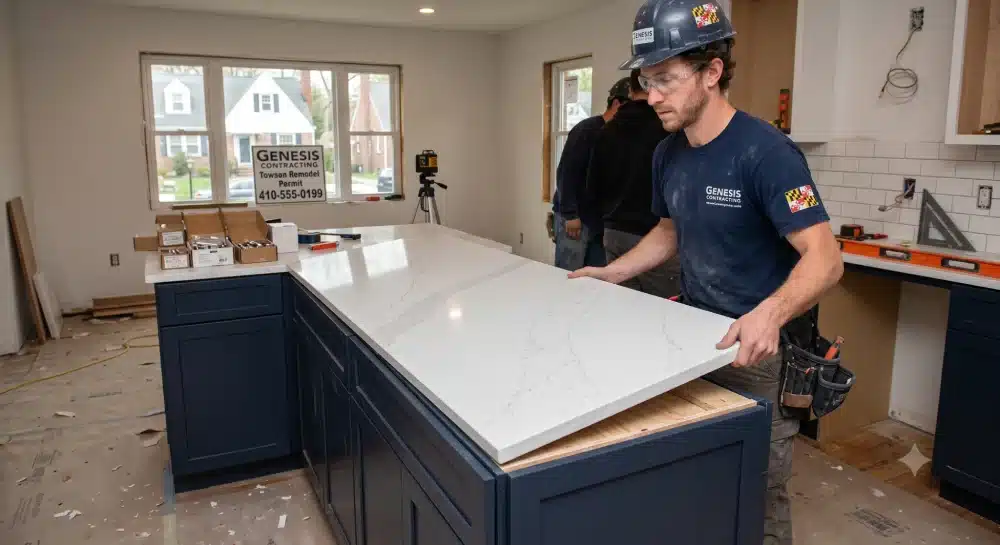
Installing kitchen surfaces properly requires strict adherence to local building codes enforced by local permitting offices. When our crews manage a complete kitchen remodeling project near Nottingham or Towson, we execute every step with precision:
- Cabinet Sub-Structure Verification: Because both materials weigh upwards of 20 pounds per square foot, cabinet boxes must be level to within 1/16th of an inch across the entire run. Uneven cabinets place point stress on stone seams, leading to edge cracks.
- Seam Placement & Matching: Quartz offers predictable, repeatable patterns that allow our master tradespeople to place inconspicuous seams. Granite features unique natural veining, requiring custom layout software to align natural stone swirls seamlessly across sink cutouts.
Which Countertop Offers Better Long-Term ROI for Maryland Homeowners?
Direct Answer: Both quartz and granite deliver high resale value, but quartz currently holds a slight edge in buyer preference due to its low-maintenance appeal. Modern home buyers in submarkets like Towson and Perry Hall prioritize low-maintenance finishes that look brand new without demanding regular sealing or special care.
Home Buyer Preference & Resale Analysis
| Buyer Demographic | Preferred Material | Primary Driver |
| Young Families & Busy Adults | Engineered Quartz | Zero Maintenance |
| Traditional & Luxury Buyers | Exotic Natural Granite | One-of-a-Kind Art |
| Rental & Investment Property | Entry Quartz / Granite | Stain Resistance |
According to consumer research from the National Association of the Remodeling Industry (NARI), durable interior finishes give sellers a competitive advantage during local home inspections and appraisals:
- The Low-Maintenance Craze: Modern buyers favor quartz’s clean aesthetic—especially white marble-look Calacatta patterns—over dark, heavily speckled granite patterns common in the early 2000s.
- The Natural Stone Appeal: High-end homebuyers looking at custom properties still appreciate one-of-a-kind natural granite slabs. No two granite slabs are identical, turning your kitchen island into a natural piece of art.
Frequently Asked Questions About Quartz and Granite Countertops
1. Does quartz stain easily from coffee, red wine, or tomato sauce?
No, high-quality quartz is non-porous and resists stains from coffee, wine, oils, and juices. Spills wipe clean with warm water and mild dish soap without soaking into the surface.
2. How often do I really need to seal granite countertops in Maryland?
Most natural granite countertops require resealing every 12 to 24 months. You can test your seal by dropping water on the stone; if the water darkens the surface within 5 minutes, it is time to reseal.
3. Can I put hot pans directly on a quartz countertop?
No, you should never place hot pots or pans directly onto quartz surfaces. The heat can break down the resin binders, causing permanent discoloration or thermal shock cracks.
4. Is quartz more expensive than granite per square foot?
Quartz and granite cost roughly the same, averaging $60 to $150 per square foot installed in Baltimore County. Basic granite can be slightly cheaper, while rare granite or marble-look quartz sits on the higher end.
5. Which material is more hygienic for preparing food with young kids?
Quartz is extremely hygienic because its non-porous surface leaves no microscopic pores or cracks for bacteria, viruses, or mold to hide in.
6. Do quartz or granite countertops require special sink plumbing setups?
Both materials support undermount sinks, but undermount cutouts require professional fabrication and extra support brackets under the sink base. Our teams manage all plumbing connections and sink supports during bathroom remodeling and kitchen updates.
7. Can quartz countertops be installed in outdoor kitchens?
No, quartz is not recommended for outdoor use because UV light from direct sunlight breaks down the resin binders, leading to fading, yellowing, or cracking. Granite is the better choice outdoors.
8. How do I clean my quartz or granite countertops safely every day?
Clean both surfaces using warm water, a soft microfiber cloth, and mild dish soap. Avoid harsh chemical cleaners, bleach, or abrasive scouring pads that can dull the surface finish.
9. Will heavy kitchen appliances crack a stone or quartz countertop?
Standard counter appliances like mixers, air fryers, and coffee makers will not crack quartz or granite. However, heavy impacts on un supported overhangs can chip or snap edges.
10. How do I verify that my countertop installer is licensed in Maryland?
Always check that your builder holds an active Maryland Home Improvement Commission license through the Maryland Department of Labor search portal. Genesis Contracting operates under MHIC #130227.
Ready to Upgrade Your Kitchen with the Right Countertop?
Choosing between quartz and granite comes down to how your family uses your kitchen every day. Whether you prefer zero-maintenance quartz or the heat-resistant beauty of natural granite, our team at Genesis Contracting is ready to bring your vision to life. From custom home additions to complete kitchen transformations, we manage design, permitting, and precision craftsmanship across Nottingham, Perry Hall, White Marsh, Rosedale, Parkville, and Towson.