
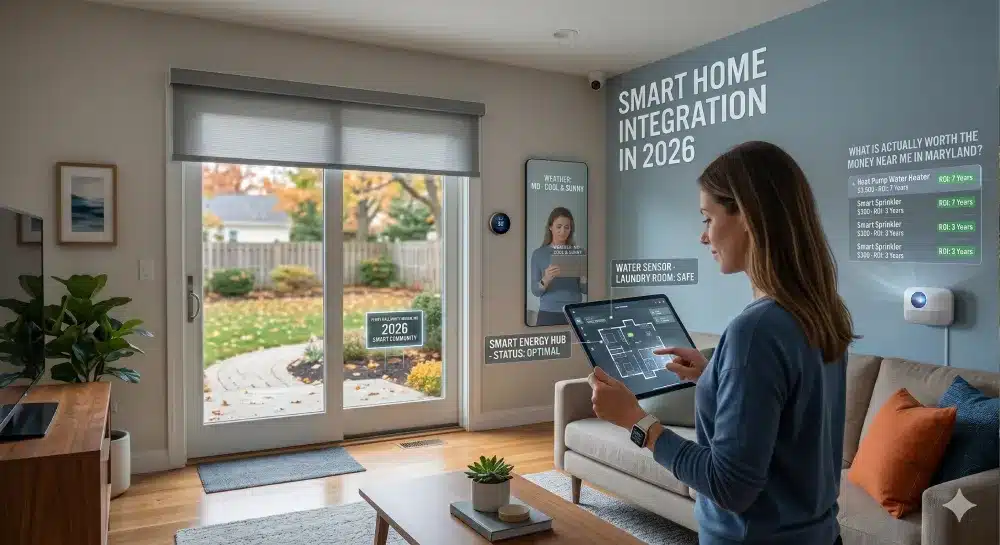
We get asked this all the time during kitchen and bathroom remodels, home additions, and basement buildouts across Perry Hall, Nottingham, and Towson. The honest answer: some smart home features are genuinely excellent investments in 2026. Others are novelties that look impressive in a showroom and collect dust within a year. Here is our unfiltered take based on real projects and real homeowner feedback in Baltimore County.
Key Takeaways: Smart Home Features Worth Investing in Near Me in Maryland
- Smart thermostats have the best payback period of any smart home technology — the EPA-certified Nest and Ecobee models reduce HVAC energy use by 10–23%, saving an average $131–$145 per year. (Source: EnergyStar.gov)
- Smart lighting systems increase home value by an average of $15,000 according to a 2024 survey by the Consumer Electronics Association (CEA).
- Homes with smart security systems sell faster and at better prices in the Mid-Atlantic market — buyers increasingly expect these features.
- The smart home market is projected to reach $338 billion globally by 2030, growing at 25% annually. (Source: Grand View Research)
- Smart home technology that integrates during construction or remodeling costs 30–50% less than retrofitting after the fact — which is why choosing the right features during your Genesis Contracting project matters.
- Genesis Contracting integrates smart home features into kitchen remodels, home additions, basement builds, and bathroom renovations throughout Perry Hall, Nottingham, Towson, White Marsh, Rosedale, and Parkville.
Why Does Smart Home Technology Matter More in a Remodel Than After the Fact?
Here is something most homeowners do not realize until it is too late: roughing in smart home infrastructure during construction is dramatically cheaper than retrofitting it afterward. Running an extra data cable through an open wall costs $40–$80. Running that same cable after the wall is drywalled costs $300–$600 — plus patching and painting.
This is exactly why we talk to every Genesis Contracting client about smart home integration at the start of their project. If you are opening walls for a kitchen remodel in Perry Hall, or framing a new home addition in Nottingham, or finishing a basement in White Marsh — that is the moment to make smart, forward-thinking decisions about infrastructure. You may not put in the technology today, but pre-wiring for it costs very little and keeps your options open.
Smart Thermostats — The Best Starting Point for Any Maryland Home
If you are only going to do one smart home upgrade, make it this one. Smart thermostats — specifically the Google Nest Learning Thermostat and the Ecobee SmartThermostat Premium — have the clearest, most measurable return on investment of any smart home device.
The U.S. Environmental Protection Agency’s Energy Star program has certified that Nest thermostats save an average of $131 per year on HVAC costs. Ecobee’s own third-party-verified data shows average savings of $145 annually. At a retail cost of $130–$250 plus $100–$200 for professional installation, you are looking at a payback period of 1.5 to 3 years for a device that lasts 10+ years. That math is genuinely compelling.
For Maryland homes — where summers are hot and humid and winters are cold enough to run gas heat heavily — the HVAC savings are near the top of the national range. And smart thermostats also have remote control capability, meaning you can adjust your home’s temperature from anywhere before you arrive, which is a quality-of-life improvement that families consistently rate highly. (Source: energystar.gov)
Smart Lighting — The Best Feature for Daily Quality of Life
Smart lighting systems — specifically Lutron Caseta, Philips Hue, or integrated systems from Control4 and Crestron — are one of the features that homeowners rave about most once they have them. And one of the most underestimated at the planning stage.
Here is what smart lighting actually does for a household in Perry Hall or Towson: dimming capability that turns every room from work-mode to relaxation-mode with a single command. Sunrise alarm simulations that wake you with gradually increasing light instead of a jarring buzzer. Automatic outdoor lighting that responds to sunset without a timer reset. Whole-home scene settings that set the right mood for movie night, dinner, or a party without adjusting 12 individual switches.
The Consumer Electronics Association’s 2024 survey found that smart lighting systems increase perceived home value by an average of $15,000 among buyers who prioritize smart home features — a buyer population that is growing rapidly. (Source: ce.org) More practically, LED smart bulbs use 75% less energy than incandescent equivalents. The Department of Energy estimates that switching a full home to LED lighting saves $225 per year on average. (Source: energy.gov)
Smart Security Systems — Table Stakes in 2026
Five years ago, smart security systems were a premium feature. In 2026, buyers in the Perry Hall and Nottingham market expect them. Ring and Nest camera systems are essentially standard equipment in new and renovated homes, and the more sophisticated systems from ADT Command, Vivint, or SimpliSafe are increasingly common in mid-to-upper range homes.
Here is a statistic that does not get enough attention: the Electronic Security Association reports that homes without security systems are 300% more likely to be broken into than homes with visible security systems. (Source: ESA, esaweb.org) In the Baltimore-area suburban market, that risk differential matters.
For our clients at Genesis Contracting, we recommend planning smart security infrastructure — doorbell camera rough-in, floodlight camera positioning, and motion sensor locations — at the start of any exterior remodeling project. It adds minimal cost during construction and ensures the final installation looks intentional, not afterthought.
Smart Appliances in the Kitchen — What Is Worth It?
We covered this briefly in our Kitchen Trends post, but it deserves its own treatment here. The smart appliance category has genuinely bifurcated in 2026: some features are legitimately useful, others are impressive demos that see minimal real-world use.
Worth it: Smart refrigerators with interior cameras
No, we do not mean the full $3,500 premium models. The practical upgrade is a fridge that lets you see inside from your phone at the grocery store. Several mid-tier Samsung and LG models now include this for $200–$400 above the non-camera equivalent. If you are the type of household that forgets what you have and doubles up, this feature genuinely pays for itself.
Worth it: Smart dishwashers with remote start
Running the dishwasher during off-peak electricity hours (typically late night in Maryland’s BGE territory) can reduce energy costs meaningfully. A smart dishwasher that can be scheduled or remotely started is a small but genuine efficiency gain.
Questionable: Smart ovens with voice control
Voice-activating your oven sounds cool. The reality is that you still have to be in the kitchen to put food in and take it out, so the remote start feature has limited practical utility. The diagnostics and maintenance alert features are genuinely useful for commercial-grade units, less so for standard residential ovens.
Skip it for most households: Smart refrigerator touchscreen panels
A $500–$1,500 premium for a touchscreen panel on your refrigerator that displays recipes and has a calendar sync function. These see heavy use for about two weeks and then families use their phones. We have seen too many of these go unused to recommend them as a standard upgrade.
Whole-Home Audio — The Feature Everyone Underestimates
A distributed audio system — speakers in multiple rooms connected to a single controllable source — is one of the most-used smart home features in the homes we have built and renovated in Perry Hall, Nottingham, and Towson. And it is dramatically cheaper to rough in during construction than to add after.
At the entry level, a Sonos or Amazon Echo system provides whole-home audio for $300–$800 with no in-wall wiring required — just power and WiFi. At the mid-level, an in-ceiling speaker system with a central amplifier and whole-home controller like Sonos Amp or Nuvo runs $2,500–$6,000 installed. For most Baltimore County families, the mid-level option is the sweet spot.
Smart Home Integration During Remodeling: Our Recommendations for Maryland Homeowners
Here is our practical priority list for Genesis Contracting clients integrating smart home features during a remodel near Perry Hall, Nottingham, or anywhere in Baltimore County:
- Smart thermostat — do this regardless of anything else. Best ROI, best payback period, most measurable impact.
- Smart lighting — especially during any renovation where switches are being replaced anyway. The incremental cost during a remodel is small.
- Smart security rough-in — plan for camera locations and smart lock connections at the start of any exterior project.
- Pre-wire for whole-home audio — if walls are open, run the cable now for pennies on the dollar.
- Smart appliances — focus on features you will actually use, not features that demo well.
- Smart bathroom features — heated toilet seats and programmable shower controls if budget allows and you are doing a full bathroom renovation anyway.
10 Most Common Questions About Smart Home Integration in Maryland
1. What is the best smart home system for a Maryland home in 2026?
For most households in Perry Hall and Nottingham, Google Home or Amazon Alexa ecosystems offer the best balance of compatibility, ease of use, and third-party device support. For higher-end whole-home systems, Control4 is the gold standard but comes at a premium price point.
2. Does smart home technology increase home value near me in Maryland?
Yes, measurably. Surveys consistently show buyers in competitive markets like Baltimore County expect and value smart home features. Smart lighting systems alone average $15,000 in perceived value according to the CEA.
3. What is the most cost-effective smart home upgrade near Perry Hall?
A smart thermostat — period. The combination of energy savings, payback period, and quality-of-life improvement makes it the best dollar-per-dollar smart home investment available.
4. Can Genesis Contracting integrate smart home features during my kitchen remodel?
Yes. We plan smart home infrastructure into every relevant project — running data cables, planning outlet placement for smart devices, and roughing in speaker wire and security camera positions during construction rather than after.
5. What is the best smart security system for a Perry Hall home?
For self-monitored simplicity, Ring or Nest Cam systems are excellent. For professional monitoring, ADT Command with smart home integration is a strong choice. Vivint is popular for whole-home smart security.
6. Is smart home technology hard to use for older homeowners near me in Maryland?
The best systems in 2026 are dramatically more user-friendly than they were five years ago. Google Nest and Amazon Echo specifically have invested heavily in simplified interfaces. That said, the best approach for any household is to identify the specific features you will actually use rather than buying a system for its capability list.
7. What smart home features are most popular in Baltimore County in 2026?
Smart thermostats, video doorbells, smart locks, and streaming audio systems are the most universally adopted. In higher-end Perry Hall and Towson homes, smart lighting systems and whole-home audio are increasingly common.
8. How much does a whole-home smart system cost near me in Maryland?
Entry-level smart home setup: $500–$2,000 using consumer devices. Mid-range system with professional installation: $5,000–$15,000. High-end custom Control4 or Crestron system: $20,000–$60,000+.
9. Does Genesis Contracting do smart home integration near me in White Marsh and Towson?
Yes. We incorporate smart home features into remodeling and addition projects throughout Perry Hall, Nottingham, White Marsh, Towson, Rosedale, and Parkville. Contact us at genesiscontracting.biz.
10. What is the best smart home investment for energy savings near me in Maryland?
Smart thermostat first, then smart LED lighting second. Combined, these two technologies can reduce a Baltimore County home’s annual energy bill by $300–$500 or more — a return that accumulates every year you are in the home.