
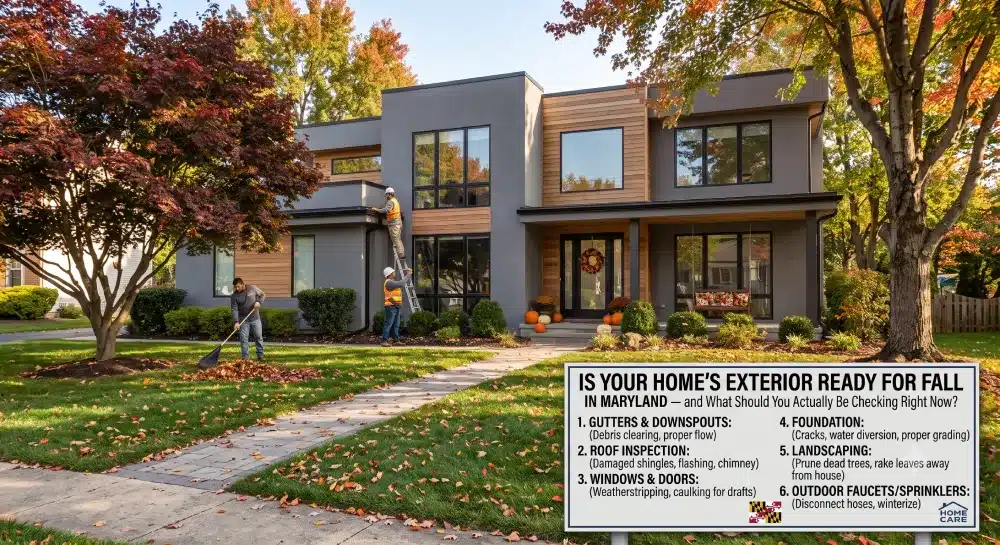
Is Your Home’s Exterior Ready for Fall in Maryland — and What Should You Actually Be Checking Right Now?
The short answer is: probably not as ready as you think. Most Baltimore County homeowners are so used to seeing their house every day that they stop actually looking at it. The paint that started peeling near the garage last summer is still there. The trim board under the second-floor window that feels a little soft — it is softer now than it was a year ago. The caulk around the front door that cracked two winters back has not been touched. None of these feel urgent in July. Every single one of them becomes a much bigger, more expensive problem by November if it does not get addressed before the cold and rain arrive. We are the team at Genesis Contracting, and we have been looking at the outsides of Baltimore County homes in Nottingham, Perry Hall, Towson, White Marsh, Rosedale, and Parkville for years. This checklist is what we actually look for — and July is the best time to do it.
Key Takeaways
- Maryland’s fall weather is the single biggest threat to deferred exterior maintenance. Freeze-thaw cycles in October and November turn small cracks in paint and caulk into large moisture intrusion problems inside your walls. (Source: NOAA, Mid-Atlantic Climate Data)
- The best time to book exterior painting near you in Baltimore County is July or August — fall slots fill by mid-September, and most reputable contractors are fully booked for October work by Labor Day.
- Water is responsible for approximately 90% of all exterior damage to residential structures. Almost all of that starts with a gap, a crack, or a failing seal that costs almost nothing to fix before moisture enters the wall cavity. (Source: National Association of Home Builders, 2022)
- Exterior paint failures account for roughly $3 billion in annual repair costs in the United States — and the majority are preventable with timely inspection and maintenance. (Source: Painting Contractors Association, 2023)
- A properly maintained exterior adds 5–10% to a home’s appraised value compared to a comparable home with deferred maintenance. (Source: Appraisal Institute, 2023)
- The stat most homeowners never hear: Wood rot starts invisible. By the time you can see and feel soft wood, the rot has typically been spreading inside for 12–24 months. Catching trim issues in summer, when you can probe with a screwdriver before rot reaches the sheathing, saves thousands.
- See our Exteriors service page and Painting service page for the full picture of what we handle.
Why Does Summer in Maryland Reveal More Exterior Problems Than Any Other Season Near You?
This is something we have noticed over years of working on Baltimore County homes, and once you understand why it happens, you will look at your house differently.
Summer does a specific kind of damage to exterior surfaces — different from winter, different from spring. Here is the pattern:
Heat causes expansion. Painted wood siding expands and contracts with temperature swings. Baltimore County averages 32 days above 90°F in a typical summer. (Source: NOAA Climate Normals, 1991–2020) That repeated expansion and contraction works caulk loose from window and door frames, causes paint films to crack and separate from the wood beneath them, and opens up small gaps in siding joints that were invisible in March.
Humidity amplifies everything. Maryland’s July relative humidity regularly sits above 74%. Moisture infiltrates every small crack that the heat opened up. Wood that gets wet and stays wet — even briefly, repeatedly — starts the decay process. You cannot see it happening. You will not feel it for months. But it is happening.
UV breaks down paint faster than most people realize. According to the Painting Contractors Association, exterior paint on south- and west-facing walls — which receive the most direct afternoon summer sun — degrades significantly faster than paint on north-facing surfaces. On a Baltimore County home, south and west walls exposed to full summer sun may need repainting a full one to two years sooner than the shaded sides of the same house. Most homeowners do not account for this when they get the “whole house painted” and assume the job is good for another ten years everywhere.
And then fall arrives. The first frost typically hits Baltimore County between October 15 and November 1. (Source: Maryland State Climatologist Office) Any moisture that infiltrated those summer cracks freezes. Water expands by about 9% when it freezes. Cracks become gaps. Gaps become channels. What was a $400 caulk and paint repair in August becomes a $2,500 rot repair in December.
That is why July is the right time to do this checklist. Not because something is on fire right now — but because what is smoldering today becomes expensive by Thanksgiving.
The Maryland Homeowner’s Summer Exterior Checklist — Work Through This One Section at a Time
Do this on a dry day. Bring a screwdriver. Wear sunscreen. Walk the full perimeter of your house twice — once from the sidewalk to look at upper sections, and once close-up to examine trim, caulk joints, and siding seams at eye level.
Section 1: Paint — What Are You Actually Looking At?
Walk every side of the house and look for these specific conditions:
Peeling or bubbling paint. This is almost always a moisture problem, not a paint quality problem. Paint does not peel from dry wood. When you see paint bubbling or lifting, it means moisture is getting into the wood from somewhere — usually from behind (moisture vapor from inside the wall pushing out) or from a failed caulk joint letting water in from the front. The paint failure is the symptom. The moisture source is the problem. Both need to be addressed before repainting, or the new paint will fail in the same spot within a year.
Chalking. Run your hand along the painted surface. If it comes away chalky white, the paint has oxidized past its useful life. This is normal for older paint — it is actually a built-in process that helps exterior paints shed dirt. But heavy chalking means the protective film is depleted and the wood beneath has limited remaining protection. Time to repaint.
Cracking and alligatoring. Paint that has developed a pattern of cracks resembling alligator skin has usually been painted over too many times without proper prep, or it was applied in poor temperature or humidity conditions. Alligatored paint needs to be scraped, not just painted over.
Fading on south and west exposures. Stand back and compare the color on your south-facing wall to your north-facing wall. If they look noticeably different, the sun has done its work. Faded paint is thin paint — it has lost much of its protective pigment and film thickness.
What it costs to address painting now vs. later: A full exterior repaint on a typical Baltimore County home (1,800–2,400 sq ft) runs $4,000–$9,000 professionally done. Waiting until rot damage has occurred under failing paint adds wood repair costs that typically range $500–$3,000+ depending on what is found. The paint job is the same cost either way. The rot repair is entirely avoidable. Visit our Painting page to see how we approach exterior painting the right way.
Section 2: Caulk — The Cheapest Maintenance You Keep Skipping
Caulk is the unsung hero of exterior maintenance, and it is the single most cost-effective thing you can do to protect your home. It costs almost nothing. It lasts three to seven years depending on product quality and exposure. And when it fails — which it does silently, usually starting with a hairline crack along the edge of a window or door frame — water gets into places it absolutely should not be.
Check every window and door frame. Look at the joint where the frame meets the siding. Poke it gently with your screwdriver. Failed caulk often feels solid but has separated from one surface — you can feel the gap when you press. Any crack, gap, or visible separation should be on your list.
Check where siding meets trim boards. Every horizontal joint where two different materials meet is a potential water entry point. On most Baltimore County homes built between 1965 and 1990, these joints were caulked once during construction and never touched again. That caulk is almost certainly failed.
Check around exterior light fixtures, hose bibs, and utility penetrations. Every place a pipe, wire, or fixture punches through your exterior wall needs to be sealed. These spots are easy to miss and frequently ignored for years.
The stat that should get your attention: The Insurance Institute for Business and Home Safety found that water intrusion through improperly sealed penetrations and joints is the leading cause of exterior wall damage in the Mid-Atlantic region, responsible for more structural repair claims than wind or impact damage. (Source: IBHS Residential Exterior Study, 2022)
Recaulking a typical Baltimore County home runs $300–$800 as a standalone project. As part of a paint prep job, it is often included. It is one of the best investments in home protection per dollar that exists.
Section 3: Siding — Look Closer Than You Think You Need To
Most homeowners look at their siding from the driveway and think it looks fine. The problems are almost never visible from the driveway.
Get close and look for these specific issues:
Cracked or split boards (wood siding). End-grain cracks on wood siding — the splits that run with the grain of the board — allow water to wick directly into the wood fiber. These do not self-heal. They get wider.
Buckling or warping (any siding type). Siding that is bowing out away from the wall, or that has a wavy appearance, has usually lost its fasteners, been improperly installed, or has moisture damage behind it. This warrants a closer look.
Gaps at seams and corners. Every siding seam and corner is a potential water entry point. Gaps that have opened up — especially at butt joints where two horizontal boards meet end-to-end — let water run directly behind the siding.
Staining below windows and above doors. Dark staining or efflorescence (white mineral deposits) below windows almost always indicates water is infiltrating the window-siding joint and traveling down the wall inside. The stain is at the exit point — the entry point is higher up.
Fiber cement siding (very common in Baltimore County renovations from the 2000s onward): check the bottom edges. Fiber cement absorbs water from its bottom edge more readily than from the face. Unpainted or poorly maintained bottom edges on fiber cement boards are a known failure point that the manufacturer warranties exclude when bottom edges are not properly primed and painted.
Vinyl siding: look for cracking, fading, and loose panels. Vinyl siding does not rot, but it does become brittle with age, especially on south and west faces with high UV exposure. Cracked vinyl panels let moisture get behind the siding where it can damage the sheathing and house wrap beneath. A single cracked panel costs $50–$150 to replace. Sheathing damage costs $2,000–$8,000.
Our Exteriors team has assessed and repaired every type of siding found in Baltimore County homes. If you are not sure what you are looking at, a professional eye is worth more than any checklist.
Section 4: Trim — This Is Where Rot Hides
Here is the honest truth about trim rot in Baltimore County homes: it is almost always further along than it looks. The visible surface of a trim board can look perfectly painted and solid, while the back face — pressed against the sheathing — is soft and crumbling.
The screwdriver test. Press the tip of a flathead screwdriver firmly into trim boards at every location where you see paint cracking, staining, or any softness. Healthy wood resists penetration. Rotted wood gives way. Pay particular attention to:
- Bottom edges of window sill extensions (they hold water)
- The bottom 12 inches of corner boards (they are closest to soil splash)
- Any trim board above a flat or low-slope section of roof (standing water migration)
- Trim immediately adjacent to gutter end caps — overflowing gutters drench this wood every rain
Fascia boards and soffits. These are the horizontal boards under your roofline and the underside of your roof overhang. Walk the perimeter and look up. Soft fascia, stained soffit, or visible gaps in soffit panels all indicate a moisture problem. If your gutters have been overflowing — a clogged gutter is basically a system for concentrating water against your fascia — the fascia wood is probably compromised.
The number that justifies acting in July: According to the Wood Protection Association, replacing a rotted trim board before the rot spreads to the sheathing behind it costs approximately 6–8 times less than replacing the same board after the sheathing is involved. A single rotted corner board repair: $150–$400. That same corner board after two more seasons: $900–$2,200 once sheathing replacement is factored in. The math is pretty clear.
Section 5: Gutters and Downspouts — The System That Protects Everything Else
We know gutters are not glamorous. But no single system on the outside of your house does more to protect your foundation, siding, fascia, and landscaping than a properly functioning gutter system — and no single system is more commonly neglected.
Check for visible sag. Gutters should pitch slightly toward the downspout. A section that has pulled away from the fascia and is sagging in the middle collects standing water, breeds mosquitoes, and backs up every rain. This is a fastener issue, typically a $75–$200 repair.
Look for joint separations. Sectional aluminum gutters — the most common type in older Baltimore County homes — connect at seams sealed with gutter sealant. That sealant fails over time. A separated joint pours water directly against your fascia with every rain. You will often see a dark stain on the fascia directly below the joint.
Check downspout extensions. Every downspout should terminate at least four to six feet from your foundation and discharge away from the house. Downspouts that dump water at the foundation are one of the leading causes of basement moisture in Baltimore County homes.
A stat almost nobody is publishing: According to the National Association of Home Builders, improperly functioning gutters and downspouts are a contributing factor in approximately 45% of all residential basement water intrusion problems in the Mid-Atlantic region. If you are dealing with a wet basement, look up before you look down.
Section 6: A Quick Look at the Roof From the Ground
We are not suggesting you get on the roof — please do not. But a five-minute ground-level inspection with a pair of binoculars (or the zoom on your phone) can catch things worth noting:
- Missing, lifted, or curled shingles on any section of roof
- Granule loss — look for dark patches where shingles look bare compared to surrounding areas, or heavy granule deposits in your gutters
- Ridge cap shingles that look raised or misaligned
- Any visible daylight between the drip edge and the fascia
- Moss or lichen growth (more common on north-facing and shaded sections)
None of these are automatic emergencies. All of them are worth noting and having a professional evaluate before fall. A small roof repair in August costs a fraction of what emergency repair or interior damage mitigation costs after a heavy October nor’easter gets under a lifted shingle.
Why July Is the Best Month to Book Fall Exterior Work Near You in Baltimore County
We want to be straightforward with you about something that is just the reality of this market: the best contractors in Nottingham, Perry Hall, Towson, White Marsh, Rosedale, and Parkville are fully booked for October exterior work by early September. Every year, without exception.
Homeowners who notice the peeling paint in July and call us in July get on the schedule for August or September — ideal conditions for exterior painting and siding work. Homeowners who notice the same peeling paint in July, think “I’ll deal with that before fall,” and call us in late September hear the same thing every year: we are booked, the best we can do is October or November, and at that point we are racing the weather.
According to the Associated General Contractors of America, contractor backlog in the residential exterior category peaks in September, with average wait times for reputable contractors reaching 6–8 weeks during that window. (Source: AGC Backlog Indicator, 2023) That means a September call is a November or December project — if the weather cooperates.
Here is what late-season exterior work looks like in Maryland: paint applied below 50°F does not cure properly. Most manufacturers void their warranty on applications below that threshold. November lows in Baltimore County regularly dip into the 30s. That is not a window you want to be working in if you can avoid it.
The homeowners who are the happiest with their exterior projects are the ones who did the checklist in July, called us in July, and had beautiful fresh paint and tight, re-caulked siding before the leaves started falling. That is the playbook. We are sharing it with you because it is true, not because it is a sales pitch.
Genesis Contracting — The Best Exterior Contractor Near You in Baltimore County, Maryland
We handle all of it. Siding repair and replacement. Exterior painting, prep and prime done right. Trim repair and replacement before it becomes a structural issue. Gutter repair and installation. Window and door replacement. Fascia and soffit work.
Everything we do on the outside of your house is covered by our full licensing, bonding, and insurance — and we pull every permit that the work requires. No shortcuts, no skipped inspections, no “we’ll figure out the permit later.”
Licensed: MHIC# 130227 | A+ BBB Accredited | Fully Bonded and Insured
Also see what we do for the rest of your home: Decks | General Remodeling | Kitchen Remodeling | Whole-House Renovations
Call us at 443-982-4289 or visit genesiscontracting.biz/contact-us. July is the right time. Do not wait.
External Resources for Exterior Home Maintenance Research
- Painting Contractors Association — Homeowner Resources — Industry authority on exterior paint standards, contractor selection, and maintenance guidance.
- Insurance Institute for Business and Home Safety (IBHS) — Residential Exterior Research — Research-backed data on how exterior envelope failures cause interior damage.
- NOAA Baltimore Climate Data — Real freeze-thaw and precipitation data for Baltimore County to understand what your home faces seasonally.
- Fiber Cement Industry Association — Maintenance Guidelines — Technical specs on caring for fiber cement siding, including bottom edge protection.
- Energy Star — Windows, Doors, and Skylights — Official guidance on energy-efficient exterior upgrades that qualify for federal tax credits.
10 Most Common Questions Homeowners Ask About Exterior Maintenance and Repairs in Maryland
Q1: How do I know if my siding needs to be replaced or just repaired? A: The short answer is: if damage is isolated to a few boards or panels, repair is almost always the right call. If more than 20–25% of the siding shows damage, fading, warping, or moisture issues, full replacement typically makes more financial sense — because you stop paying for repeated repairs and start with a material with a full warranty and known lifespan. We evaluate this on every estimate at no cost to the homeowner.
Q2: How long does exterior paint last in Maryland? A: On properly prepped surfaces using quality products, exterior paint on a Baltimore County home should last 7–10 years on north-facing and shaded surfaces. South- and west-facing walls that take direct summer sun typically hold up 5–7 years before noticeable fading and film breakdown. These numbers assume proper application — meaning appropriate temperature and humidity conditions, proper primer, and no application over failing existing paint.
Q3: What is the best time of year to paint the exterior of my house in Maryland? A: Late spring (May–early June) and early fall (September–October) are the sweet spots in Maryland. Temperatures are mild, humidity is lower than peak summer, and paint cures optimally. Summer painting can be done well with adjusted work schedules (early morning application), but requires more attention to conditions. We never paint in temperatures below 50°F or above 90°F, period.
Q4: How much does exterior painting cost in Baltimore County, MD? A: A full exterior repaint on a typical two-story Baltimore County home (roughly 1,800–2,400 sq ft of paintable surface) runs $4,000–$9,000 professionally done, depending on prep work required, number of stories, and accessibility. Homes with significant peeling or rot repair needed before painting will run higher. We provide detailed written estimates that break out prep and painting costs separately so you understand exactly what you are paying for.
Q5: Can I paint over peeling paint without removing it? A: You can — but it will peel again, often faster than the original failure. Peeling paint needs to be scraped or sanded down to the sound surface before repainting. This is the single most important part of an exterior paint job, and it is also the part that some contractors skip to save time. It is why paint jobs sometimes fail in two years instead of eight. Ask your painter specifically what prep process they use.
Q6: What are the signs that trim needs to be replaced versus just repainted? A: Use the screwdriver test we described in the checklist above. If the screwdriver tip penetrates the wood easily, it needs replacement, not paint. Paint on rotted wood does not restore the wood’s structural integrity — it covers it and delays detection of the worsening damage beneath. Replace it, prime all six faces of the new board before installation, and then paint it. That sequence is the difference between trim that lasts 15 years and trim that rots in four.
Q7: Do gutters need to be replaced or can they be repaired? A: Most gutter issues — sags, separated joints, end cap failures, downspout separations — are repairable for well under $500. If gutters are severely corroded, completely pulling away from the fascia along multiple sections, or are an undersized system for your roof area, replacement makes more sense. We assess gutters as part of every exterior estimate and give you an honest recommendation.
Q8: How do I know if moisture has already gotten behind my siding? A: Common signs from the outside include staining or efflorescence below windows, soft areas in trim boards, paint bubbling from the inside out, and visible gaps at siding seams. From the inside, you may notice musty smells in rooms adjacent to exterior walls, or staining on interior drywall. If you suspect moisture intrusion behind the siding, this warrants a professional assessment sooner rather than later — the longer moisture sits in a wall cavity, the more expensive the repair becomes.
Q9: Are there permits required for siding replacement or exterior painting in Baltimore County? A: Exterior painting does not require permits in Baltimore County. Siding replacement on a structure beyond a certain threshold does require a permit — Baltimore County classifies it as an alteration to the building envelope. Window and door replacements also require permits. Genesis Contracting handles all permitting for every project scope that requires it. We never suggest skipping permits, and we never ask homeowners to pull their own.
Q10: What is the first thing I should do if I find rot in my exterior trim? A: Call a contractor for an assessment as soon as possible — before the next significant rain. Mark the location with tape so you do not lose it. Do not try to fill it with wood filler and paint over it as a permanent fix — exterior wood fillers are appropriate for small, surface-level damage, not for boards where the rot has penetrated through the thickness of the wood. The sooner the rotted board is removed and replaced, the less likely the rot has spread to the sheathing or framing behind it. Early action is always cheaper than deferred action with rot.
Genesis Contracting is a licensed (MHIC# 130227), bonded, and insured exterior contractor serving Nottingham, Perry Hall, Towson, White Marsh, Rosedale, Parkville, and the greater Baltimore County, Maryland area. Call 443-982-4289 or visit genesiscontracting.biz/ to schedule your summer exterior assessment.