
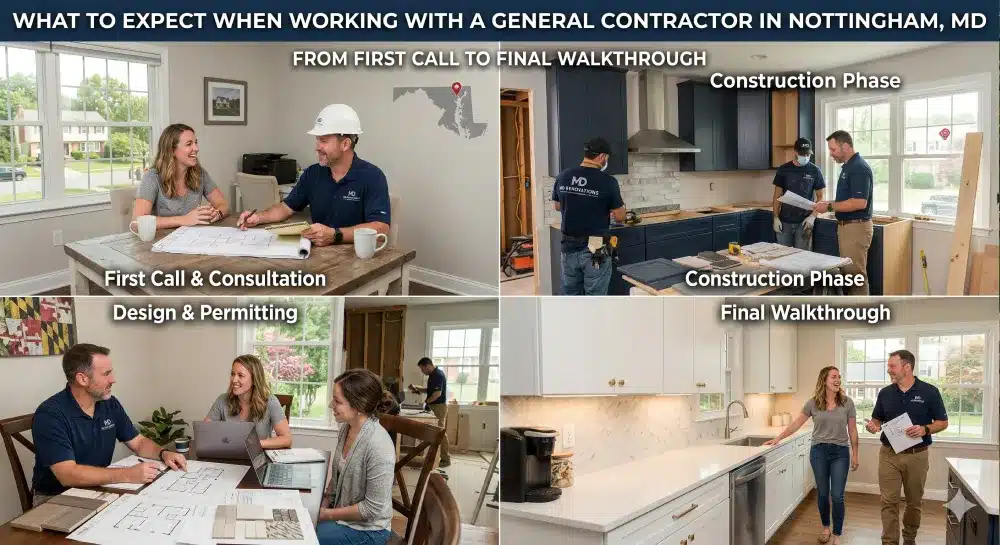
What Should You Expect When Working With a General Contractor in Nottingham, Maryland — From the First Phone Call to the Final Walkthrough?
By the Team at Genesis Contracting & Home Improvements | Serving Nottingham, Perry Hall, White Marsh, Towson & the Greater Baltimore Area
For most homeowners in Nottingham, Perry Hall, and the surrounding Baltimore County communities, hiring a general contractor for a significant home improvement project is not something that happens every year. It is a significant decision — financially, logistically, and in terms of trust. You are inviting a team into your home, handing over a meaningful sum of money, and counting on a contractor to deliver what they promised on the schedule they committed to.
That process should not be mysterious. And the more you understand about how a professional general contractor operates — from the first conversation through the final inspection — the better positioned you are to make a good hiring decision, set realistic expectations, and protect yourself if something goes sideways.
This post walks through the entire client journey at Genesis Contracting & Home Improvements. It is also a practical guide to what every homeowner in Baltimore County should expect from any reputable general contractor — and what the warning signs are when a contractor is not operating the way they should.
We serve Nottingham, Perry Hall, White Marsh, Towson, Rosedale, and Parkville — and we have been doing this for over a decade. Here is exactly what working with us looks like, from start to finish.
Step 1 — Verify the Contractor Before You Call Anyone
Before we get to the process of working with a contractor, let us talk about the step most homeowners skip entirely: verification.
Maryland law requires every home improvement contractor to hold a valid MHIC license — issued by the Maryland Home Improvement Commission (MHIC), a division of the Maryland Department of Labor. Any home improvement work valued at $500 or more requires a licensed contractor. This is not a recommendation — it is a legal requirement, and it is one of the most important consumer protections available to Baltimore County homeowners.
Here is why it matters in practical terms:
The MHIC maintains a Guaranty Fund that compensates homeowners for actual monetary losses — up to $30,000 per homeowner — resulting from poor workmanship or a contractor’s failure to perform. (MHIC Guaranty Fund FAQs, Maryland Department of Labor). This protection only applies when you hire a licensed contractor. Hire an unlicensed contractor and you have no recourse through this fund — regardless of how bad the work is or whether the contractor disappears mid-project.
As the Maryland People’s Law Library notes: “If you hire an unlicensed contractor or a contractor with an expired license, you cannot file a MHIC Guaranty Fund claim.” That protection has real dollar value. Do not give it up to save a small amount upfront.
How to verify a contractor’s MHIC license:
- Ask the contractor for their MHIC license number — a reputable contractor provides this immediately without hesitation
- Verify the license status at the Maryland Department of Labor MHIC lookup — you can search by name, business name, or license number
- Confirm the license is active, not expired, suspended, or revoked
- Check the complaint history — the lookup tool shows disciplinary actions
Additionally, verify:
- General liability insurance — request a current certificate of insurance. This protects your property if something is damaged during the project.
- Workers’ compensation insurance — if a worker is injured on your property and the contractor carries no workers’ comp, you may be exposed to liability.
Genesis Contracting is fully MHIC-licensed, fully insured, and happy to provide documentation of both immediately. Our MHIC license number is verifiable through the Maryland DLLR public lookup.
Step 2 — The Initial Consultation and Site Visit
Once you have verified a contractor’s credentials, the process begins with a consultation. For any significant home improvement project — a kitchen remodel, bathroom renovation, basement finish, deck build, addition, or whole-house renovation — this consultation should happen in person, at your home.
What a professional consultation looks like:
A qualified contractor comes to your home, walks the space with you, listens carefully to what you want, asks clarifying questions about your goals and budget, and gives you honest feedback about what is realistic within your parameters. They take measurements. They assess existing conditions — the structural situation, the mechanical systems, any visible concerns that will affect scope or cost.
What you should pay attention to during the consultation:
- Does the contractor listen, or do they dominate the conversation?
- Do they ask about your budget honestly and engage with it, or do they avoid the topic?
- Do they flag potential concerns they notice — things that might affect the project scope — or do they stay silent about anything that might complicate the sale?
- Do they give you honest timeline expectations, or do they tell you what you want to hear?
A contractor who tells you your kitchen remodel will be done in four weeks when the permit alone takes two and the cabinets take six is either not experienced enough to know better or is telling you what he thinks you want to hear. Neither is good.
At Genesis Contracting, our consultations are free, with no obligation. We tell you honestly what we see — including things that might complicate the project or add cost — because a homeowner who is surprised during construction is an unhappy client, and unhappy clients do not come from honest conversations at the start.
Step 3 — The Proposal and Contract
After the consultation and measurement visit, a professional contractor produces a detailed proposal. This is one of the most important documents in the entire project — and the quality of the proposal tells you a great deal about the contractor.
What a professional proposal includes:
- A detailed, itemized scope of work describing every phase and component of the project
- Material specifications — not just “new cabinets” but the specific cabinet line, door style, and finish
- Labor inclusions and exclusions
- A clear statement of what is NOT included (so there are no surprises about what you will need to handle separately)
- Permit costs
- A payment schedule tied to project milestones
- A project timeline with approximate start and substantial completion dates
- Warranty information
What to watch for — and avoid:
- Lump-sum proposals without itemization — a lump sum number with no breakdown makes it impossible to compare contractors accurately or understand what you are actually getting
- Vague scope language — “kitchen remodel per discussion” is not a scope of work. It is a setup for disputes.
- Unusually low bids — a bid that is 30–40% below others is not a deal. It usually means inferior materials, corners being cut, or a contractor who will come back mid-project asking for more money once you are committed.
- Pressure to sign immediately — legitimate contractors give you time to review a proposal. High-pressure “sign today or lose the price” tactics are a red flag.
Maryland law requirements for the contract itself:
Per MHIC contract regulations, every home improvement contract in Maryland must:
- Be in writing and legible
- Include the contractor’s MHIC license number
- Include a detailed description of work and materials
- State the total contract price
- Include approximate start and completion dates
- Include required MHIC notices about the Guaranty Fund and dispute resolution
- Not require more than one-third of the contract price as a deposit — this is a legal limit in Maryland, not a negotiating point
That last point is critical. Maryland law limits upfront deposits to no more than one-third of the total contract price. A contractor who demands 50% or more upfront is either financially unstable, not familiar with Maryland law, or creating a situation where they hold your money without full accountability. Any of those is a serious concern.
Step 4 — Permitting and Pre-Construction Planning
Once the contract is signed and the project deposit is collected, the work before the work begins.
For any Baltimore County project that involves structural changes, electrical work, plumbing modifications, or mechanical work, our team submits permit applications through Baltimore County’s Department of Permits, Approvals and Inspections (PAI) before any construction begins. We covered Baltimore County’s specific permit requirements in detail in earlier posts in this blog series — for kitchen remodeling, basement finishing, and deck construction.
What happens during the pre-construction phase:
- Permit applications are submitted to Baltimore County PAI (typically 10–15 business days for review)
- Materials are ordered — cabinets, flooring, fixtures, tile, and any long-lead items are placed on order so they arrive when needed
- Subcontractors are scheduled — electricians, plumbers, and other licensed trade specialists are confirmed on the schedule
- A detailed project schedule is prepared and shared with you
- A pre-construction meeting is held to walk through the schedule, discuss dust and access management, and confirm final material selections
One thing we are direct about at this stage: construction cannot begin until permits are in hand. No legitimate contractor should suggest starting work before permits are issued. The permit is the county’s authorization to proceed — working without it exposes you, not just the contractor, to real legal and financial risk.
Step 5 — Construction Phase and What Daily Life Looks Like
This is the phase most homeowners have the most questions about — and the most anxiety around. What does it actually feel like to have a construction crew in your home?
What our team does to minimize disruption:
- We protect existing flooring and finishes with drop cloths and surface protection before any work begins
- Dust containment measures are put in place before demolition — sealed doorways, negative pressure systems where appropriate
- Work areas are cleaned at the end of each work day — you should not be navigating a construction disaster zone every morning
- We establish a regular work schedule and communicate any changes to it proactively
What you should expect as a homeowner:
- Noise — construction is loud. We work normal business hours (typically 7:30 or 8:00 AM to 5:00 or 6:00 PM) and do not schedule work on weekends without discussion. But during working hours, there will be noise.
- Dust — even with containment measures, fine construction dust migrates. Plan for increased cleaning in adjacent rooms during an active project.
- Limited access — the work area will not be accessible during construction. If we are remodeling your kitchen, plan for a temporary kitchen setup (see our earlier post on kitchen remodel timelines).
- Staging materials — materials will be stored somewhere in or near the home. We discuss staging locations at the pre-construction meeting so there are no surprises.
Communication during construction:
This is where many contractor relationships break down — not because of the work itself, but because homeowners feel left in the dark. At Genesis Contracting, you have a direct point of contact throughout the project. We provide regular schedule updates, notify you immediately when inspections are approaching, and communicate any change in scope, timeline, or budget before acting on it — not after.
If you are ever uncertain about what is happening or why, call us. We would rather answer ten questions than have a client feel anxious about their project.
Step 6 — Inspections Throughout the Project
For permitted projects in Baltimore County, inspections are required at specific stages of the work. These are mandatory hold points — construction cannot proceed past each stage until the inspection is passed.
Typical inspection sequence for a major remodel in Baltimore County:
- Rough plumbing inspection — before floors or walls are closed over new plumbing rough-in work
- Rough electrical inspection — before walls are closed over new wiring
- Framing inspection — for structural work, before insulation and drywall
- Insulation inspection — where applicable
- Final trade inspections — electrical final, plumbing final, mechanical final
- Final building inspection — the project’s official completion from a permit standpoint
Our team schedules every inspection through Baltimore County PAI’s portal and manages the inspection sequence so that no phase is inadvertently closed before the required inspection. You do not need to coordinate with the county — we handle it entirely.
Why inspections matter beyond compliance:
Inspections are how you know — with official documentation — that the systems behind your walls were verified by an independent building official as safe and code-compliant. A passed final inspection is not just a bureaucratic checkbox. It is a documented record that protects you at resale, and it is evidence that the work was done properly if any question ever arises about the project.
Step 7 — Punch List and Final Walkthrough
As construction wraps up, we conduct a detailed punch list walkthrough with you — a systematic review of the completed project to identify anything that needs correction before we consider the job done.
What gets reviewed during the punch list walkthrough:
- Every surface, finish, and fixture is examined
- Doors and drawers are opened and tested — we look for anything that binds, gaps unevenly, or does not align properly
- Tile grout lines and caulk joints are inspected
- Paint is reviewed for holidays, drips, or areas needing touch-up
- Fixtures are tested — faucets, lights, outlets, appliances
- Any item that does not meet the standard we agreed on is documented and added to the punch list
How punch list items are resolved:
Everything documented during the walkthrough is addressed before we close out the project. Our standard is simple: the project is not done until every punch list item is resolved and you are satisfied. This is not negotiable — we do not ask for final payment until the work is complete and you have signed off on it.
Final permit closeout:
Once all punch list items are addressed, Baltimore County’s final inspection is completed, and the permit is officially closed out. You receive documentation of the completed permit — this becomes part of your home’s improvement record and is something you will want to retain for future reference and eventual resale.
Step 8 — After the Project — Warranty and Ongoing Relationship
A professional contractor’s relationship with a client does not end when the final check clears. It extends through the warranty period — and ideally beyond.
What our warranty covers:
Genesis Contracting stands behind our workmanship. If something we built or installed fails due to a workmanship issue within the warranty period, we come back and fix it. This is distinct from material warranties — which are handled by the manufacturers and are transferable to you — but our commitment to the work we performed is direct and personal.
What to do if you have a concern after project completion:
Call us. Any legitimate contractor should be reachable after a project is complete, should take post-completion concerns seriously, and should be willing to assess any issues that arise. A contractor who becomes unreachable immediately after receiving final payment is a contractor who was never thinking about a long-term client relationship.
We have been serving Nottingham, Perry Hall, and the surrounding Baltimore County communities for over a decade. The majority of our new project inquiries come from past clients and their referrals. That kind of business only comes from doing the work right — and standing behind it.
Red Flags to Watch for When Hiring Any General Contractor in Maryland
Based on our experience and Maryland’s own consumer guidance, here are the clearest warning signs that a contractor is not operating professionally:
Licensing red flags:
- Cannot provide an MHIC license number without hesitation
- Claims MHIC licensing is not required for your project (it is required for virtually all residential work over $500)
- License is expired, suspended, or revoked when you check the MHIC lookup
Contract and payment red flags:
- Requests more than one-third of the contract price as an upfront deposit (illegal in Maryland per MHIC regulations)
- Refuses to provide a written contract or offers only a vague verbal agreement
- Requires cash payment
- Pressures you to sign immediately or lose the price
- Provides a quote that is 30–40% below every other estimate
Insurance red flags:
- Cannot produce a current certificate of general liability insurance
- Has no workers’ compensation coverage for their crew
- Becomes defensive or evasive when asked for insurance documentation
Communication and conduct red flags:
- Does not take measurements during the consultation
- Provides a scope-of-work that says “per discussion” rather than specifying materials and work
- Cannot clearly explain what permits will be required for your project
- Suggests skipping permits “to save time or money”
- Becomes unreachable between the contract signing and the start date
The BuildZoom guidance from Maryland notes that the Maryland Home Improvement Commission recommends getting at least three written bids before hiring — and specifically warns against automatically accepting the lowest bid, which often signals inferior materials or a plan to increase costs mid-project.
Why Baltimore County Homeowners Choose Genesis Contracting
At Genesis Contracting & Home Improvements, we have been serving homeowners in Nottingham, Perry Hall, White Marsh, Towson, Rosedale, Parkville, and the greater Baltimore area for over a decade. Here is what that means in practice:
We are fully MHIC-licensed and fully insured. Our license number is verifiable through the Maryland Department of Labor. We carry general liability and workers’ compensation insurance on every project.
We pull every required permit. No exceptions, no suggestions to skip the process. Every project is permitted, inspected, and documented through Baltimore County PAI.
We provide detailed, itemized proposals. You know exactly what you are getting and what it costs before you sign anything.
We follow Maryland’s deposit rules. Our deposits do not exceed one-third of the contract price. We do not ask for payment until work milestones are completed.
We communicate throughout. You always have a direct contact, receive regular updates, and hear about any issues from us before they become surprises.
We stand behind our work. Our craftsmanship warranty means that if something we built fails due to our workmanship, we come back and make it right.
Our full range of services includes kitchen remodeling, bathroom remodeling, basement finishing, home additions, deck construction, whole-house renovations, exterior work, flooring, painting, fencing, and investor-friendly contractor services.
View completed projects in our project gallery and read what our clients say on our testimonials page.
Contact us today for a free in-home consultation and estimate. Call us at (443) 982-4289. There is no cost and no obligation — just an honest conversation about your project.
Frequently Asked Questions — Hiring a General Contractor in Baltimore County
Q1: What is an MHIC license and why does it matter when hiring a contractor in Maryland? The MHIC license is issued by the Maryland Home Improvement Commission and is legally required for any contractor performing residential home improvement work valued over $500 in Maryland. Beyond legal compliance, it matters because it connects you to the MHIC’s Guaranty Fund — which can compensate homeowners up to $30,000 for actual losses caused by a licensed contractor’s poor workmanship or failure to perform. If you hire an unlicensed contractor, that protection does not exist. Always verify a contractor’s MHIC license at the Maryland Department of Labor’s public lookup before signing any contract.
Q2: How much can a contractor require as a deposit in Maryland? Maryland law, administered through the MHIC, limits upfront deposits to no more than one-third of the total contract price. This is a legal ceiling, not a starting point for negotiation. A contractor who requires 50% or more upfront is violating Maryland law and creating a financial situation where they hold a disproportionate share of your money before doing a proportionate share of the work. This is one of the clearest contractor red flags in the state. Genesis Contracting strictly adheres to the one-third maximum.
Q3: Do I need to get multiple estimates before hiring a contractor in Baltimore County? The Maryland Home Improvement Commission recommends getting at least three written bids before hiring for any significant project. This is sound advice for two reasons: it gives you market context for what fair pricing looks like, and it helps you evaluate how thoroughly different contractors have thought through your project. A dramatically low bid is almost always a red flag — not a deal. Compare itemized proposals, not just total numbers.
Q4: What permits are required for home remodeling projects in Baltimore County? It depends on the scope of work. Any project involving structural changes, electrical work, plumbing modifications, or mechanical systems requires permits from Baltimore County’s Department of Permits, Approvals and Inspections (PAI). Purely cosmetic work — painting, hardware replacement, flooring on an existing surface — typically does not. Genesis Contracting handles all required permits for every project we build. We have covered specific permit requirements in depth throughout this blog series for kitchens, basements, and decks.
Q5: What should a home improvement contract in Maryland include? Per MHIC contract regulations, every Maryland home improvement contract must be in writing, include the contractor’s MHIC license number, describe the work and materials in detail, state the total contract price, include approximate start and completion dates, and contain required MHIC notices about the Guaranty Fund and dispute resolution. Beyond the legal requirements, a professional contract should include an itemized scope of work, payment schedule tied to milestones, warranty terms, and clear exclusions. Vague contracts protect no one — insist on specifics in writing before signing anything.
Q6: What should I do if a contractor asks me to pay cash or skip permits? Both are serious red flags. Cash payments make it extremely difficult to document what you paid and eliminate a paper trail if disputes arise. A request to skip required permits almost always means the contractor does not want the work inspected — which raises an obvious question about why. Unpermitted work can result in stop-work orders, forced demolition of completed work, insurance claim denials, and serious complications when you sell your home. Maryland law requires permits for most home improvement work of any significance. Any contractor suggesting you skip them is not operating professionally.
Q7: How do I know if a contractor is properly insured in Maryland? Ask for a current certificate of insurance before signing any contract. The certificate should show general liability insurance (typically $1 million per occurrence minimum) and workers’ compensation insurance for employees. Call the issuing insurance company to verify the certificate is current and active — certificates can be forged or represent cancelled policies. A contractor who becomes evasive when asked for insurance documentation should not be hired. Genesis Contracting carries full general liability and workers’ compensation insurance and provides documentation immediately upon request.
Q8: What recourse do I have if a contractor does poor work in Maryland? If your contractor is MHIC-licensed, you have several options: file a complaint with the MHIC, which investigates and can impose penalties; file a claim with the MHIC Guaranty Fund for compensation up to $30,000 for actual losses; or pursue the contractor civilly in court for breach of contract. If your contractor is unlicensed, your recourse is limited to civil court with no Guaranty Fund protection. This is why verifying MHIC licensing before signing any contract is so important — it is the foundation of all your consumer protections as a Maryland homeowner.
Q9: How long does a typical home remodeling project take in Baltimore County? It depends entirely on scope. We covered kitchen remodel timelines in Blog Post #8 and bathroom project timelines in Blog Post #5 in this series. As a general framework: cosmetic updates typically run 3–8 weeks total; mid-range remodels involving permits and trade work run 3–5 months from first call to completion; full gut renovations with custom materials run 5–8 months. Permit processing in Baltimore County typically takes 10–15 business days for complete applications, and material lead times — particularly custom cabinetry — add significantly to pre-construction timelines.
Q10: What areas does Genesis Contracting serve in Baltimore County? We serve homeowners and real estate investors throughout Baltimore County — including Nottingham, Perry Hall, White Marsh, Towson, Rosedale, Parkville, and the greater Baltimore area. Our services include kitchen remodeling, bathroom remodeling, basement finishing, home additions, deck construction, whole-house renovations, exterior work, flooring, painting, fencing, and investor-friendly contractor services. Contact us here or call (443) 982-4289 for a free in-home estimate.
Genesis Contracting & Home Improvements — Proudly Serving the Greater Baltimore Area Nottingham | Perry Hall | White Marsh | Towson | Parkville | Rosedale | Baltimore County (443) 982-4289 | genesiscontracting.biz