
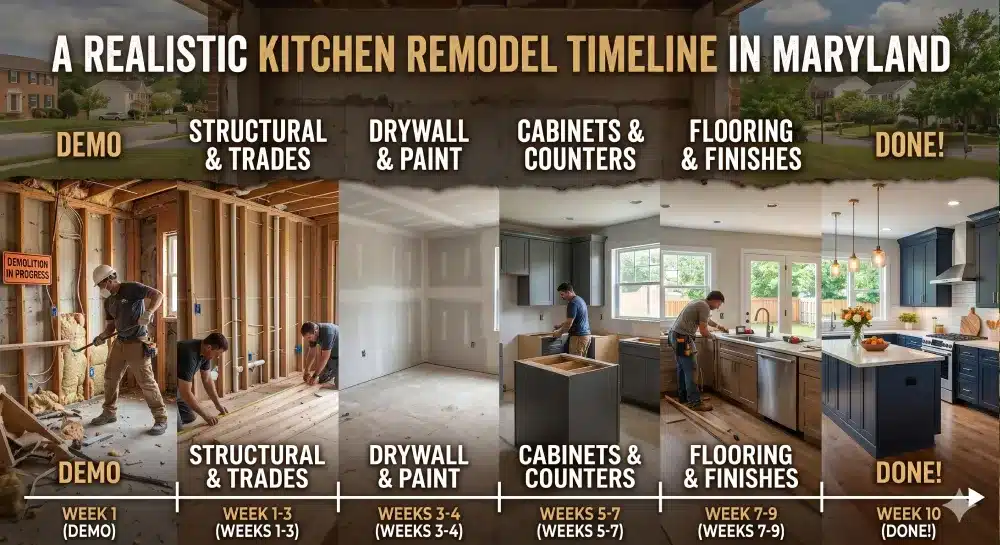
How Long Does a Kitchen Remodel Take in Maryland — and What Does Each Phase of the Process Actually Look Like?
By the Team at Genesis Contracting & Home Improvements | Serving Nottingham, Perry Hall, White Marsh, Towson & the Greater Baltimore Area
This is the question every homeowner asks within the first five minutes of a kitchen remodel consultation. How long is my kitchen going to be out of commission? How long am I going to be living off a microwave and takeout?
The honest answer is: it depends on what you are doing. And most of the answers you will find online significantly underestimate the total timeline by leaving out the planning, permitting, and material procurement phases — which together often take longer than the actual construction.
Here is the real number for Baltimore County homeowners: a mid-range kitchen remodel in Maryland takes between 3 and 5 months from your first contractor conversation to a finished kitchen you can cook in. The construction phase itself — from demolition to final walkthrough — typically runs 6–12 weeks depending on scope. (Cornerstone Remodeling, 2025) But that 6–12 weeks does not start until after design is finalized, materials are ordered and received, and permits are approved — all of which take time.
For a full gut renovation with layout changes, wall removal, and custom cabinetry, the total timeline from first call to cooking in your new kitchen frequently runs 4–6 months or longer. That is not a contractor being slow. That is the reality of a comprehensive kitchen remodel executed properly in Baltimore County.
At Genesis Contracting & Home Improvements, we handle kitchen remodeling throughout Nottingham, Perry Hall, White Marsh, Towson, Rosedale, and Parkville. We give every homeowner an honest timeline at the start — not a best-case-scenario number, but a realistic schedule that accounts for permits, material lead times, inspection sequences, and the specific complexity of their project.
This post walks you through every phase in detail, tells you how long each one realistically takes in Baltimore County, and explains what the most common causes of delay are — and how to avoid them.
The Complete Kitchen Remodel Timeline at a Glance
Before we break down each phase, here is the full timeline picture for the most common remodel types in Baltimore County:
| Remodel Type | Planning + Permits + Materials | Construction | Total Timeline |
| Cosmetic refresh (cabinets, counters, paint — no layout changes) | 3–5 weeks | 2–4 weeks | 5–9 weeks |
| Mid-range remodel (new cabinets, counters, flooring, trade work) | 6–10 weeks | 6–8 weeks | 12–18 weeks (3–4.5 months) |
| Full gut remodel (layout changes, wall removal, full systems) | 8–14 weeks | 8–12 weeks | 16–26 weeks (4–6 months) |
| Full gut with custom cabinetry | 12–20 weeks | 10–14 weeks | 22–34 weeks (5–8 months) |
The construction phase gets most of the attention — and we will cover it in detail. But the pre-construction phase is where most timeline surprises live. Homeowners who understand both halves of the process are far less likely to feel blindsided by the overall duration.
Phase 1 — Planning, Design, and Material Selection (3–8 Weeks)
This is the phase most homeowners underestimate most severely. And it is the phase where the most important decisions get made.
What happens during planning and design:
- Initial consultation and site measurement
- Layout discussion and design development
- Material selections: cabinetry, countertops, backsplash, flooring, fixtures, lighting, appliances
- Finalization of scope of work and detailed proposal
- Contract execution
Why it takes longer than people expect:
Cabinet lead times are the biggest planning-phase variable. Here is the breakdown by cabinet type:
- Stock cabinets (available off the shelf at home improvement stores): 1–2 weeks delivery
- Semi-custom cabinets (factory-built with some customization options): 4–6 weeks from order to delivery
- Custom cabinets (built to your specific dimensions and design): 8–14 weeks from order to delivery
This single variable can extend your overall timeline by weeks before a single tool is picked up. Homeowners who select custom cabinetry in March should not expect their kitchen to be done by May — the cabinets alone will not arrive until June or later.
Countertop lead times add another timing consideration. Stone countertops (quartz, granite, marble) require a template to be taken after cabinets are installed, followed by fabrication, which typically adds 2–3 weeks from cabinet completion to countertop installation. The countertop cannot be templated until the cabinets are in, and the cabinets cannot go in until rough-in work is done and inspected.
The single most important advice for this phase: Make every material selection before demolition begins. Lock in your cabinetry, countertop, flooring, tile, fixtures, and appliances before the first wall is touched. Changing your countertop selection after cabinet installation can delay the project by 1–3 weeks — and mid-project changes are among the most common causes of timeline overruns. The planning phase is the time to change your mind, not the construction phase.
Phase 2 — Permitting in Baltimore County (10–15 Business Days After Submission)
Once scope and design are finalized, permit applications can be submitted. For any kitchen remodel in Baltimore County that involves electrical work, plumbing changes, or structural modifications — which includes the vast majority of meaningful kitchen remodels — permits are required.
As we covered in detail in our blog post on kitchen remodel permits in Baltimore County, here is the Baltimore County permitting reality:
What typically triggers permits:
- Any new electrical circuits, outlets, or panel work
- Any plumbing relocation, addition, or modification
- Any structural changes — wall removal, new openings, beam installation
- Creation of a new kitchen in a space that was not previously a kitchen
Permit processing timeline in Baltimore County: For complete, code-compliant applications, Baltimore County’s Department of Permits, Approvals and Inspections (PAI) typically processes residential permits in 10–15 business days — roughly 2–3 weeks. Applications that require revisions or corrections take longer. This is why we submit permit applications during the planning phase, overlapping with material procurement time, rather than waiting until everything else is ready.
The permitting-material overlap strategy:
Smart contractors submit permit applications and place material orders simultaneously. Cabinet lead time (4–6 weeks for semi-custom) overlaps almost exactly with permit processing (2–3 weeks). If both happen concurrently, neither one creates net additional delay. If permit submission is deferred until after design is finalized and materials are ordered, it adds 2–3 weeks of dead time to the schedule where nothing can move forward.
At Genesis Contracting, we manage permitting concurrently with material procurement to avoid this unnecessary delay. We are fully MHIC-licensed and handle every permit application through Baltimore County PAI’s online portal.
Phase 3 — Demolition (2–5 Days)
Once permits are in hand and materials are ordered (and confirmed to be on track for delivery), demolition begins. This is the phase that gets the most dramatic coverage on renovation TV shows — and it really does move quickly.
What happens during demolition:
- Existing cabinets are removed (carefully if you are donating or reusing)
- Countertops are removed
- Appliances are disconnected and removed
- Flooring is removed (timing depends on your flooring type — more on this below)
- Existing backsplash tile is removed
- If wall removal is part of your project, structural demo begins here
- Hidden conditions are revealed — water damage, outdated wiring, old galvanized plumbing
What demo reveals in older Baltimore County homes:
This is the phase where surprises live. Homes in Nottingham, Perry Hall, and White Marsh built in the 1960s–1980s frequently have conditions behind the walls that were invisible before demo: outdated galvanized plumbing, undersized electrical panels, mold from a slow leak that was never noticed, or structural conditions that affect your layout plan. These discoveries are not contractor failures — they are the reality of remodeling older housing stock.
When our team encounters unexpected conditions during demo, we stop, document, photograph, and present you with options and associated costs before proceeding. This is the right approach — but it can add days to the schedule when significant conditions are found. The 10–15% contingency budget we recommend for every Baltimore County kitchen remodel is partly for this reason.
Timeline: Most demolition completes in 2–5 days depending on kitchen size and scope. Wall removal that requires structural beam installation takes longer.
Phase 4 — Rough-In Work (1–3 Weeks)
After demo, the behind-the-walls work begins. This is the phase homeowners see the least but that is absolutely foundational to everything that comes after. It is also the phase with the most mandatory inspection hold points.
What rough-in work includes:
Plumbing rough-in (if applicable):
- Relocating supply lines to the new sink position
- Relocating drain lines for new fixture positions
- Adding supply and drain lines for a dishwasher, pot filler, or additional fixture
- Any connection to an island
Electrical rough-in:
- New circuits for appliances (dedicated circuits for refrigerator, dishwasher, microwave, range)
- Under-cabinet lighting circuits
- Island outlets
- Panel upgrade if required
- GFCI outlet installation per current Maryland code
Structural work (if applicable):
- Beam installation for wall removal (this requires a structural engineer’s specification in Baltimore County and is one of the most time-variable phases)
- New framing for modified openings
Inspections — the mandatory hold points:
Baltimore County requires inspections of rough-in work before walls can be closed. This is not bureaucratic delay — it is how the county verifies that the systems behind your walls are safely installed before they are hidden permanently.
Required rough-in inspections typically include:
- Rough plumbing inspection (must pass before floor is closed)
- Rough electrical inspection (must pass before drywall goes up)
- Structural/framing inspection if applicable
Each inspection requires scheduling through Baltimore County PAI’s permit portal, and inspection availability depends on the county’s current scheduling queue. Our team manages this scheduling proactively to minimize wait time between completing rough work and receiving the inspection.
Timeline: Rough-in work typically takes 1–2 weeks for a standard kitchen with plumbing and electrical modifications. More complex scopes — significant panel upgrades, extensive plumbing reconfiguration, structural beam work — can push this to 3 weeks or longer.
Phase 5 — Drywall, Insulation, and Priming (3–7 Days)
Once all rough-in inspections are passed, walls are closed. This phase is typically brief but must not be rushed — drywall finishing (taping, mudding, sanding) requires drying time between coats that cannot be accelerated.
What happens in this phase:
- New drywall is hung where walls were opened
- Taping and joint compound application (requires 2–3 coats with drying time between each)
- Sanding
- Priming — typically done before cabinets go in for cleaner results
Timeline: 3–7 days depending on the extent of drywall work. Kitchens with significant wall removal require more drywall than a standard remodel. Drying time between mud coats is climate-dependent — Baltimore County’s humidity can slow drying in summer months.
Phase 6 — Flooring (2–4 Days)
Flooring timing relative to cabinet installation is a decision that varies by project. Some flooring types go in before cabinets — particularly when a continuous floor surface is desired that runs under the toe kicks. Other approaches install flooring after cabinets to reduce material waste and simplify installation around cabinet footprints.
Our team makes this decision based on the specific flooring material and your project’s configuration and discusses it with you during planning.
Common flooring timelines in Baltimore County kitchens:
- Luxury vinyl plank (LVP): 1–2 days for a typical kitchen
- Tile (ceramic or porcelain): 2–4 days for installation plus drying/curing time
- Hardwood or engineered hardwood: 2–3 days installation plus potential acclimation time
Timeline: 2–4 days for most Baltimore County kitchen flooring installations.
Phase 7 — Cabinet Installation (3–5 Days)
This is when your kitchen starts looking like a kitchen again. Cabinet installation is one of the most skill-dependent phases of a remodel — getting cabinets perfectly level and plumb in a room that is almost certainly not perfectly square requires patience and expertise.
What cabinet installation involves:
- Base cabinets installed first, leveled and anchored to wall studs
- Wall cabinets next, secured to studs at the correct height
- Any pantry or tall cabinets
- Cabinet doors hung and adjusted
- Any interior cabinet accessories (pull-out shelves, lazy Susans, drawer organizers)
Timeline: Cabinet installation for a standard kitchen runs 3–5 days for experienced installers. Larger kitchens, complex configurations, or extensive custom cabinetry can run longer.
Important note on countertop sequencing: Countertops cannot be templated until cabinet installation is complete and the cabinets are fully set. The templating appointment (measuring for the exact dimensions of the installed cabinets) is scheduled after cabinet completion, followed by fabrication, which adds 2–3 weeks from cabinet completion to countertop installation. This sequence is unavoidable with stone countertops — the template must reflect the actual installed cabinets, not the planned dimensions.
Phase 8 — Countertops, Backsplash, and Appliances (2–4 Weeks)
These three installations happen in sequence after cabinet completion. Countertops come first, backsplash follows, then appliances are set and connected.
Countertop sequence:
- Templating appointment after cabinets are set (1–2 days after cabinet completion)
- Fabrication at the stone yard (typically 1–2 weeks)
- Delivery and installation (1 day, typically)
Backsplash: Standard tile backsplash installation takes 2–3 days after countertops are in. More complex patterns — herringbone, custom mosaic, large-format subway tile with tight joints — can take 3–5 days plus grouting time.
Appliances: Built-in appliances (range, refrigerator, dishwasher) are set and connected after countertops are in. Final connections for gas ranges and dishwashers require the licensed plumber to complete the hookup. This phase typically runs 1–2 days.
Phase 9 — Finishing Touches, Final Inspections, and Punch List (1–2 Weeks)
The final phase brings all the details together — and it is the phase that takes longer than homeowners typically expect because of the sheer number of small items that constitute “done.”
What the finishing phase covers:
- Hardware installation (cabinet pulls, drawer handles)
- Lighting installation and connection
- Plumbing fixture final connection (sink, faucet, garbage disposal)
- Backsplash caulking and grout sealing
- Touch-up painting and trim work
- Final appliance installation and testing
Final inspections: Baltimore County requires final inspections for all permitted trades. Electrical final, plumbing final, and building final inspections must all pass before the project is officially complete from a permit standpoint. Our team coordinates these inspections and addresses any items raised before final permit closeout.
The punch list: After final inspections, we walk through the completed kitchen with you and document anything that needs adjustment — a drawer that binds slightly, a tile edge that needs additional caulking, a light fixture that needs to be leveled. Punch list completion typically runs 2–5 days.
Timeline: The full finishing phase runs 1–2 weeks from final countertop and appliance installation through final inspections, punch list completion, and permit closeout.
What Causes Kitchen Remodel Delays — and How to Avoid Them
Based on our experience with Baltimore County kitchen remodels, these are the most common causes of timeline overruns:
- Late material selections The single most controllable delay source. Every material selection that is not finalized before construction begins is a potential delay. Countertop changes after cabinet installation. Flooring selections that are back-ordered. Appliances that ship in 8 weeks instead of 4. Lock everything in before demo day.
- Custom cabinetry lead times Custom cabinets can take 8–14 weeks from order to delivery. Homeowners who do not account for this during planning find themselves waiting for their cabinets to arrive after everything else is ready. Order early — ideally as soon as the design is finalized.
- Permit revisions Permit applications that come back with requests for corrections or additional information from Baltimore County PAI add 1–3 weeks to the pre-construction phase. Complete, code-compliant submissions avoid this. Our team’s familiarity with Baltimore County’s requirements means our applications rarely require revision.
- Hidden conditions discovered during demolition Water damage, outdated wiring, mold, and structural surprises add time and budget. These are not avoidable — they are the nature of remodeling older homes. The mitigation is having a contingency budget (10–15%) and a contractor who communicates immediately and presents options without pressure.
- Inspection scheduling delays Required inspections can only happen when the county’s inspection queue allows. During busy seasons — spring and fall in Baltimore County — inspection scheduling can run 3–5 business days from request to visit. Our team factors this into scheduling and requests inspections as soon as the preceding phase is complete.
- Scope changes during construction Every mid-project change adds time. Changing countertop material after templating. Adding an outlet after electrical rough-in is closed. Deciding to move the island after cabinets are on order. Changes are possible — but they have real timeline costs. Make decisions during the planning phase.
Living Without a Kitchen During Your Remodel — Practical Advice
For most Baltimore County kitchen remodels, you will be without a functional kitchen for 6–10 weeks during the construction phase. Here is how to make that manageable:
Set up a temporary kitchen before demo day:
- A microwave is essential
- A mini-fridge handles basics
- A two-burner hot plate covers most cooking needs
- A portable countertop dishwasher, or plan to wash dishes in the bathroom
- A folding table provides surface space
Plan your meals:
- Slow cookers and Instant Pots work well during remodels — one pot, minimal cleanup
- Weeknight meal prep on weekends reduces the stress of daily cooking constraints
- Build a comfortable budget for takeout — expecting to cook every meal without a kitchen leads to frustration
Protect the rest of your home: Dust from demo and construction work spreads. Our team seals doorways and work areas, but asking about dust containment practices before the project begins is worth doing.
Get a Realistic Timeline from Genesis Contracting
When you work with Genesis Contracting & Home Improvements on a kitchen remodel, you get a project-specific timeline during your initial consultation — built around your actual scope, your material selections, Baltimore County’s current permit processing times, and a realistic buffer for the unexpected.
We serve Nottingham, Perry Hall, Towson, White Marsh, Rosedale, Parkville, and the greater Baltimore area. We are fully MHIC-licensed, handle all permitting in-house, and communicate proactively throughout every project.
We also offer bathroom remodeling, basement finishing, deck construction, home additions, whole-house renovations, flooring, painting, exterior work, and investor-friendly contractor services throughout Baltimore County.
Contact us today for a free in-home consultation or call (443) 982-4289. View our completed projects in the project gallery and read what our clients say on our testimonials page.
Frequently Asked Questions — Kitchen Remodel Timeline in Maryland
Q1: How long does a kitchen remodel take in Baltimore County, Maryland? The total timeline from first contractor conversation to completed kitchen depends on scope. A mid-range kitchen remodel in Baltimore County typically takes 3–5 months total — including the planning, permitting, material procurement, and construction phases. The construction phase alone runs 6–12 weeks depending on complexity. Full gut renovations with custom cabinetry and layout changes can run 5–8 months from start to finish. These timelines account for Baltimore County’s permit processing times (10–15 business days) and the reality of custom material lead times. For a project-specific estimate, contact Genesis Contracting here.
Q2: How long does the permit process take for a kitchen remodel in Baltimore County? Baltimore County PAI typically processes complete, code-compliant residential permit applications in 10–15 business days — approximately 2–3 weeks. Applications that require corrections or revisions take longer. Genesis Contracting submits permits concurrently with material procurement to avoid adding net time to the schedule. We handle the complete permit process for every kitchen remodel we build.
Q3: What is the most common cause of kitchen remodel delays in Maryland? Late material selections — specifically cabinetry and countertops — are the most controllable and most common cause of delay. Custom cabinetry ordered after construction begins can delay the project by 6–12 weeks. Countertop selections changed after templating add 1–3 weeks. The best protection against delay is locking in every material selection before demolition begins. Unexpected conditions discovered during demo (water damage, outdated wiring, mold) are the most common uncontrollable delay source — which is why a 10–15% time and budget contingency is essential for older Baltimore County homes.
Q4: Do I need to move out during a kitchen remodel? For most kitchen remodels in Baltimore County, you can stay in your home with some adjustment. The kitchen will be non-functional for the construction phase, so setting up a temporary kitchen (microwave, mini-fridge, hot plate) in another room is essential. The main disruptions are dust during demolition and rough-in work, noise during construction hours, and limited cooking access for 6–10 weeks. For whole-house renovations where multiple rooms are affected simultaneously, temporary housing may make more sense — but a kitchen-only remodel is generally manageable in place.
Q5: When is the best time of year to start a kitchen remodel in Baltimore County? Winter (January–February) is typically the most favorable time to start a kitchen remodel in Baltimore County. Contractor availability is highest, permit processing is typically faster due to lower volume, and material lead times may be shorter. Starting in winter positions your kitchen to complete in the spring — before peak outdoor season. Spring and fall are the busiest seasons for remodeling contractors in Baltimore County; projects starting in March or April may face longer lead times for contractor scheduling. Contact us early if you have a target completion date — we plan backwards from your goal.
Q6: How long does cabinet installation take for a kitchen remodel? Cabinet installation for a standard Baltimore County kitchen typically takes 3–5 days for an experienced installation crew. Larger kitchens, complex configurations, or extensive custom cabinetry runs can extend this. After cabinet installation is complete, countertops can be templated — the measurement visit for stone countertops happens after cabinets are fully set, followed by 1–2 weeks of fabrication before installation. This countertop sequence is unavoidable and should be factored into any realistic kitchen remodel timeline.
Q7: How long does a full gut kitchen renovation take compared to a cosmetic refresh? A cosmetic kitchen refresh — new cabinet doors, countertops, appliances, and paint without moving any systems — can complete in 5–9 weeks total including planning and procurement. A full gut renovation with layout changes, wall removal, new plumbing configuration, and custom cabinetry typically runs 5–8 months from first consultation to move-in. The difference is primarily driven by permit complexity, structural work, and custom material fabrication timelines. Genesis Contracting provides a project-specific timeline during every free consultation.
Q8: What happens if unexpected problems are found during kitchen demolition? Hidden conditions discovered during demolition are common in older Baltimore County homes — water damage, outdated electrical panels, galvanized plumbing, mold, or structural surprises. When our team encounters an unexpected condition, we stop work immediately, document and photograph everything, and present you with options and associated costs before proceeding. This transparency is essential — homeowners should never feel pressured to make major decisions on the spot during demo. The 10–15% contingency buffer we recommend for every kitchen remodel budget exists specifically for these situations.
Q9: How does Genesis Contracting communicate during a kitchen remodel? We provide a project-specific schedule before construction begins and communicate proactively throughout. You receive updates on phase completions, upcoming inspection scheduling, and any issues that arise — before they become surprises. You always have a direct point of contact for questions. We do not believe homeowners should have to chase their contractor for updates. If something changes — a material is delayed, an inspection surfaces a question — you hear about it from us immediately.
Q10: What kitchen services does Genesis Contracting offer in Baltimore County? We handle the full scope of kitchen remodeling throughout Baltimore County: complete gut renovations, mid-range remodels, cosmetic refreshes, open-concept conversions, and kitchen additions. We manage design consultation, permitting, demolition, rough-in trades, cabinet installation, flooring, countertops, backsplash, appliances, and finishing throughout Nottingham, Perry Hall, Towson, White Marsh, Rosedale, Parkville, and the greater Baltimore area. Contact us today for a free estimate or call (443) 982-4289.
Genesis Contracting & Home Improvements — Proudly Serving the Greater Baltimore Area Nottingham | Perry Hall | White Marsh | Towson | Parkville | Rosedale | Baltimore County (443) 982-4289 | genesiscontracting.biz