
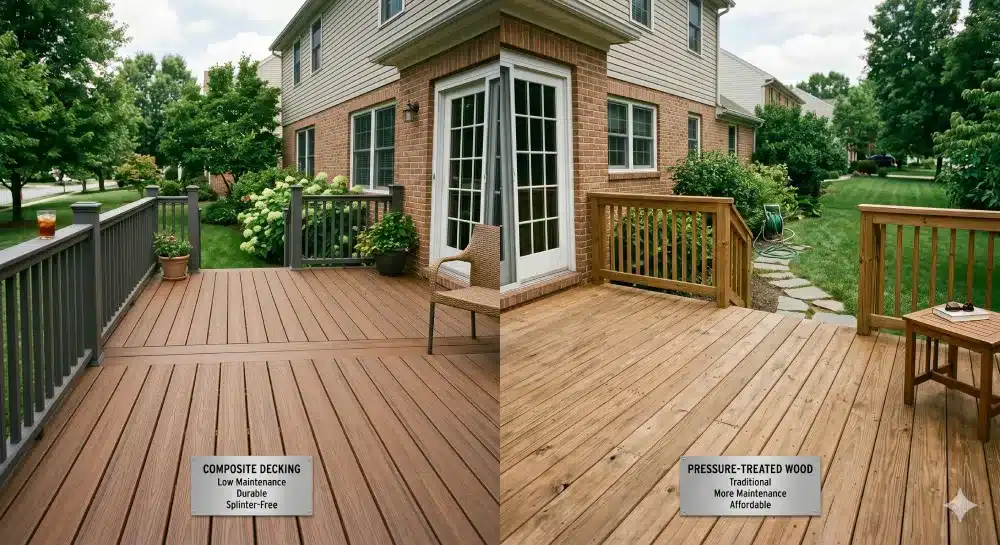
Composite vs. Pressure-Treated Decking in Maryland — Which Is the Better Choice for Baltimore County Homeowners?
By the Team at Genesis Contracting & Home Improvements | Serving Nottingham, Perry Hall, White Marsh, Towson & the Greater Baltimore Area
Walk into any home improvement store in the Baltimore area and you will find pressure-treated lumber and composite decking sitting side by side. The price tags are dramatically different. The pitch for each one sounds compelling. And most homeowners leave more confused than when they arrived.
Here is the truth: both materials can build a great deck. The right choice depends on your budget, your lifestyle, your timeline, and — critically — the specific demands of Maryland’s climate. Because one thing that separates a deck decision in Maryland from one in Arizona or the Pacific Northwest is that our weather is genuinely hard on outdoor materials. We get humid summers with heat and UV exposure that breaks down wood fibers. We get heavy spring rains. We get freeze-thaw cycles in winter that stress every material from the footings up. And we get four distinct seasons of temperature swings that wood and composite handle very differently.
After over a decade of building decks across Nottingham, Perry Hall, White Marsh, Towson, Rosedale, and Parkville, our team at Genesis Contracting & Home Improvements has seen every combination of budget, preference, and outcome. This post gives you the honest, Maryland-specific breakdown you need to make the right call for your home.
Understanding Maryland’s Climate — Why It Changes the Deck Material Decision
Before comparing materials, it is worth understanding what your deck is actually up against in Baltimore County.
Maryland’s four-season climate creates specific challenges:
- Humid summers — Baltimore averages approximately 55–60 inches of precipitation annually, with high humidity throughout the summer months. This moisture cycles through wood fibers, causing expansion, contraction, warping, and — over time — rot.
- UV exposure — Maryland’s summer sun is intense, and UV exposure causes both natural wood and early-generation composite products to fade and degrade. Modern capped composite products resist this far better than either natural wood or uncapped composite.
- Freeze-thaw cycles — Baltimore County experiences regular freeze-thaw cycling in winter. Water that has penetrated wood grain freezes, expands, and accelerates cracking, splitting, and structural breakdown. Composite handles freeze-thaw cycles significantly better than natural wood.
- Frost line depth — Maryland’s frost line sits at approximately 30 inches in most of Baltimore County. Deck footings must extend below this depth regardless of surface material, but the freeze-thaw stress on deck boards themselves is a real factor in material selection.
As one Maryland-specific deck pricing analysis noted, Maryland’s humidity, freeze-thaw cycle, and summer sun are hard on wood — a PT deck that looks great year one will need staining by year three and board replacement by year fifteen. That is not a knock on pressure-treated lumber — it is simply what our climate does to it.
The bottom line on climate context: Maryland’s weather is more demanding on exterior wood than many parts of the country. This shifts the lifetime cost comparison between pressure-treated and composite more in composite’s favor here than it would be in a drier climate.
Pressure-Treated Wood — What It Actually Is and How It Performs in Maryland
Pressure-treated (PT) lumber is the most common and most affordable decking material in the United States. It is regular lumber — typically Southern Yellow Pine — that has been treated with preservatives under pressure to resist rot, insects, and moisture penetration.
What PT does well in Baltimore County:
- It is the most affordable upfront option for homeowners on a budget
- It is widely available and easy to work with
- It accepts staining and painting readily
- When maintained properly, it provides a genuine natural wood look and feel
- It is the most cost-effective option for the framing and structural components of any deck — regardless of what surface material you choose for the decking boards
What PT requires in Maryland:
- Annual cleaning — power washing to remove mold, mildew, and debris that accumulate in Baltimore County’s humid climate
- Staining or sealing every 1–3 years — Maryland humidity and UV exposure break down any protective coating relatively quickly. Without consistent staining, PT wood will gray, crack, and begin deteriorating within a few years
- Board inspection and replacement — individual boards that split, warp, or show signs of rot need to be replaced over time, adding maintenance cost and hassle
- New PT lumber requires a drying period — freshly treated lumber contains moisture from the treatment process and should be allowed to dry before staining, which means it will initially look rough and weathered
PT lifespan in Maryland: With diligent annual maintenance, pressure-treated decking in Maryland’s climate lasts approximately 15–20 years. Without consistent maintenance, that lifespan shortens significantly. The International Association of Certified Home Inspectors notes that pressure-treated pine deck boards generally last 10 to 15 years — and in Maryland’s climate, reaching the upper end of that range requires real commitment to annual upkeep.
PT deck costs in Baltimore County in 2025:
- $23–$40 per square foot installed for standard pressure-treated construction
- A standard 12×20 deck (240 sq ft) runs approximately $5,500–$9,600 in Baltimore County
- A 300 sq ft deck with one stair run typically runs $6,900–$12,000
Composite Decking — What It Is and Why It Has Taken Over the Maryland Market
Composite decking is manufactured from a blend of recycled wood fibers and plastic materials. The category has improved dramatically over the past decade — early composite products (pre-2010) had real issues with fading, staining, and mold that gave the material a poor reputation. Modern capped composite is fundamentally different and substantially better.
What modern composite decking looks like:
Today’s premium composite products — Trex, TimberTech, and AZEK are the three dominant national brands — feature a protective polymer cap over the composite core. This cap is what makes the difference. It resists moisture penetration, UV fading, staining, and mold in ways that early uncapped composite simply did not. Premium composite products now come with warranties of 25 to 50 years from the manufacturers — longer than most homeowners will own their homes.
What composite requires in Maryland:
Essentially: washing once or twice a year. That is it.
- No staining
- No sealing
- No sanding
- No board replacement from rot or splitting
- An annual wash with a garden hose or light pressure wash keeps it looking new
For Baltimore County homeowners who have maintained a PT deck through multiple Maryland summers — the staining, the power washing, the weekend projects every two or three years — the appeal of composite is not just about longevity. It is about reclaiming those weekends.
What composite does NOT do well:
- Higher surface temperature — composite boards absorb and retain heat more than natural wood. On a hot Maryland summer afternoon in direct sun, composite decking can be noticeably warmer underfoot than PT wood. Lighter colors help. Shade structures help more.
- Higher upfront cost — composite is meaningfully more expensive at installation, which is the primary reason many homeowners choose PT.
- Cannot be refinished or re-stained — composite’s color is permanent. You cannot change it after installation the way you can re-stain PT wood.
Composite deck costs in Baltimore County in 2025:
- $40–$74 per square foot installed for mid-range composite (Trex Enhance, TimberTech Terrain)
- $80–$120 per square foot installed for premium composite and PVC (Trex Transcend, TimberTech Legacy, AZEK Vintage)
- A standard 12×20 deck in mid-range composite runs approximately $9,600–$17,760 in Baltimore County
- Premium composite on the same footprint runs $19,200–$28,800
Composite lifespan: Composite boards average approximately 25 years of service life, per the International Association of Certified Home Inspectors, with premium capped products warranted for up to 50 years. In Maryland’s climate, composite consistently outperforms its rated lifespan when installed correctly.
The Real 20-Year Cost Comparison for Baltimore County Homeowners
This is the comparison most homeowners do not run before choosing their decking material — and it changes the decision significantly.
Let us model two identical 300 square foot Baltimore County decks over 20 years.
Pressure-Treated Deck — 300 sq ft — 20-Year Cost in Baltimore County:
| Item | Cost |
| Initial installation | $8,700 (at $29/sq ft) |
| Annual cleaning (power washing) × 20 years | $2,000–$4,000 |
| Staining/sealing every 2 years × 10 applications | $3,000–$6,000 |
| Board replacements (estimate) over 20 years | $1,500–$3,500 |
| Total 20-year cost of ownership | $15,200 – $22,200 |
Composite Deck — 300 sq ft — 20-Year Cost in Baltimore County:
| Item | Cost |
| Initial installation (mid-range) | $14,700 (at $49/sq ft) |
| Annual light cleaning × 20 years | $200–$600 total |
| Staining/sealing | $0 |
| Board replacements | $0 (within warranty period) |
| Total 20-year cost of ownership | $14,900 – $15,300 |
80% of deck repair calls are for wood decks over 12 years old according to one industry analysis — a statistic that reflects exactly the pattern our team sees in Baltimore County. The PT decks we build in year one start generating service calls around year ten to twelve. The composite decks we build are still looking new.
The practical conclusion: for most Baltimore County homeowners, the 20-year lifetime cost of composite is within $2,000–$5,000 of pressure-treated — and at the end of those 20 years, the composite deck still looks new while the PT deck may be approaching replacement. For a 300 sq ft deck, the lifetime cost of ownership over 20 years is usually within $2,000–$5,000 between composite and PT once you factor in maintenance — and composite still looks new at year 20.
The Framing Question — Does Material Choice Affect the Substructure?
One important point that often gets lost in the composite vs. PT debate: the material choice applies primarily to the deck surface boards and railing. The structural substructure — the posts, beams, joists, and ledger board — is almost always built from pressure-treated lumber regardless of what surface material you choose.
This is standard practice and makes perfect economic sense. Structural PT framing is completely appropriate for deck substructure when properly installed with the correct spacing and ventilation. It is the surface boards — the ones that take direct weather exposure, UV, foot traffic, and moisture cycling — where the composite vs. PT choice matters most.
At Genesis Contracting, we build all of our deck substructures with properly pressure-treated framing lumber regardless of the surface material selected. The structural integrity of the deck is non-negotiable. The surface material decision is about your preferences, budget, and long-term goals.
Natural Wood Alternatives — Cedar, Redwood, and Ipe
While pressure-treated and composite dominate the Baltimore County deck market, natural wood alternatives deserve mention for homeowners who want genuine wood aesthetics with better performance than standard PT:
Cedar and Redwood Naturally rot-resistant due to their inherent oils, cedar and redwood provide a warmer, more refined wood aesthetic than PT without the chemical treatment process. In Maryland’s climate, cedar and redwood gray relatively quickly without periodic sealing, with a lifespan of 20–25 years with regular maintenance. They cost approximately 20% more than PT lumber.
Ipe (Brazilian Walnut) Ipe is an exotic hardwood so dense that it requires pre-drilling for fasteners and specialized tools. It is genuinely one of the most durable natural decking materials available — with a lifespan of 40+ years in Maryland’s climate when properly maintained. The trade-off is significant: it is expensive ($65–$110 per square foot installed) and requires annual oiling to maintain its rich brown color, though it will simply silver gracefully without treatment if you prefer a weathered look.
Our honest take on natural wood alternatives in Baltimore County: For most homeowners, the maintenance requirements of cedar and redwood are similar enough to PT that the premium is hard to justify. Ipe is genuinely exceptional in durability — but its cost and installation complexity put it in a specific niche. For homeowners who absolutely want natural wood, Ipe is the best long-term performer in Maryland’s climate.
Which Material Is Right for Your Baltimore County Home?
Here is the honest framework we use when discussing material choices with homeowners across Nottingham, Perry Hall, and the rest of Baltimore County:
Choose pressure-treated if:
- Budget is your primary constraint and the upfront cost difference is a genuine obstacle
- You are building a deck on a property you plan to sell within 3–5 years and are optimizing for lowest cost
- You enjoy hands-on home maintenance and are genuinely committed to an annual deck maintenance routine
- You are building in a shaded area where UV and heat retention are less of a factor
- You want the framing and any non-visible structural elements (which we build in PT regardless of what surface you choose)
Choose composite if:
- You want the lowest-maintenance outdoor living surface for Maryland’s climate
- You plan to stay in your home long-term and want a deck that looks great with minimal effort for 25+ years
- You have children or pets who will use the deck regularly — no splinters, no rough surfaces as the deck ages
- You are building a larger deck where the 20-year cost comparison makes composite the better financial decision
- You want the premium look and finish options that top composite brands offer
- You value manufacturer warranties of 25–50 years as a genuine risk-reduction tool
The scenario where the choice is clearest: A 400+ square foot deck for a family planning to stay in their Baltimore County home for 15+ years. The 20-year cost of ownership for composite is comparable to PT when maintenance is factored in, the deck looks better at year 15 and 20 than any maintained PT deck, and the zero-maintenance lifestyle is a genuine quality-of-life upgrade. For a deck this size, we lean composite in almost every conversation.
The scenario where PT makes clear sense: A functional 160-square-foot ground-level deck for a homeowner on a strict budget who is diligent about maintenance and planning to list the property in the next few years. PT delivers a good deck at the lowest upfront cost.
What Baltimore County Homeowners Should Know Before Choosing a Deck Material
A few practical points worth knowing before you finalize your material choice:
All deck projects require permits in Baltimore County regardless of material. Baltimore County’s Department of Permits, Approvals and Inspections requires permits for all deck construction. Material choice does not affect the permitting requirement. Genesis Contracting handles the complete permit process for every deck we build.
Footings go below the frost line regardless of material. Maryland’s frost line in most of Baltimore County is approximately 30 inches. All deck footings must extend below this depth to prevent frost heave. This is a structural requirement that applies to every deck regardless of whether the surface boards are PT or composite.
Color matters more with composite than with PT. With PT, you can re-stain to a different color down the road if your preferences change. With composite, the color is permanent. Choose carefully — lighter colors stay cooler underfoot in Maryland’s summer sun. Look at color samples in direct sunlight, not just under showroom lighting.
Railing material is a separate decision. Many homeowners choose PT framing and composite decking, then pair it with aluminum or cable railings for a contemporary look. Railings are a separate material decision with their own cost implications — cable railing systems are popular in Baltimore County right now but add $4,000–$12,000 to a project compared to standard pressure-treated or aluminum post and rail systems.
Why Choose Genesis Contracting for Your Deck in Baltimore County?
When you are investing $10,000–$30,000 in a deck, the contractor you choose matters as much as the material you select. Composite or PT — the installation quality determines how well either material performs over time. Improperly spaced boards that trap moisture, footings that do not reach below frost depth, ledger attachments that allow water infiltration: all of these are contractor execution failures that will damage any deck, regardless of whether the surface boards are $15 or $50 per square foot.
At Genesis Contracting & Home Improvements, we build every deck to Baltimore County code, pull every required permit through Baltimore County PAI, and install with the attention to flashing, spacing, and structural detail that determines how well your deck holds up through Baltimore County’s full four-season cycle.
We build decks throughout Nottingham, Perry Hall, White Marsh, Towson, Rosedale, and Parkville. We are fully MHIC-licensed and fully insured. We offer free in-home estimates and can walk you through the material decision for your specific home, budget, and goals.
We also handle kitchen remodeling, bathroom remodeling, basement finishing, home additions, whole-house renovations, exterior work, flooring, painting, and fencing throughout the greater Baltimore area.
Contact us today for a free in-home estimate or call (443) 982-4289. View completed projects in our project gallery and read client feedback on our testimonials page.
Frequently Asked Questions — Composite vs. Pressure-Treated Decks in Maryland
Q1: Is composite or pressure-treated decking better for Maryland’s climate? For most Baltimore County homeowners, composite outperforms pressure-treated over the long term in Maryland’s climate. Maryland’s combination of humid summers, heavy spring rains, and winter freeze-thaw cycles is genuinely hard on natural wood — requiring consistent annual maintenance to prevent premature deterioration. Composite resists moisture, UV fading, mold, and freeze-thaw stress without annual maintenance. In Maryland’s humidity, pressure-treated decks need restaining every 1–2 years and typically last 15–20 years with diligent care, while composite typically lasts 25–50 years with minimal upkeep. That said, PT is a perfectly good material for the right homeowner and budget.
Q2: What is the real cost difference between composite and pressure-treated in Baltimore County? The upfront cost gap is real — mid-range composite runs approximately $40–$74 per square foot installed versus $23–$40 for pressure-treated. On a 300 square foot deck, that is roughly a $6,000–$9,000 difference at installation. However, when 20-year maintenance costs are factored in — annual cleaning, biennial staining, and board replacement for PT versus minimal cleaning for composite — the total lifetime cost difference narrows to approximately $2,000–$5,000 for most Baltimore County projects. At that gap, composite’s superior performance and appearance make it the better long-term value for homeowners who are staying put.
Q3: How long does a composite deck last in Maryland? Modern capped composite decking — from brands like Trex, TimberTech, and AZEK — averages approximately 25 years of service life per the International Association of Certified Home Inspectors, with premium products carrying manufacturer warranties of up to 50 years. In Maryland’s climate, properly installed composite consistently reaches and often exceeds its rated lifespan. Early composite products (pre-2010) had issues with fading and mold — modern capped composite is fundamentally different and far more durable.
Q4: Does pressure-treated wood need to be maintained every year in Maryland? Yes — and this is the critical maintenance reality for PT decks in Baltimore County. Maryland’s climate requires annual cleaning (power washing) and staining or sealing every 1–2 years to prevent premature deterioration. Without consistent maintenance, PT decks in our climate show significant wear within 10–12 years. The maintenance schedule is manageable — but it is a real annual commitment that homeowners need to be honest with themselves about before choosing PT over composite.
Q5: Can composite decking be used for the deck frame and substructure as well as the surface? In most cases, no — and this is not a limitation. Composite and PVC products are engineered for deck surface boards and railing components, not structural framing. The posts, beams, joists, and ledger board are almost always built from pressure-treated lumber regardless of what surface material you choose. This is standard industry practice. Genesis Contracting builds all deck substructures in properly pressure-treated framing lumber — the surface material choice applies to what you walk on and see, not what holds everything up.
Q6: Does the deck material affect my Baltimore County permit requirements? No. Baltimore County requires a permit for all deck construction regardless of the surface material used. Both PT and composite deck projects require the same permit application through Baltimore County PAI, the same review process, and the same inspection sequence. Genesis Contracting handles the complete permit process for every deck we build — including the footing inspection, framing inspection, and final inspection.
Q7: Which composite decking brand is best for Maryland weather? Trex, TimberTech, and AZEK are the three dominant premium brands and all perform well in Maryland’s climate. The main differences are in color options, surface texture, warranty terms, and price tier. All three offer capped polymer composite that resists Maryland’s humidity, UV, and freeze-thaw conditions. Within each brand, the mid-range and premium tiers offer meaningfully better UV and stain resistance than the entry-level products. For Baltimore County homeowners choosing composite, we recommend at least a mid-range capped product — the performance difference over entry-level composite is significant over a Maryland climate exposure.
Q8: Can I replace just the deck boards with composite while keeping an existing PT frame? Yes — this is called a re-deck or deck board replacement, and it is a cost-effective option when the substructure of an existing deck is structurally sound. A re-deck in composite typically costs $30–$70 per square foot depending on the composite product and any railing replacement. If your existing PT frame is in good condition but your surface boards are deteriorating, replacing the boards with composite gives you the low-maintenance surface without the cost of a full new deck. Genesis Contracting can assess any existing deck structure and advise whether a re-deck is appropriate or whether the substructure needs replacement as well.
Q9: Is composite decking worth the extra cost for a smaller deck? For very small decks — under 150 square feet — the upfront cost premium for composite is harder to justify on lifetime cost grounds alone, since the total maintenance savings on a small PT deck are modest. For small decks, the decision comes down more to lifestyle preference: if you want zero maintenance, composite is worth it at any size. If you are cost-focused and willing to maintain it, PT works fine on a small deck. For decks 200 square feet and larger, the lifetime cost comparison increasingly favors composite.
Q10: Does Genesis Contracting build both composite and pressure-treated decks throughout Baltimore County? Yes. We build decks in both materials throughout Nottingham, Perry Hall, White Marsh, Towson, Rosedale, Parkville, and the greater Baltimore area. We help every homeowner through the material decision based on their specific budget, goals, and home — and we do not push one material over the other. Our job is to build you the best deck for your situation, not to steer you toward higher-margin materials. Contact us for a free in-home estimate or call (443) 982-4289.
Genesis Contracting & Home Improvements — Proudly Serving the Greater Baltimore Area Nottingham | Perry Hall | White Marsh | Towson | Parkville | Rosedale | Baltimore County (443) 982-4289 | genesiscontracting.biz