
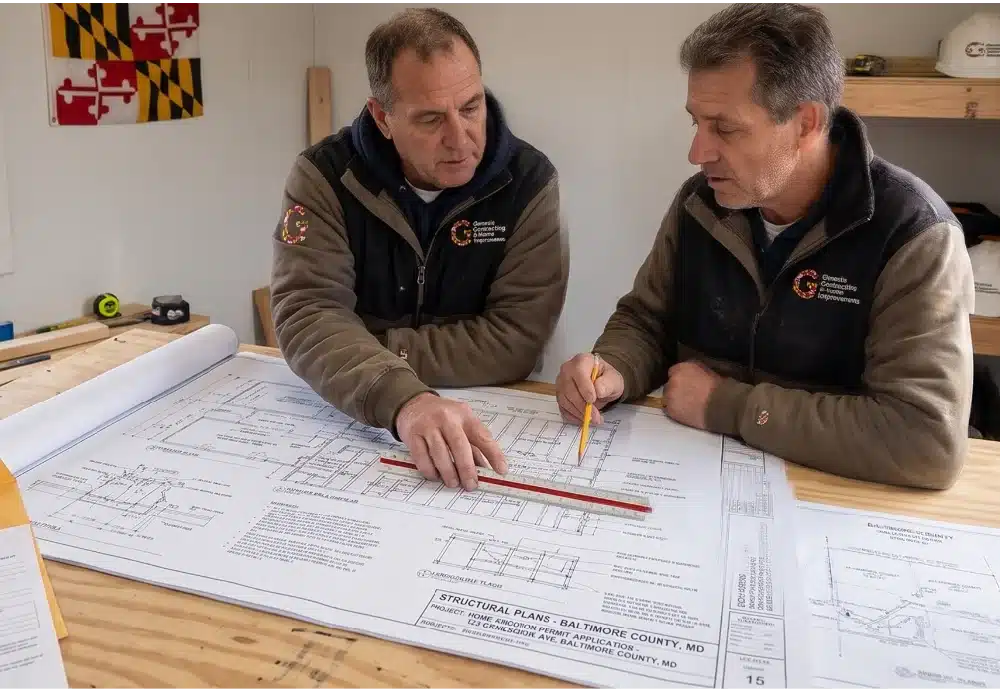
Key Takeaways
- Permit Triggers: Any structural change, electrical/plumbing relocation, deck build, or home addition in Baltimore County requires a building permit by law.
- Financial Risks: Unpermitted work can freeze your home sale, void your home insurance coverage, and lead to double-fee penalties from county inspectors.
- Local Timelines: Fast-track express permits take 1–3 days, while heavy structural ePlans reviews at County Office Building in Towson typically take 3–6 weeks.
- Contractor Accountability: Your contractor must hold an active Maryland Home Improvement Commission (MHIC) license to pull trade permits legally.
What Types of Home Remodeling Projects Require a Permit in Baltimore County?
Direct Answer: Baltimore County mandates building permits for any renovation that alters your home’s structural frame, load-bearing walls, plumbing, gas, electrical lines, or exterior footprint. Minor cosmetic updates—like changing kitchen cabinets, laying vinyl plank flooring, or swapping out a light fixture—do not require permits.
Our field crews get asked this question every single week across Towson, Parkville, and White Marsh. Homeowners want to make sure they do things right without wasting time or money. The general rule is simple: if you are replacing things in the exact same spot without touching the guts of the house, you usually skip the permit. But the second you start cutting wood, moving pipes, or extending wires, the local building authority steps in.
Permit Requirements Matrix
| No Permit Needed | Permit Required by Law |
| • Cabinet swapping (same footprint) | • Removing load-bearing walls |
| • LVP or tile floor installation | • Running new electrical |
| • Replacing existing sink fixtures | • Relocating supply/drain lines |
| • Exterior painting / trim repair | • Building new decks/porches |
| • Swapping a ceiling fan (same electrical box) | • Finishing raw basements |
Here is how common home remodeling projects break down across our local service areas:
- Kitchen Remodeling: Swapping out old granite for quartz on existing boxes doesn’t need a permit. Knocking down the load-bearing wall between your kitchen and dining room to create an open concept does.
- Bathroom Remodeling: Replacing a toilet or vanity in the exact same drain location is fine. Converting a tub into a walk-in tile shower with new drain placements requires a plumbing permit.
- Deck Construction & Extensions: Building any new deck, extending an existing ledger board, or replacing structural support posts requires a building permit.
- Finishing Basements: Turning an unfinished lower level into a living space demands structural, electrical, and HVAC permits, along with proper code-compliant egress windows.
How Long Does the Baltimore County Permit Process Take for Local Renovations?
Direct Answer: Simple residential permits take 24 to 72 hours through Baltimore County’s online E-Permits system, while complex structural plans take 3 to 6 weeks for full review. Reviews take place through the County Office Building located on West Chesapeake Avenue in Towson.
Baltimore County Permit Timeline
| Review Type | Turnaround Time | Scope of Work |
| Quick-Turn E-Permits | 1–3 Days | Express cosmetic fixes & mechanical swaps |
| Standard Plan Review | 1–2 Weeks | Decks, simple basements |
| Full ePlans Review | 3–6 Weeks | Structural additions, major layout reconfigurations |
When our team prepares an ePlans submission for homeowners in Nottingham or Perry Hall, we build approval windows right into the project schedule. Approval speed depends entirely on the scope of work:
- Fast-Track E-Permits (1 to 3 Business Days): Direct mechanical swaps, standard roof replacements, and like-for-like water heater replacements.
- Standard Building Review (1 to 2 Weeks): Simple ground-level deck builds and minor non-structural wall alterations.
- Full Structural ePlans Review (3 to 6 Weeks): Home additions, second-story pop-tops, structural kitchen removals, and basement conversions requiring egress cuts.
Maryland weather makes timing crucial. Winter freeze-thaw cycles and heavy summer rain can shift soils and stall work. Submitting plans early ensures your project stays on schedule when good weather hits.
What Happens If You Remodel Your Home Without a Permit in Maryland?
Direct Answer: Skipping permits triggers immediate stop-work orders, double-fee penalties from inspectors, and severe friction when selling your home. Unpermitted work can also allow insurance companies to deny coverage for water leak or fire claims.
Risks of Unpermitted Work
| Risk Factor | Consequence |
| Stop-Work Orders | Immediate stop-work order posted on your front yard |
| Fines & Penalties | Double penalty fees tacked onto base permit costs |
| Structural Invasions | Mandatory tear-out demands to expose covered electrical or framing |
| Insurance Issues | Voided homeowner insurance claims during floods or fires |
| Closing Delays | Canceled home buyer sales during title and escrow inspections |
Some cut-rate contractors try to convince homeowners in Rosedale or Parkville to skip permits to “save money.” That short-term shortcut leads to massive long-term costs. According to the National Association of the Remodeling Industry (NARI), unpermitted work is one of the top reasons home sales fall out of escrow during the buyer inspection phase.
- You Face Double Fees and Stop-Work Orders: If a County inspector spots an unpermitted dump trailer or framing crew, they post a stop-work notice on your front door instantly. You will pay double the base permit fee to clear the violation.
- You May Have to Tear Down Finished Drywall: Inspectors cannot sign off on structural framing, rough plumbing, or wiring they can’t see. They will order you to cut open brand-new drywall so they can inspect the work behind it.
- Your Insurance Can Reject Future Claims: If an unpermitted electrical line causes a fire or an uninspected pipe bursts, your home insurer may deny your claim outright.
- Resale Problems: Today’s buyers check county permit records online before making an offer. Unpermitted additions or basement work can derail a sale or force expensive last-minute fixes.
Why Should Your General Contractor Handle the Permit Application Process?
Direct Answer: Licensed contractors take legal liability for building code compliance and hold the required master trade credentials. Homeowners who pull “Homeowner-Assisted Permits” take on full liability for code violations, contractor injuries, and failed inspections.
Contractor vs. Homeowner Permit Pull
| Responsibility | Contractor Pull | Homeowner Pull |
| Legal liability for code | Contractor | Homeowner |
| Trade credential verification | Automated | Manual / High Risk |
| Scheduling inspections | Contractor handles | Homeowner coordinates & stays on-site |
| Failed inspection rework | Contractor pays | Homeowner pays |
In Maryland, home improvement work over $500 requires a contractor licensed by the Maryland Home Improvement Commission (MHIC). When our team at Genesis Contracting handles your project, we manage every part of the permit process from start to finish.
- Trade Licensing: Electrical, plumbing, and HVAC work must be pulled by a licensed Master Tradesperson in Baltimore County. Homeowners cannot pull these trade permits themselves.
- Professional Accountability: When a licensed builder pulls the permit, they guarantee the construction meets Maryland Building Performance Standards. If an inspector flags an issue, the contractor fixes it on their own dime.
- Hassle-Free Inspections: We schedule the county inspectors, meet them on-site, walk the job, and secure the final sign-offs so you don’t have to miss work.
Frequently Asked Questions About Baltimore County Permits
1. Do I need a permit to finish my basement in Parkville or Nottingham?
Yes, converting an unfinished basement into a living area requires a building permit along with electrical and plumbing permits. The work must comply with local emergency egress rules, insulation codes, and ceiling height standards.
2. Can I pull my own remodeling permits as the property owner?
You can pull a general building permit for your primary residence, but you take on full legal liability for all work and safety codes. Licensed trade contractors must still pull all electrical, plumbing, and HVAC permits.
3. How much do residential building permits cost in Baltimore County?
Most standard residential remodeling permit fees start around $100 to $200. Total costs depend on the square footage and total valuation of the project.
4. Do I need a permit to replace my existing back deck?
Yes, replacing or rebuilding a deck requires a permit to ensure proper footings, ledger board attachments, and guardrail heights.
5. What is the difference between an MHIC license and a trade license?
An MHIC license permits a company to perform home improvements in Maryland. Separate Master trade licenses are required for electrical, plumbing, and HVAC installations.
6. Will pulled permits increase my local property taxes?
Permits notify tax assessors of home improvements. Cosmetic updates rarely affect taxes, but additions and finished basements increase your home’s assessed value and equity.
7. What happens during a Baltimore County home inspection?
A county inspector reviews structural framing, wiring, or plumbing before walls are closed. They verify that the construction matches approved plans and local building codes.
8. How do I check if a contractor is licensed in Maryland?
Look up their MHIC license number on the Maryland Department of Labor website. Genesis Contracting operates under MHIC #130227.
9. Do I need a permit to replace windows or exterior doors in Towson?
Swapping doors or windows in existing frames usually does not require a permit. Cutting wider openings or altering structural headers does.
10. How long is a Baltimore County building permit valid once issued?
Permits remain active as long as work starts within 6 months and passes an inspection at least once every 180 days.
Ready to Plan Your Remodel the Right Way?
Don’t let permitting stress derail your home improvement plans. Contact our team at Genesis Contracting today to set up a consultation. We handle design, plans, permits, and construction across Nottingham, Perry Hall, White Marsh, Rosedale, Parkville, and Towson.